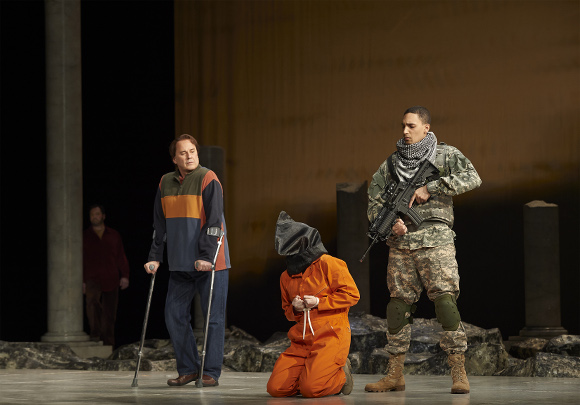
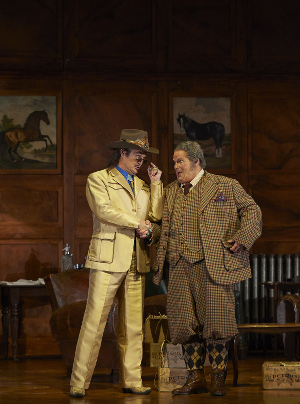
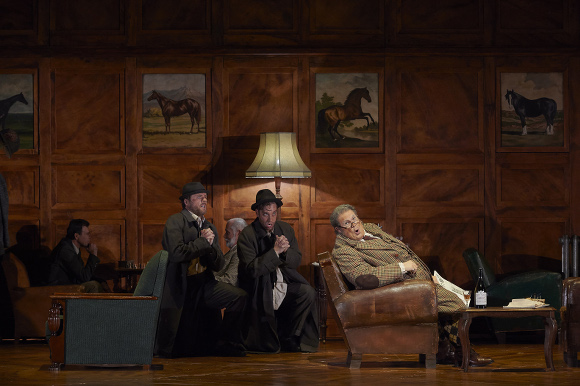
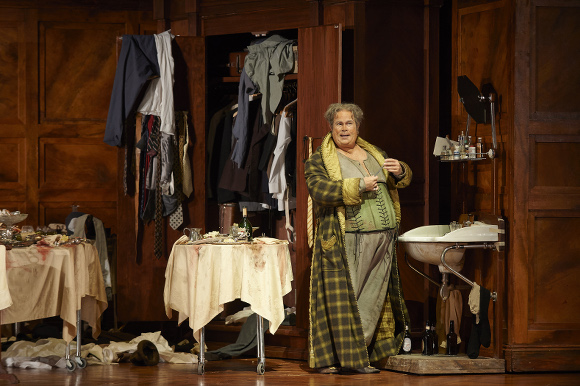
Last night, the COC opened its 2014/15 season with Verdi’s Falstaff; a work I was not familiar with and one that turned out to be a bit of a surprise. It’s not your usual Verdi. It’s his last opera, composed when he was 80, and is not at all typical of his earlier work. There are hardly any “big tunes” or even conventional arias. The odd chorus harks back to an earlier style but much of the music is quite dark; heavy use in places of the lower pitched instruments, especially for a “comedy”. Don’t take that as a criticism though. It’s a musically and dramatically tight, even compact, work that is both incredibly funny and also something more disturbing. Perhaps it’s as much about mortality as love.
Tag Archives: verdi
Moving into October
October is the month things usually really get going again in Toronto and this year is no exception. The calendar for the first third of the month is very busy. Highlights include three free concerts in the Richard Bradshaw Amphitheatre, the opening of two productions at the Canadian Opera Company and Nuit Blanche events at the Canadian Music Centre and the UoT Music Department.
Woman on the edge
A few weeks ago I reviewed Phillippe Béziat’s documentary traviata et nous, about the making of the 2011 Aix festival La traviata. I’ve now had a chance to watch the DVD of the finished product and it’s superb. Forget those Traviatas in which a star soprano simpers vacuously across an overstuffed set, this is compelling drama. François Sivadier’s production is dark, dangerous and incredibly moving. Natalie Dessay’s Violetta is a terrifyingly intense portrait of a woman who knows from the beginning she is dying in “this desert which is known to men as Paris”. There is no further need for heavy symbolism to remind us of the centrality of death to the piece which makes an interesting contrast with Willy Decker’s famous production.
Maria Callas at Covent Garden
There’s not a lot of film footage of Maria Callas performing and most of what there is is of concerts. What makes this disk special is that it contains the whole of Act 2 of Tosca recorded at the Royal Opera House on 9th February 1964. It’s a Zeffirelli production and Tito Gobbi sings Scarpia with Renato Cioni as Cavaradossi. It gives, I think, a pretty good idea of Callas’ appeal as an actress and as a personality. She is fascinating to watch but in many ways quite hard to listen to. My partner, who was in the next room, thought I was listening to an atonal modern piece, which is as much as I’m going to say about accuracy of pitch. I found myself more caught up in thinking about that modern audience segment that wants to go back to “the good old days” because if this is representative I think they are nuts. It’s not about Callas. Well directed I think I’d have enjoyed seeing her. It’s the overly melodramatic, well, everything. OK, I know it’s Tosca but Gobbi’s eye rolling scenery chewing is like three Bryn Terfels without the self deprecating twinkle in the eye. One wants to shout “watch out for the crocodile!” And is he ever loud? At first I just thought it was a recording balance thing but I don’t think so as he sounds way louder than the other singers. It’s hard (and probably unfair) to judge a voice on the basis of a rather ropey recording like this but I wouldn’t pay to hear barking like this.
traviata et nous
traviata et nous is a documentary by Philippe Béziat about the creation of the 2011 Aix Festival production of Verdi’s La Traviata. The stars are stage director Jean-François Sivadier and his leading lady, Natalie Dessay. It’s two hours long and is much more insightful than the average “making of” bonus feature. This really gets inside the heads of the director and the performers (we see a fair bit of Charles Castronovo and Ludovic Tézier as well as Dessay) as they begin to understand and then elaborate on the director’s ideas. Dessay comes across, as one would expect from her performances, as an exceptionally intelligent, thoughtful and hard working person. Sivadier too is très sympa; worlds removed from the caricature of a German Regie director ruthlessly imposing his ideas on libretto and performers alike. I found it interesting that when Sivadier is working with Dessay or Tézier French is spoken but at pretty much all other times the working language, even in a French house like Aix, is English.
Sondra Radvanovsky at the Zoomerplex
So, Sondra made a live broadcast for 96.3 FM at lunchtime today. It was one of those media things where the audience was aggressively stage managed by the floor staff but otherwise quite enjoyable. Also there was lunch which was a definite plus. What was a bit annoying was the overall vibe of “fitting opera into the programming for old folks”. Way to build a new audience there!
The performance was varied and interesting with Sondra on good form and the ever reliable Rachel Andrist on piano. There was no printed progrmme or lyric sheets so I’m going from my hastily scribbled notes but we got some Rachmaninov songs, which suited Sondra really well plus arias from Trovatore, Norma, Tosca and Andrea Chenier plus a Verdi song, Copland’s Simple Gifts and I could have danced all night. Nothing if not varied! It’s interesting how dropping from big opera rep to something like the Copland can be astonishingly effective. Simplicity and lack of artifice has it’s charms. And, yes, I want to hear her Norma and, if rumour is half way correct, probably will in the not too distant future.
Upcoming events
There’s quite a lot happening before the COC season kicks off again with the opening of Handel’s Hercules on April 5th. Here are some of the highlights including several rarities.
On March 22nd at 7:30pm and 23rd at 3pm the Cantemus Singers are putting on a concert performance of Purcell’s The Fairie Queene at the Church of the Holy Trinity. The cast includes Iris Krizmanic, soprano (Juno); Maria Soulis, soprano (Mopsa); and Michael Pius Taylor, tenor (Phoebus). Tickets are $20; $15(sr/st); $10(child).
Upcoming events
Ridiculously short notice I know but VOICEBOX/Opera in Concert’ are closing their season with Verdi’s Stiffelio this afternoon at the St. Lawrence Centre. This 1850 workconcerns an adultery in the house of a Protestant minister and was so severely censored by the Italian authorities that Verdi withdrew it in 1856 and it’s rarely seen. VOICEBOX will present the scholarly edition prepared from the Carrara family MS in the early 90’s. It’s a concert performance with piano accompaniment featuring Ernesto Ramirez, Laura Albino and Geoffrey Sirett.
On Wednesday there’s a rare performance of Gagliano’s La Dafne by Capella Intima and the Toronto Continuo Collective. An ensemble of dramatic voices accompanied by lutes, theorbos, harpsichord and viola da gamba will present Ovid’s tale of Apollo and Daphne. It’s at noon and forms part of the COC’s free concert series in the Richard Bradshaw Amphitheatre.
Finally, on March 3rd Toronto Masque Theatre is presenting a soirée on the history of the masque form. There will be panel discussions and performances by soprano Patricia O’Callaghan, guitarist Ken Whiteley and others. It’s at 7.30pm at 21 Shaftesbury Avenue, Toronto. Tickets are by donation ($20 suggested) and seating is limited so registration is required either online at torontomasquetheatre.com or by calling 416-410-4561.
Kennedy era Un ballo in maschera works on many levels
The Canadian Opera Company’s new production of Verdi’s Un ballo in maschera is based on an intriguing concept that adds insight in many places but comes a bit unstuck in others. Coupled to some superb performances, it makes for an enjoyable and intriguing night at the theatre that will have the more adventurous busily and happily dissecting the piece for hours and the die hards reaching for their Zeffirelli pills.
The Scottish opera
Verdi’s Macbeth is one of those early works where he seems to be trying to grow out of bel canto but not quite making it. There is some splendidly dramatic music and some that just seems completely incongruous given the subject matter. The witches’ chorus at the beginning of Act 3 is a case in point. That said Phyllida Lloyd’s production for the Royal Opera House takes the piece seriously and does a pretty good job of presenting the drama in a straightforward but visually attractive way.