Collaborations

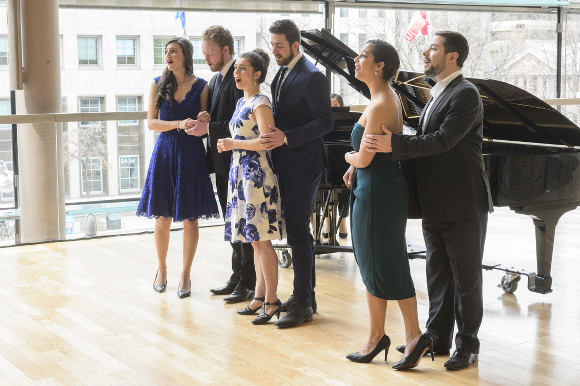
Lunchtime saw the annual concert featuring visiting members of the Atelier lyrique de l’Opéra de Montréal.  It turned into something of a Donizettifest.  First up was soprano Cécile Muhire with Adina’s aria Prendi, per me sei libero.  This was quite competently sung though she seemed very nervous.  The nerves seemed to vanish though when she was joined by her Nemorino, Jean-Philippe Fortier-Lazure, for the duet when he tries the elixir.  One of the things that has always struck me about the Ensemble Studio is how quickly it teaches singers to have stage presence.  J-P was a very funny, rather drunk, Nemorino and his swagger seemed to rub off on Cécile who looked much more at home in this number.
2016-04-28-COC-Collaborations-106

Continue reading

Dmitri Hvorostovsky at Koerner Hall

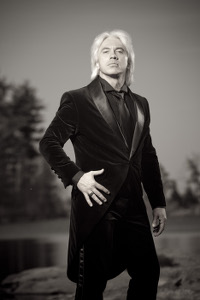
20110128_dmitri-hvorostovksy-2A packed out Koerner Hall just saw something half way between an art song recital and a revivalist meeting.  To say that Mr. Hvorostovsky has a fan club would be a gross understatement.  He was greeted by cheers, every song got prolonged applause (alas for those of us who prefer some continuity in a set), there were more flowers than at Princess Di’s funeral and about the only thing missing was that, mercifully, no underwear got thrown on stage.  Oh, and, despite the requests to the contrary, the whole show was “artfully” lit by the constant flashes from phone cameras.  He also sang some songs.  In fact it was a nicely chosen mixture of Glinka, Rimsky-Korsakoff, Tchaikovsky and Strauss.  Full details are here.
Continue reading

Program for Dmitri Hvorostovsky recital

Dmitri-Hvorostovsky-014_0The program for Dmitri Hvorostovsky’s February 21 recital at Koerner Hall has been released.  It is:


Glinka:
To Molly (Do not demand songs from a singer), (text: Kukolnik)
It’s Pleasant to Be with You (text: N.Ryndin)
Say Not That It Grieves the Heart (text: N. Pavlov)
Doubt (text: Kukolnik)
Bolero (text: Kukolnik)

Continue reading

Russia Cast Adrift

The opening concert of Off Centre Music Salon’s season was a programme of Russian romantic and post romantic works, songs and piano pieces, entitled Russia Cast Adrift.  The first half of the afternoon was devoted to the sort of songs that explain why “smert” is one of about six Russian words that I recognize.  It kicked off with a Rachmaninoff prelude played with vigour by William Leathers before going into a series of songs by Sviridov, Rachmaninoff, Tchaikovsky, Glière, Arensky and Mussorgsky.  The singing was shared by soprano Nathalie Paulin, mezzo Emilia Boteva, tenor Ernesto Ramirez and baritone Geoffrey Sirett with Boris Zarankin and Inna Perkis at the piano.

Continue reading

Songs of Love and Death

There may be cheerful songs in Russian but I’m not sure I have ever heard one.  Certainly there were none on offer at the Four Seasons Centre today when Ekaterina Gubanova and Rachel Andrist offered up a recital of Tchaikovsky and Mussorgsky works.  There’s a reason why one of three Russian words I can recognize is “Schmert”.  Depressing as the texts may have been these were truly wonderful performances.  Gubanova has a dark, very Slavic colour though she can brighten it when she chooses and she’s utterly fearless singing with great passion and, yes, there was a high C in there.

2015-05-19-COC-Gubanova-008

Continue reading

Inspired by Love

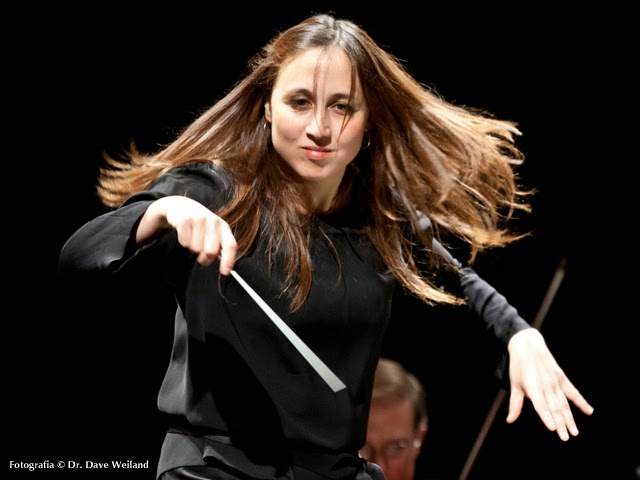
Joana CarneiroOnce in a while it’s fun to go to something almost entirely undemanding (for the audience at least!).  So, yesterday afternoon I attended a concert of classical “lollipops” given by the TSO under the baton of young Portugese conductor Joana Carneiro.  The chief attraction for me was that recent Ensemble Studio graduates Simone Osborne and Wallis Giunta were also performing.  Things got going with the overture from Il Nozze di Figaro. It was a brisk and stylish performance with Ms. Carneiros displaying a very physical conducting style.

Continue reading

Intense, if a bit weird, Onegin

Mariusz Treliński’s Eugene Onegin originated in Warsaw but was filmed in Valencia.  It’s distinctly on the Regietheater end of the spectrum but it’s intense and oddly compelling.  The sets are spare and almost abstract.  A silent character, O***, is interpolated.  He’s a sort of Commendatore’s ghost who comments on the action and interacts with characters at key moments; with Tatiana during the letter scene and with Lensky before the duel for example.  A lot of action takes place in front of the pit, usually simultaneously with action further back on stage making for quite complex (and hard to film) visuals.

1.forest Continue reading

Robert Pomakov with members of the Gryphon Trio

Yesterday’s lunch time concert featured bass Robert Pomakov accompanied by members of the Gryphom Trio.  The programme kicked off with two songs by Glinka with Bob accompanied by Roman Borys on cello and Jamie Parker on piano.  The first piece was called Lullaby but it’s hard to imagine anyone sleeping through Bob’s powerful rendering.  The second piece, Doubt, showcased some lovely playing by Borys.

Pomakov Gryphon Trio - Tim Flynn Continue reading

Queen of Spades

Yuri Temirkanov’s 1992 Kirov Opera production of Tchaikovsky’s Queen of Spades is extremely traditional but not dull.  It’s given the default Catherine the Great setting and there are opulent ball rooms, gold braid, wigs and crinolines aplenty.  There’s also careful direction of the action and some good acting so it’s far from a “park and bark” snoozefest, though it has nothing new or original to say.  The lighting for the supernatural bits is especially atmospheric.

Continue reading