A series of blog posts discussing time, perceptions of time and historically informed performance (HIP) plus seeing Opera Atelier’s Der Freischütz got me thinking along some curiously convergent lines and arriving at the conclusion that HIP isn’t and can’t be what it is often purported to be; a fairly faithful attempt to reproduce a work as it would have been seen by its first viewers or “as the composer intended” or something like that. Not, of course, that even if it was, we would see and hear it as the original audience did but that perhaps is a topic for another day.
Tag Archives: salzburg
Rosenkavalier on the brink
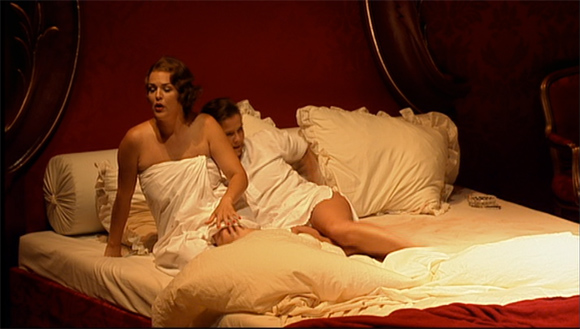
Robert Carsen’s 2004 production of Der Rosenkavalier at the Salzburg Festival was apparently enormously controversial at the time. In many ways that says more about the iconic status of the piece in Salzburg tradition than about Carsen’s production. There are a few controversial elements. He has updated the period to 1914 and the third act is set in a brothel with a fair amount of nudity. Beyond that, the production is pretty faithful to the libretto and has, I think characteristic Carsen touches like long lines of tables and chairs and a certain geometric elegance. He seems to be using the sides of the stage to comment on the action which tends to be fixed centre stage. I say seems because the video direction (by Brian Large) is utterly perverse and makes it extraordinarily difficult to see what Carsen is doing, let alone decode it. We see the whole stage, maybe, for three seconds in the whole piece. Otherwise 99% of what we get is either close up and even closer up or apparently shot from the restricted view seats high up and close to the side of the stage. The other 1% is just plain nuts and includes a section of the Sophie/Octavian duet in Act 2 where, on stage, Octavian is maybe twenty feet to Sophie’s right but on camera he’s standing right up close on her left hand side. I could go on but I won’t. Suffice it to say the video direction comes close to wrecking an otherwise excellent DVD.
Good news!
Intermezzo reports that Harrison Birtwistle’s 1991 (revised 1994) opera Gawain is to be performed at the 2014 2013 Salzburg Festival. I saw this when originally broadcast on TV in the UK and really want to see it again. I’m hoping that there will be a DVD release as it’s unlikely(!) that I will make it to Salzburg. I’m half surprised that it hasn’t been performed again or spread beyond Covent Garden (same is true of The Minotaur of course). But only half surprised. There seems to be a real reluctance currently to produce work that is seen as less “accessible”. There are exceptions of course. Saariaho seems to be quite fashionable for example but overall, and especially on this side of the Atlantic, the modernist tradition seems to have been firmly rejected.
A rather straightforward Cenerentola
Rossini’s La Cenerentola takes almost three hours to tell a very straightforward version of the Cinderella story. Generally directors, despairing of the this, either camp it up (for example the Els Comediants production seen, inter alia, in Houston and Toronto in recent years) or they try to find a few more layers of meaning as in Ponnelle’s film version. Michael Hampe does neither in his 1988 Salzburg production, preferring to tell the story as a straightforward morality tale. I guess if one really loves the music and it’s really well sung this could work but, ultimately, I found it rather dull. Continue reading
But in me life has halted
It’s perhaps odd that somebody like me, who got into Janáček’s music as a teenager, should have taken so long to discover his operas but I’m so glad I did. The latest discovery is Věk Makropulos in a 2011 recording from the Groβes Festspielhaus in Salzburg with Angela Denoke as the 337 year old diva Emilia Marty. It’s a strange work dramatically; a sort of fantastic detective story. Apparently it’s based on a comedy (by Karel Čapek, the guy who coined the modern meaning of “robot”) though how it got from a comedy to the opera is a bit of a mystery. It’s weird, compelling and creepy but not at all funny. It also has a terrific score. Continue reading
Claus Guth’s Cosí
In 2009 Claus Guth wrapped up his Da Ponte cycle for Salzburg with Cosí fan tutte. I really like his Le Nozze di Figaro and after seeing this Così I’ll certainly be seeking out the Don Giovanni too.
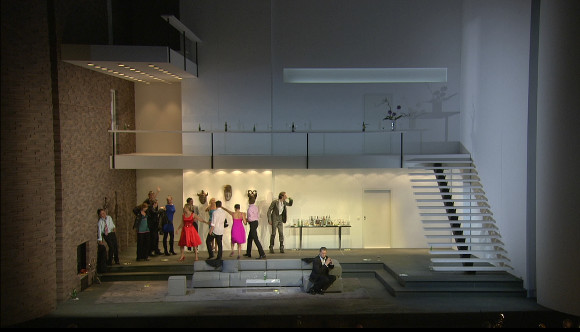
This production was staged in the Haus für Mozart and uses a single set. It’s the girls’ apartment; a very expensive looking two level loft with a broad staircase that recalls the Figaro. The setting is contemporary and it opens on the aftermath of what appears to have been a rather good party. The men are preparing to leave when Don Alfonso issues his challenge. It’s the edgiest version of the scene I’ve watched with quite an undertone of violence. This is clearly not going to be a light comedy. By Una bella serenata the characteristic feathers of the Figaro have appeared. The edginess continues throughout the first act with many deft touches, especially a power cut staging of Come Scoglio. When the “Albanians” appear there is only the most perfunctory effort at disguise. No slapstick moustaches here. Continue reading
Don Giovanni in the 21st century
After a week of nostalgia wallowing in ancient “productions” from the met and the COC it’s back to Regietheater with a vengeance for the 100th DVD review on this blog. The subject is Martin Kušej’s Salzburg production of Don Giovanni which premiered in 2002 but was recorded in 2006 as part of the M22 project.
For a start there’s nothing giocoso about this dramma. It’s a very bleak and complex production with lots of ideas; some of which work and some of which are more problematic, and it’s provoked more discussion at the Kitten Kondo than just about any other recording we’ve watched recently. Rather than write a 3000 word review I’m going to write a normal length review and follow it up with one or more posts on aspects of the production that seem particularly worth exploring. Continue reading
Happy ever after?
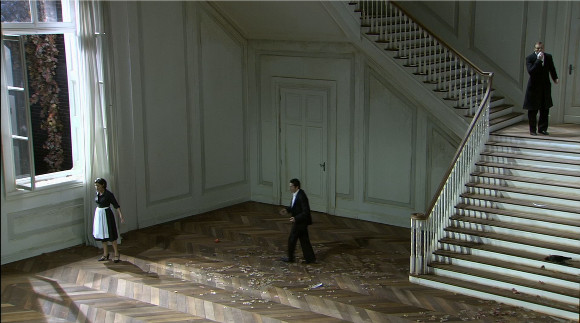
I’ve watched the Blu-ray version of the 2006 Salzburg production of Le Nozze di Figaro a few times now but sitting through it with notepad at the ready made me realise how much I hadn’t seen on the previous viewings. My notes are copious. I usually take a couple of pages or so. This time I covered four pages and it could easily have been more. You have been warned.
Mozart and sheep puppets
When the Salzburg Festival decided to do all 22 Mozart operas for the 25th anniversary in 2006 there must have been a fair amount of thought put into to what to do about the lesser works. I have to say that the solution they came up with for Bastien und Bastienne, written when Mozart was twelve, and Der Schauspieldirektor is most ingenious.
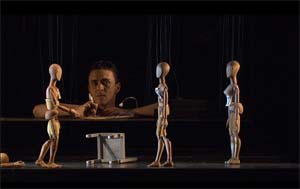
The director, Thomas Reichert, came up with the ingenious idea of combining the two singspiels and performing them with puppets in the Salzburger Marionettentheater.
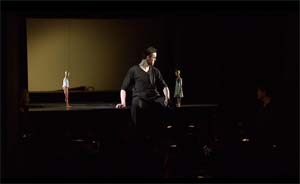
The work breaks into three parts; a largely spoken prologue based on Der Schauspieldirektor where Frank (Alfred Kleinheinz) and Buff (Radu Cojocariu) audition the puppets for the roles in Bastien und Bastienne. The puppetry in this section is quite wonderful. The decision is made to split cast Bastienne which sets up the soprano rivalry for the final part of extracts from Der Schauspieldirektor. In between we get the performance of Bastien und Bastienne with Cojocariu singing the magician Colas on stage with the puppets while Bernhard Berchtold, Evmorfia Metaxaki and Aleksandra Zamojska sing from the pit.
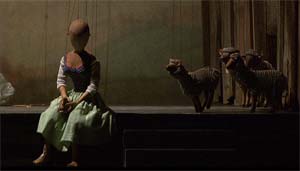
It’s charming complete with puppet sheep. The finale well exploits the difference in voice between the fuller, more mature Zamojska and the brilliant coloratura of Metaxaki. It’s lots of fun with some good gags and excellent singing from the young cast, especially Cojocariu. The orchestra is the Junge Philharmonie Salzburg conducted by Elisabeth Fuchs.
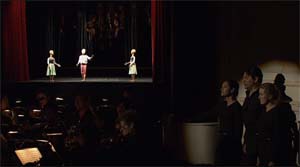
The video direction is by Stefan Aglassinger. He does a good job of producing a coherent video which is not easy because the action takes place on stage, in the pit and around the auditorium. It was filmed in HD and the picture is an excellent 16:9. Sound options are PCM stereo and DTS 5.1. There are English, French, German and Spanish subtitles. The disc includes a reasonably interesting “Making of” documentary.
How to do Purcell
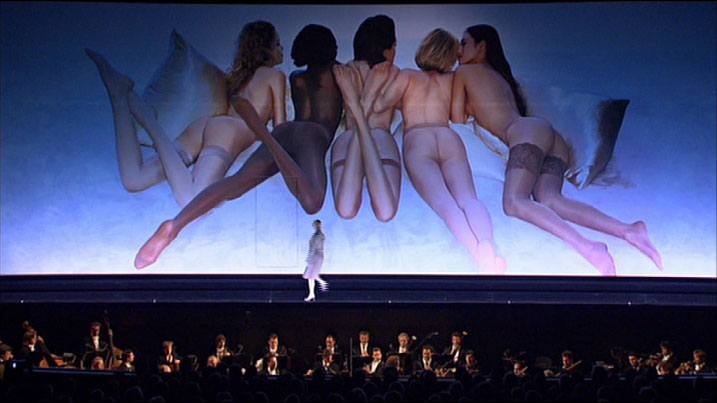
A while ago I had the misfortune to watch a thoroughly misconceived version of Purcell’s King Arthur. I have now had a chance to watch a version from the 2004 Salzburg Festival and it’s a lot better! This production by Jürgen Flimm takes Purcell and Dryden’s work and treats it respectfully but not solemnly. As originally intended, it’s given as a series of scenes spoken by actors interspersed by songs which are sung by five singers who change role as needed. The dialogue is in German but the singing is in English which seems a bit odd at first to an English speaker but one soon gets used to it. Flimm uses Dryden’s text for the most part but interpolates some scenes, notably where Merlin, disguised as an investment banker’s wife, enters via the auditorium and delivers a diatribe about Regietheater and how Salzburg has gone all to Hell. It’s just like being at a typical COC Opera 101. It’s staged in the appropriately baroque Felsenreitschule and the set mirrored the arcades of the building with a brightly painted wooden arcade structure set behind the stage. The orchestra is in a sunken pit in the middle of the stage so the action takes place all around them. There is clearly some heavy duty projection equipment behind the set because the production uses a wide range of, often spectacular, lighting effects.