Sondra Radvanovsky at the Zoomerplex

sondraSo, Sondra made a live broadcast for 96.3 FM at lunchtime today.  It was one of those media things where the audience was aggressively stage managed by the floor staff but otherwise quite enjoyable.  Also there was lunch which was a definite plus.  What was a bit annoying was the overall vibe of “fitting opera into the programming for old folks”.  Way to build a new audience there!

The performance was varied and interesting with Sondra on good form and the ever reliable Rachel Andrist on piano.  There was no printed progrmme or lyric sheets so I’m going from my hastily scribbled notes but we got some Rachmaninov songs, which suited Sondra really well plus arias from Trovatore, Norma, Tosca and Andrea Chenier plus a Verdi song, Copland’s Simple Gifts and I could have danced all night.  Nothing if not varied!  It’s interesting how dropping from big opera rep to something like the Copland can be astonishingly effective.  Simplicity and lack of artifice has it’s charms.  And, yes, I want to hear her Norma and, if rumour is half way correct, probably will in the not too distant future.

Continue reading

Il Trittico

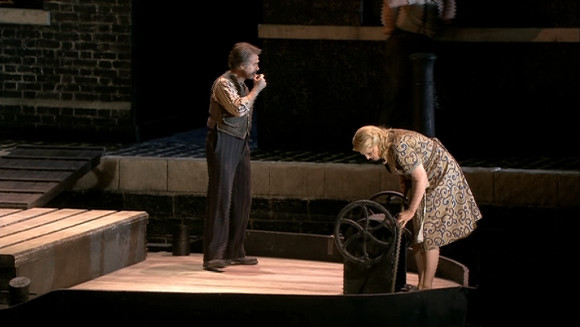
Puccini’s Il Trittico is a collection of three one act operas designed to be performed on a single evening.  They rarely are.  Perhaps this is because performing all three makes for a rather long evening (and for a huge cast) or maybe it’s because two of the three aren’t all that great.  In any event, while most opera goers will likely have seen the comedy Gianni Schicchi, most will likely not have seen the two tragedies that precede it; Il Tabarro and Suor Angelica.  However, all three works were performed as a triple bill at the Royal Opera House in 2011.  The show was broadcast by the BBC and is available on Blu-ray and DVD.  All three pieces were directed by Richard Jones and Anthony Pappano conducted.

1.michele_giorgetta Continue reading

Earworms

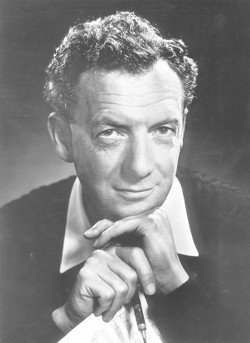
brittenEarworms are funny things.  What causes a particular passage of music to stick in one’s mind almost obsessively?  I’m thinking about this now because I’ve seen two operas twice in the last couple of weeks and one is filling my waking moments with highly detailed flashbacks.  It’s not just tunes.  I’m hearing the orchestration and the inflexion of the words.  And it’s not the odd tune here and there.  It’s great long passages and many of them.  The other, although I would recognise most every phrase on hearing it, is not doing that at all.  Here’s the odd thing.  The one that’s leaving no impression at all is number three world wide in terms of number of performances(1) and is, of course, Puccini’s La Bohème.  The one I can’t get out of my head is far down the list at number 88 and it’s Britten’s Peter Grimes (and note that it’s the Britten centenary).

Know I have to ponder whether there is any connection between this and the fact that while all the cheap seats for Peter Grimes seem to sell out, the boxes on fat cat row are half empty.

Note 1: http://www.operabase.com/top.cgi?lang=en&

La Bohème again – Rodolfo III

For my second look at La Bohème at the COC I caught the first night of what is, effectively, the third cast.  This is actually the first cast but with Eric Margiore replacing Dmitri Pittas as the third Rodolfo of the run.  So, how did it compare to Wednesday night’s effort?

Joyce El-Khoury as Musetta - Photo:Michael Cooper

Joyce El-Khoury as Musetta – Photo:Michael Cooper

Continue reading

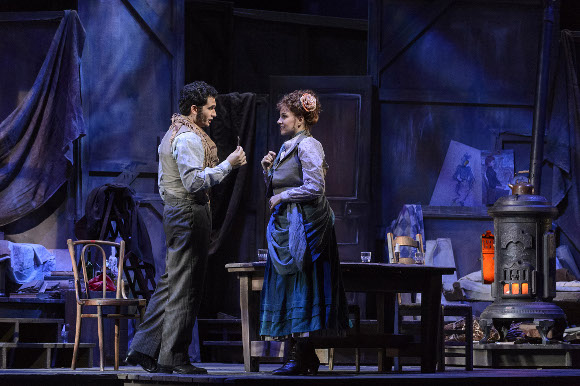
La Bohème at COC is lots of fun

La Bohème has been running at the COC for a couple of weeks now but last night was the first performance for the second cast.  There are some new faces; Michael Fabiano comes in as Rodolfo with Simone Osborne as Musetta, Tom Corbeil as Colline and Cameron McPhail as Schaunard.  There are also some change ups.  Joyce El-Khoury swaps Musetta for Mimi and  Phillip Addis swaps Schaunard for Marcello.  I’ll be back Friday to see the opening night cast with the exception of Eric Margiore coming in as Rodolfo.

149 - Rodolfo and Mimi (not Michael Fabiano) Continue reading

Starry Tosca

Puccini’s Tosca doesn’t seem to lend itself to Regie type treatments.  Even quite adventurous directors seem to mostly stick to the very specific time and place of the libretto (even though, as Paul Curran pointed out to me, the plot makes no sense in the Rome of 1800).  In the 2012 Royal Opera House recording Jonathan Kent certainly takes very few liberties with the piece; the church is a church, the palace a palace and the castle a castle. There are a few deft design touches.  Both Cavaradossi and Tosca wear very bright colours indicative of the new dyes that became available at the period (actually I think this is a slight anachronism – must check with the fashion lemur) whereas Scarpia is more conservatively attired.  Generally though it’s pretty straightforward.

1.painting Continue reading

Et in Bohemia ego

It’s a curious fact that two of the three most popular operas; Verdi’s La Traviata and Puccini’s La Bohème, are about women dying from tuberculosis.  It’s also curious that they are almost always presented as frothy escapist fantasies in which Death makes his appearance only in the tear jerking finale.  It’s very curious because Death stalks the libretto of both operas, albeit usually well hidden behind brocade, champagne and Christmas decorations.  In 2005, at Salzburg, Willy Decker broke with convention and made Death an explicit actor in La Traviata creating the famous red dress production that has even been seen at that bastion of conservatism the Metropolitan Opera.  In 2012 Stefan Herheim did something similar for La Bohème in Oslo.

1.bed Continue reading

Signal boost

It’s not often someone takes the piss out of one of my favourite operas and leaves me laughing like a drain but Chris Gillett has done it with his synopsis of a recently discovered Britten opera Tyco the Vegan.

This may inspire me to go further with describing the late Puccini “masterpiece” Lorenzo d’Arabia featuring belly dancers, dodgy Arabs, stiff upper lipped Brits, sheep’s eyeballs, a trio by Ali, Abdul and Achmet and a touching final scene where the beautiful princess Salima sings desperately of her abandonment by Lorenzo while buried up to the neck in sand.  Of course she dies.  Horribly.

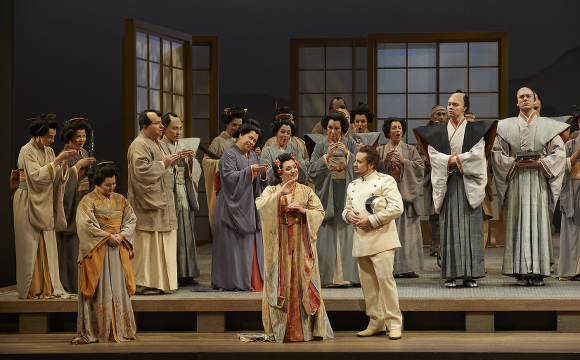
Chen Kaige does Turandot

Zubin Mehta seems to be making a habit of teaming up with Chinese film directors to stage Turandot.  This time the director is Chen Kaige (Farewell My Concubine) and he chose Liu King and Chen Tong Xun to do the sets and costumes.  The production in question took place at Valencia’s I Festival del Mediterrani in 2008.  It’s actually in an opera house rather than on location in the Forbidden City but this production ends up having a rather similar look and feel to Zhang Yimou’s earlier one.

1.moon Continue reading

‘Tis the season to speculate

Finley-Gerald-02With a month or so to go before the Canadian Opera Company officially announces its 2013/14 season it’s surely time for some uninformed speculation.

There are three big anniversaries in 2013; the bicentenaries of Verdi and Wagner and the centenary of Benjamin Britten.  One would think all would be represented but maybe not.  We know Verdi will be.  Gerald Finley announced at the Rubies that he would make his role debut in the title role in Falstaff at COC in 2013/14 so we can ink that one in.  Britten seems probable.  There’s a Houston/COC co-pro of Peter Grimes, directed by Neil Armfield that is due to to come to Toronto.  I think we can pencil that one in.  No idea on casting but I would love to see Stuart Skelton myself.  Wagner, I’m not so sure.  Maybe February’s run of Tristan und Isolde will be COC’s sole nod to Wagner.  Certainly the next most likely candidate; the Lyon/Met/COC Parsifal is, apparently, not expected before 2015.

Continue reading