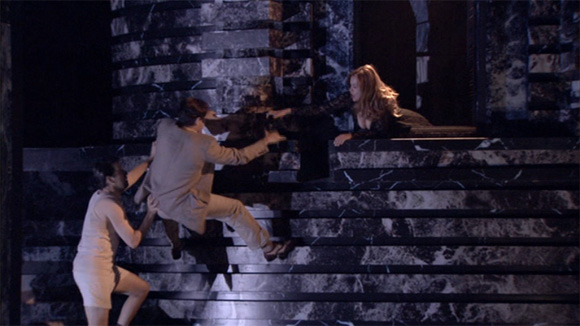
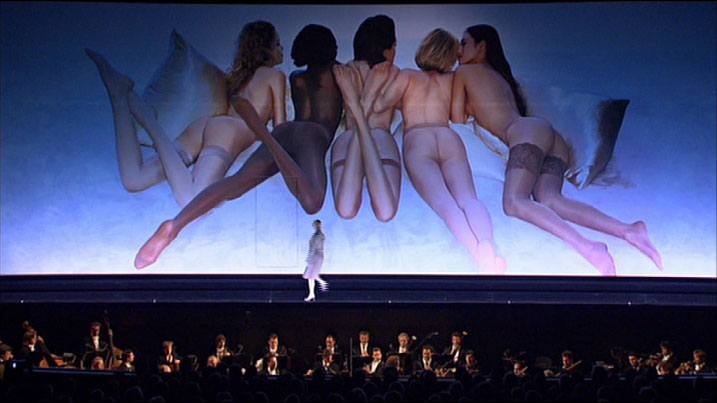
A new Salzburg da Ponte cycle – Così fan tutte

Every few years the Salzburg Festival replaces the productions of the three Mozart/da Ponte collaborations with new productions.  At least in recent years they have entrusted all three to the same director but the “refresh” happens in different years and not always in the same order.  I reviewed Claus Guth’s offerings here (Le nozze di Figaro, 2006; Don Giovanni, 2008; Così fan tutte, 2009) and noted the way that certain linking elements developed over the course of the “cycle”.  I was interested to see whether the same thing held for the newest iteration by Sven-Eric Bechtolf.  All three have now been released on Blu-ray (though due to availability issues I have the Così on DVD) so I thought I should watch them in the order they appeared at the festival and see what transpires.  So here we go with Così fan tutte recorded in 2013 in the Haus für Mozart.

1-guys

Continue reading

Hyper traditional Figaro

The 2009 production of Mozart’s Le nozze di Figaro from Madrid’s Teatro Real had me doing a bit of a double take.  It’s all pouffy wigs, breeches and heaving bosoms.  In fact it’s so traditional that it wouldn’t be out of place in Winnipeg or Omaha but comes as something of a surprise in a major European house.  In the “Making of” feature, included as an extra, director Emilio Sagi suggests that the opera is so “perfect” that only a “hyper-realist” approach is appropriate.  It’s an interesting idea but “hyper-realist” here turns out to mean a bunch of established opera conventions that bear as much of a relationship to “reality” as, say, a James Bond film does.  There is one minor directorial intervention.  A air of buxom extras appear in almost every scene.  I’m not entirely sure why.  Perhaps they are the Wonderbra of the production as their sole purpose seems to be to uplift the cleavage quotient.  For the record, the piece is presented uncut so Basilio and Marcellina get their big arias in the last act.  The traditional approach, I know, has its adherents.  I’m not one of them.  I could have used a few ideas!

1.act1

Continue reading

Maometto II

Rossini’s rarely performed opera seria Maometto II opened at the Four Seasons Centre last night in a production by David Alden and with substantially the same cast as when it played in Santa Fe on 2012.  This is the restored Maometto in the edition prepared by Hans Schellevis in an attempt to get as close to Rossini’s initial Naples score as possible.  So, no happy ending and all the complexity of Rossini’s original design.

Maometto-MC-0287

Continue reading

Adventure story

Robert Carsen doesn’t seem disposed to treat Handel too reverentially.  Although there is some of the trademark Carsen cool minimalism in his 2011 Glyndebourne production of Rinaldo (not to mention symmetrically arranged furniture) there’s also a degree of humour, as there is in his Zürich Semele.  I find it very effective and, judging by the audience reaction, so did the people who saw it at Glyndebourne.

1.cane Continue reading

Ercole amante

Cavalli’s Ercole amante was written for the wedding of Louis XIV to Marie-Thérèse, a Habsburg princess.  The marriage itself being the seal on the French victory over Spain in the war that had lasted until 1659.  It’s an odd work considering.  It’s not nearly as weird as, say, Il Giasone or La Didone but it’s hardly what one would expect for the nuptials of Le Roi Soleil.  It’s clear from both the Prologue and the ending that Ercole is Louis but he’s also a most unlikeable character.  In this version of the Hercules story he’s in love with his son’s (Hyllo) girlfriend (Iole) and will stop at nothing to bed her including casting off his wife (Deianira), imprisoning his son and bumping off Iole’s father.  In the end he’s attacked by the spirits of various people he has wronged before succumbing to the trick with the centaur’s poisoned shirt.  He’s made immortal and paired off with Hebe in the heavens but it’s hardly a tale of kingly virtue or marital fidelity.  For good measure, along the way a good chunk of the Graeco-Roman pantheon make an appearance.

1.francespain Continue reading

Gerry Finley’s Don Giovanni

Jonathan Kent’s 2010 Glyndebourne production of Don Giovanni has a great cast and high ambitions but, ultimately, doesn’t really come off, largely because the relationships between the characters too often fall short of anything interesting.  The concept, as explained in the two short bonus segments, is that Don Giovanni is set in a society in transition and that the title character is a sort of harbinger of the new mores.  The “society in transition” chosen by Kent is a sort of hybrid of Fellini’s La Dolce Vita and the last years of Franco’s regime in Spain.  He might have done better to just pick one as the Fellini elements get pretty much reduced to the costumes and the Franco elements really don’t go anywhere.

window Continue reading

Don Giovanni in the 21st century

After a week of nostalgia wallowing in ancient “productions” from the met and the COC it’s back to Regietheater with a vengeance for the 100th DVD review on this blog.  The subject is Martin Kušej’s Salzburg production of Don Giovanni which premiered in 2002 but was recorded in 2006 as part of the M22 project.

For a start there’s nothing giocoso about this dramma. It’s a very bleak and complex production with lots of ideas; some of which work and some of which are more problematic, and it’s provoked more discussion at the Kitten Kondo than just about any other recording we’ve watched recently.  Rather than write a 3000 word review I’m going to write a normal length review and follow it up with one or more posts on aspects of the production that seem particularly worth exploring. Continue reading