There may be cheerful songs in Russian but I’m not sure I have ever heard one. Certainly there were none on offer at the Four Seasons Centre today when Ekaterina Gubanova and Rachel Andrist offered up a recital of Tchaikovsky and Mussorgsky works. There’s a reason why one of three Russian words I can recognize is “Schmert”. Depressing as the texts may have been these were truly wonderful performances. Gubanova has a dark, very Slavic colour though she can brighten it when she chooses and she’s utterly fearless singing with great passion and, yes, there was a high C in there.
Last night at Walter Hall, as part of the Toronto Summer Music Festival, Chris Maltman and Graham Johnson gave a recital that explored the experience of war through song. It was a long and varied programme with twenty two songs in four languages commemorating most of the great empires that went to war in 1914 though many of the songs were from earlier periods. At the core of the programme were early 20th century settings of English pastoral poems. Butterworth’s settings of Houseman were there but, sneakily, we got Somervell’s much less well known setting of Think no more lad. In a similar vein there were Gurney and Finzi. The Americas were represented in a characteristically rambunctious Ives setting of a horribly jingoistic McCrae poem; He is there. McCrae may be the only well known war poet who managed to survive until 1918 without developing any sense of irony. Beyond the English speaking world there were songs by Mussorgsky, Mahler, Fauré, Schumann, Wolf and Poulenc.
Back to Koerner Hall last night for a concert of chamber music and art song. Anchoring the show were the Gryphon Trio. They kicked off with the Debussy Piano Trio in G Major. This was an enjoyable and compact piece with a very playful second movement. Then came what was, for me, the main reason for going, Mussorgsky’s Songs and Dances of Death. For this the Gryphons were joined by Toronto bass Robert Pomakov. He was excellent. Obviously completely at home singing in Russian he produced a nuanced reading of text and music. His acting with the voice was exemplary and no extraneous physical acting was required. His control of dynamics was exemplary. He has a really big voice which he deployed as appropriate but he was also capable of floating a lovely pianissimo. Accompaniment from the Gryphons was also well up to par. There are some interesting instrumental lines including making the cello go about as low as a cello can to match the bass voice. Continue reading →
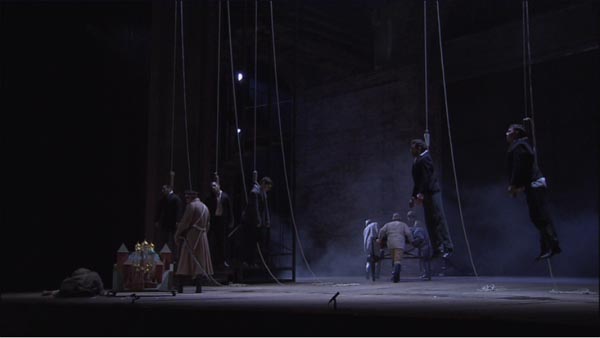
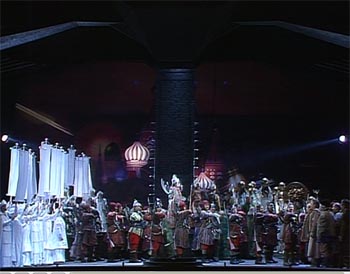
There are only two video recordings of Mussorgsky’s Khovanshchina currently available. The 1989 Vienna recording, which I wrote about yesterday, and a 2007 production from Barcelona’s Gran Teatre del Liceu which I’ve also just had a chance to see.
The two productions make for interesting contrasts on many levels. In Barcelona, music director Michal Boder, while opting to use the Shostakovich orchestration as a basis modifies it in places with elements of the Rimsky-Korsakoff version. He also uses Voronhov’s lower key alternative to the Stravinsky in the final chorus and he makes some cuts; most notably the Susannah scene in Act 3. He also gets quite a different sound from the orchestra. Where Abbado in Vienna is very refined, one might almost say Viennese, Boder is brasher. In places the music almost sounds like Shostakovich with the characteristic braying brass. Admittedly some of this may be due to the quality of the recorded sound. The Vienna recording is rather soft focussed Dolby 2.0 while Barcelona gets very crisp and detailed DTS 5.1 (There’s LPCM stereo too but I didn’t check it out).
Mussorgsky’s Khovanshchina may be the most depressing opera ever written. It’s a catalogue of executions, murders, betrayals and mass executions that are no doubt designed to show the extreme purity of the Russian soul. I’m glad I’m not Russian. It’s also a rather beautiful score, though how much that’s due to Mussorgsky who didn’t complete and didn’t orchestrate it is, I suppose, anyone’s guess. In the version I watched; a 1989 performance from the Wiener Staatsoper, the ending is by Stravinsky and the orchestration by Shostakovich. Continue reading →
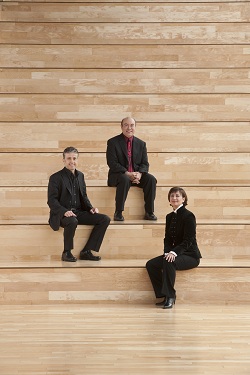
Today’s free lunchtime concert in the Richard Bradshaw Amphitheatre was given by Canadian bass, Robert Pomakov and the Gryphon Trio (Annalee Patipatanakoon – violin, Roman Borys – cello, Jamie Parker – piano).
First up we got Parker and Pomakov performing Beethoven’s An die ferne Geliebte. Pomakov has a big voice as I knew from having heard his Monterone twice this month at the Four Seasons Centre. I was impressed by how well he could scale back his volume and even more impressed by the wide and appropriate range of tone colours he deployed. He doesn’t sound entirely secure at ppp but for a voice of his type he was pretty good! Next the Gryphons gave us the Elegia from Arensky’s piano trio. I don’t know this work at all but they sounded very accomplished and musical. The finale was Mussorgsky’s Songs and Dances of Death in Gary Kulesha’s arrangement for voice and piano trio. This time Pomakov could let rip with all his considerable power accompanied with equal fervour by the Gryphons. The whole thing was very impressive and very loud!
The scary thing is that Pomakov has only just turned thirty and already has this huge sound. Apparently he’s had it for a while because he’s sung in twenty COC productions going back ten seasons. I did check out Youtube to see if I could find Pomakov and there is one clip of him singing the Russian National Anthem at the World Cup of Hockey in 2004. Here it is.


 operaramblings