Magdalena Kožená and Simon Rattle

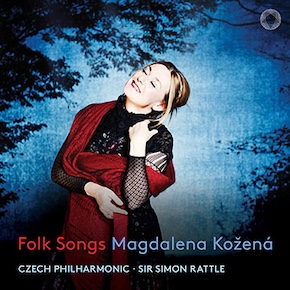
PTC5187075-Kozena-Czech-Phil-Folk-Songs-cover-lowresThe new CD from husband and wife team Magdalena Kožená and Sir Simon Rattle consists of four sets of folk songs arranged for mezzo-soprano and orchestra; all of them pretty well known.  There are the Five Hungarian Folk Songs of Bartok, Berio’s Folk Songs (all eleven of them), Ravel’s Cinq mélodies populaires grecques and Montsalvatge’s Cinco canciones negras.

They all get really good performances.  There some extremely fine and idiomatic singing from Kožená with excellent diction in seven different languages from Occitan to Armenian and a real sense of what each cycle is about.  For example, she really catches the Latin American rhythms and feeling in the  Montsalvatge.  But what’s really even more impressive is that she is so perfectly at one with the orchestra.  The rapport is more like what one expects with a really good collaborative pianist.  And the Czech Philharmonic is a really good orchestra as witness their playing of the very complex Berio settings.  It’s an extremely satisfying album on all counts.

It’s well recorded too.  The recordings were made in Dvořàk Hall at the Rudolphinium in Prague at various times between 2020 and 2023 and they are spacious, detailed and well balanced.  There is a booklet with full texts and translations plus other information.  Available formats are physical CD, MP3 and CD quality and 96kHz/24bit FLAC.  I listened to CD quality digital.

Catalogue number: Pentatone PTC 518707

Shuffle: Philcox and Szabó

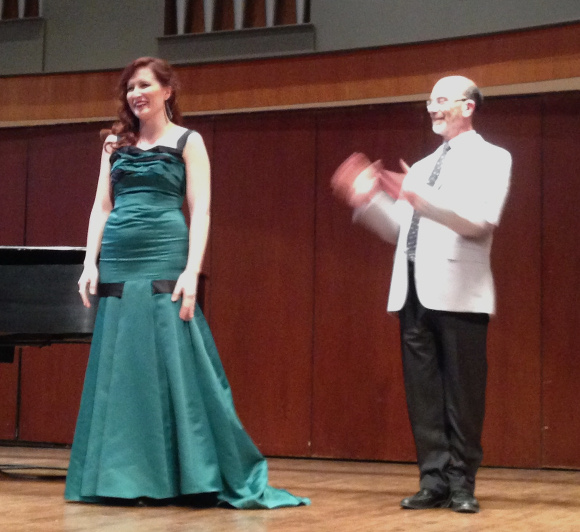
Last night’s early evening free “shuffle” concert at Heliconian Hall featured Krisztina Szabó and Stephen Philcox.  They started out with Xavier Montsalvatge’s Cinco canciones negras; a lively collection of Spanish songs featuring scenes from Cuban life.  The songs, very much French influenced, varied in mood from quite sombre to wild and were presented with skill and wit.  The main event though was the reprise of two works that Philcox and Szabó premiered in March at Walter Hall; Miss Carr in Seven Scenes by Jeffrey Ryan and Four Short Songs by John Beckwith.  I reviewed that March performance here and really don’t see any reason to revise my opinion about the works or the performances except to note that last night, of course, Krisztina sang all the Beckwith songs.

philcoxszabo

Morphology of Desire

To Mazzoleni Hall yesterday to hear Christina Campsall’s graduating recital.  I think over the course of the year she has become my “top tip” for this year’s graduating class at the Conservatory and nothing that happened yesterday did anything to shake that judgement. It was a pretty intense program that was definitely more shade than light but that, I think, rather suits her voice.  The opening set, Mahler’s Rückert Lieder, was a case in point.  Dark, brooding texts, dark, brooding music and a dark, brooding voice with plenty of power.  We have a mezzo here not a second soprano!  That said, her high notes are all there and there seems to be plenty of power all through the registers, though to be fait I’ve only seen her once in a large hall and that was in operetta.  Very good German too with a distinct northern inflection.  All the consonants!

campsall

Continue reading

Kickin’ Puss

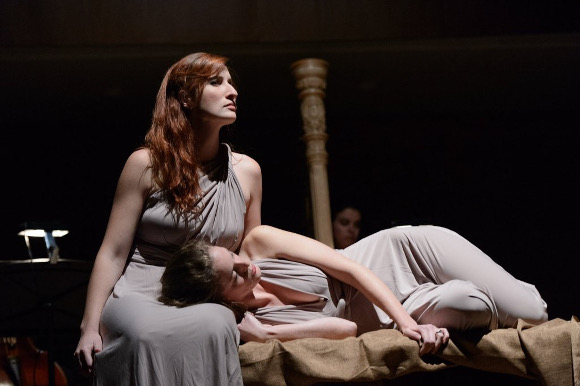
Xavier Montsalvatge’s El Gato con Botas, given last night by the Glenn Gould School at Mazzoleni Hall, may not be the most profound thing in the opera canon but it is fun.  The 1948 score is jazzy and accessible and the libretto has fun with the fairy tale of the scheming cat and her gormless monkey servant.  The lighter, even absurdist, elements of the plot were rather played up, and to good effect, in Liza Balkan’s production.  Mazzoleni Hall is not the easiest place to present opera.  There’s no pit and no way to do surtitles.  Not much in the way of wing space or scenery handling either.  Balkan got round this by placing the band on stage and using very simple sets and props that often spilled over into the auditorium even getting Charles Sy, sitting in the front row, to take a selfie of the wedding party at the end.  Given that the Spanish numbers were not surtitled, it was smart to add extra English dialogue, much of it improvised.  I certainly didn’t have any difficulty following the story.  Credit too to lighting designer David Degrow too for making the most of the limited resources of Mazzoleni.

folksongs

Continue reading