La France au printemps

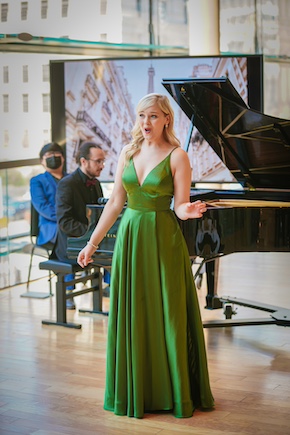
france 2Thursday’s concert by members of the Ensemble Studio in the RBA was an all French affair (at least as far as language went) and it was rather good.  Karoline Podolak iniated proceedings with Mattia Senesi at the piano with Kurt Weill’s “Youkali”.  Now I’ve heard this sung by everybody from Barbara Hannigan to Benjamin Appl and I’d have to see that Ms. Podolak is right up there.  There was no male stripper though.

Korin Thomas-Smith has something of a penchant for the bizarre and I think that’s a fair description of two sets drawn from Apollinaire’s Bestiaire.  There were five of the Poulenc settings (about as far from Dialogues of the Carmelites as one could imagine) and six from Rachel Laurin’s more atonal and abrasive settings.  I would probably sing these songs if I had four dromedaries and could sing.  Fine work from Brian Cho at the piano. Continue reading

One to watch

Last wednesday’s RBA recital was given by mezzo-soprano Jingjing Xu; the 2022/23 Wirth Vocal prize winner, and Christopher Knopp; piano.  It was one of the most impressive performances by a singer at this stage of her career (just finished her master’s) that I have heard in quite a while.  Mr. Knopp is pretty impressive too and it’s obvious that they have worked together quite a lot.

xu_knopp

Continue reading

L’Étoile du Nord

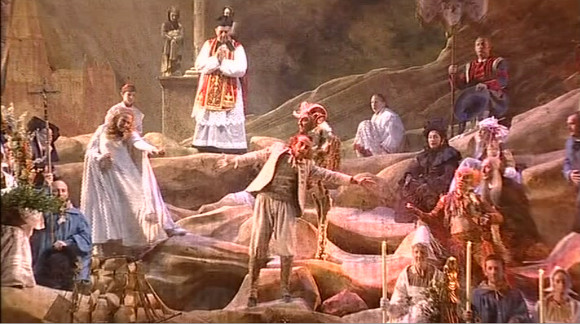
letoiledunordL’Étoile du Nord is an 1854 opera written by Meyerbeer for the Opéra-Comique.  It follows on from a series of successful grand operas for L’Opéra de Paris.  To some extent it’s an attempt to create something lighter than the early works but the composer doesn’t quite seem able to let go and the work combines comic and serious elements in a way I cannot describe as successful.  Format wise it’s pretty much an opéra-comique with no ballet (though some folk/social dancing) and spoken dialogue. Continue reading
When the going gets weird

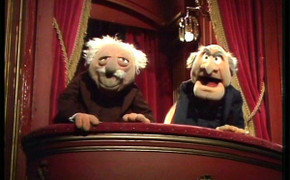
the-muppets-statler-and-waldorfA couple of years ago I produced a series of “best of” lists for video recordings, which I’ve updated from time to time.  One can find them on the Index of DVD reviews page.  So, for fun, I thought I’d put together a “weirdest” list.  Mostly this captures operas that are intrinsically weird but I’ve included the odd recording where the director has gone a bit nuts in an attempt to get something out of non too promising material.  So, in alphabetical order by composer, here is the “weird list”.   Continue reading

Meyerbeer in the museum

Meyerbeer’s L’Africaine was a huge hit in Paris, London and New York when it premiered in 1865.  I’m not sure why.  It has all of the things that make Meyerbeer seem very dated and not as much of the good stuff as Les Huguenots, or even Dinorah.  It’s ostensibly about Vasco de Gama but that’s just a peg to pin a love triangle and a bunch of exoticism on.  Are we actually supposed to believe that the Portugese wanted to find a way around the Cape to find out what was there?  It would have been a lot easier to get hold of a copy of Herodotus.  It’s also long.  Even with cuts it runs well over three hours in the version recorded at San Francisco Opera in 1988.

1.room Continue reading

My darling goat

Meyerbeer’s Dinorah ou le Pardon de Ploërmel must be a very strong candidate for the silliest opera ever written.  It concerns a young girl, Dinorah, who is deserted on her wedding day by her fiancé Hoël who disappears in search of a cursed treasure.  She goes mad.  There’s sheep and goat ballet, a lullabye to a goat accompanied on the bagpipes, more sheep and goat ballet and a scene where Dinorah sings a very difficult aria to her own shadow.  There’s a “ghastly” enchanted glen scene at the end of which Dinorah, pursuing her pet goat, falls into a river; apparently fatally.  Rather than resolve this we then get another half hour of pastoral with a hunter and a reaper and assorted shepherdesses and, inevitably, dancing sheep and goats before Hoël shows up having rescued Dinorah. He persuades her that the last twelve months have all been a bad dream and they get married accompanied by much pious singing.

1.wedding Continue reading

Ein Reich, ein Volk, ein König

In many ways Meyerbeer’s Les Huguenots is a typical mid 19th century French grand opéra.  It takes a sweeping, epic story; in this case the St. Bartholomew’s Day Massacre, and grafts onto it the elements the paying public demanded; spectacle, ballet, showpiece arias etc.  The result is unwieldy and, when applied to such grim subject matter, almost grotesque.  The 1991 Deutsche Oper production by John Dew (performed in German as Die Hugenotten) takes these disparate elements and works with them; mixing laugh out loud and extremely grim to create a piece of music theatre that is truly disturbing.

1.badge Continue reading

Gentle Death, I embrace you

1.urbainIt’s 1990 and Dame Joan Sutherland is retiring.  Australian Opera decide to stage Meyerbeer’s Les Huguenots as a farewell gala.  In some ways it’s an odd choice as the Sutherland character, Marguerite de Valois, only appears in two of the five acts of an opera that’s rather long despite cuts.  Still, as a vehicle for an ageing coloratura it’s not a bad choice.  The production is by Lotfi Mansouri so there is nothing to get in the way of the plot and, by the same token, nothing much to think about.  It’s also, equally characteristically, quite dark in places.  Everything then rests on the performances.  Continue reading