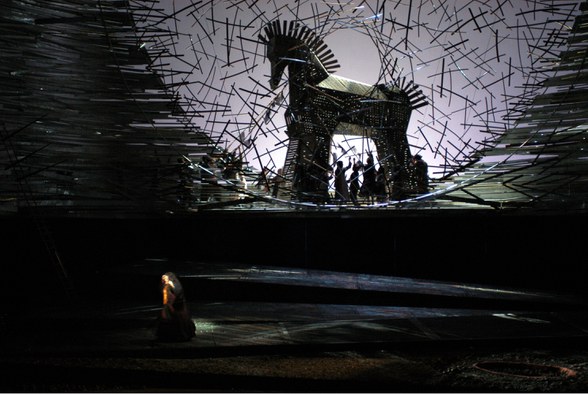
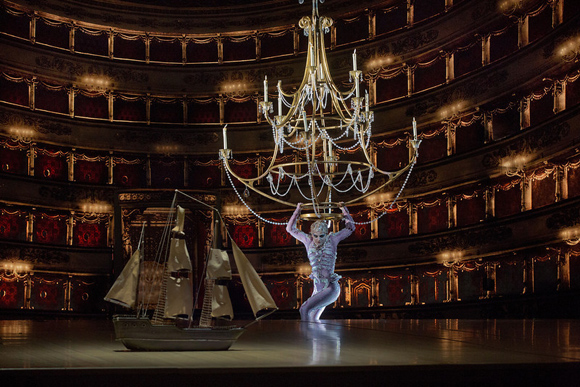
Berlioz’ Les Troyens is opera on a grand scale. Only a really big company like the Met could possibly afford to stage it. Yesterday’s performance used a chorus of 110, a larger orchestra, at least twelve soloists and a bunch of dancers. It also lasted 5 1/2 hours including the intervals. Was it worth it? For the most part I’d say yes.
Tag Archives: metropolitan opera
A more enchanted island
Thomas Adès’ The Tempest has had something like eight runs since its premiere at Covent Garden in 2004. It recently opened at the Metropolitan Opera in a new production by Robert Lepage which was broadcast as part of the Met in HD series this afternoon. It’s an interesting work musically. Some of the vocal writing is reminiscent of Britten. It all tends to a high tessitura for the voice type concerned and goes to extremes in that direction for the soprano part of Ariel where parts are so high that clear articulation of the words is impossible. Writing for voice and orchestra ranges from dissonant to extremely lyrical (the act 2 duet between Miranda and Ferdinand). Key and time signature changes are legion and many of the intervals for the singers are extreme. It must be extremely difficult to perform but it’s rather lovely to listen to.
Not a DVD review
There are an awful lot of opera DVDs about. It sometimes seems like there’s a new Tosca or Traviata out every week, often for no apparent reason. It’s perhaps surprising then that some works don’t make it to DVD. One particularly egregious case would seem to be John Adams’ Nixon in China. It’s a good piece and has had plenty of productions both in North America and elsewhere. A couple of years ago I saw it twice in 24 hours; on a Friday evening at COC followed by the HD broadcast from the Met the following afternoon and I’ve been listening to an audio recording of the COC version on my walk to and from work. But there’s no DVD! I guess that the Met probably planned to release the HD recording but James Maddalena, the Nixon in the recording, was so obviously ill I was actually surprised that he continued after the interval and I guess that scuppered that. Continue reading
Frock Opera
Giordano’s Fedora is a sort of apotheosis of the 19th century Italian opera. It’s a melodramatic love story in an aristocratic Russian setting. There is murder and suicide and plots and a dead mother and brother. The music is dramatic, even bombastic, when the mood suits but finds time to give showpiece arias for the principals. There is not a single idea in libretto or score that could give anyone an uncomfortable thought. The Metropolitan Opera’s 1996 production by Beppe di Tomasi builds on this by playing it dead straight and setting it in a series of suitably opulent settings complete with extravagant frocks. The cherry on the already rather rich cake is casting Placido Domingo as Loris Ipanoff and Mirella Freni as Fedora Romazoff. I imagine it’s many people’s idea of the perfect night at the opera In it’s way it’s the polar opposite of, say, Bieito’s Wozzeck. Continue reading
Idomeneo at the Met
The 1982 Metropolitan Opera recording of Mozart’s Idomeneo will likely please those who like their Mozart on the well done side. The story telling is straightforward (though there are some design quirks), the orchestra is big, the tempi are not too sprightly and the vocal talent is starry if not especially Mozartian. To reinforce this James Levine has made a number of cuts and interpolations from different early performances to structure things a bit more like a grand opera and less like a tragédie lyrique. Continue reading
Birgit Nilsson’s Elektra
I grew up with the Solti Ring and Nilsson’s Immolation Scene still makes the hair on my neck bristle. The 1980 video recording of her performance in the title role of Strauss’ Elektra at the Metropolitan Opera really doesn’t have the same effect. The voice is accurate enough, there’s still a lot of power and the vocal acting is good but somehow the voice seems to have hollowed out and to lack resonance. Admittedly she’s not helped by the recording which seems to favour the orchestra over the voices fairly consistently. The other sopranos suffer from the acoustic/recording too but come off better and if Leonie Rysanek really had a high fever it’s not obvious. Mignon Dunn’s Clytemnestra is also well sung. The orchestra plays wonderfully for James Levine and gets much better treatment from the sound engineers. Continue reading
Very traditional Don Giovanni from the Metropolitan Opera
The 2000 Metropolitan Opera recording of Mozart’s Don Giovanni is based on Zeffirelli’s 1990 production somewhat modified by director Stephen Lawless. It’s an entirely traditional “breeches and boobs” affair with baroque painted flats, tricorne hats etc. Blocking is mostly very basic with a lot of “park and bark” just livened up with a bit of prop twiddling. It works because it has a superb cast who sing and act (within the limits of the production) extremely well.
At the core is Bryn Terfel in the title role. You get what you expect; a big voice that can be scaled back to quite beautiful, menace, physical presence and a touch of humour when required. If you have seen his more recent Scarpia or Mephistopheles you know what to expect. He’s backed up Ferruccio Furlanetto in a rather broadly comic take on Leporello which, though I find it unsubtle, isn’t inappropriate in this production. The Terfel/Furlanetto relationship is very much master/servant. No ambiguity about two sides of one character here! Continue reading
Kathleen Battle steals the show again
In this next episode of our wallow in Met nostalgia we are looking at the 1988 production of Richard Strauss’ Ariadne auf Naxos. It’s a starry affair with James Levine conducting, Jessye Norman in the title role, James King as Bacchus, Kathleen Battle as Zerbinetta and Tatiana Troyanos as the Komponist. There’s even a bit of luxury casting in the minor roles with Barbara Bonney and Dawn Upshaw among the nymphs. It’s also as old fashioned as one could possibly imagine, being a revival of a production that premiered in 1962. Continue reading
Hockney’s Flute
It seems to be “looking back at older Metropolitan Opera productions” week here in the blogosphere. Over at The Earworm there’s a series of posts on a 1980 production of Don Carlos. Our subject will be the 1991 Die Zauberflöte.
The production was designed by David Hockney and the look varies from the whimsical; the opening scene, to the grandiose; the final scene, with bits of Egyptiana in between. It’s very handsome. The direction is described as “original direction” by John Cox and “direction” by Guus Mostart. I’m not entirely sure what this means as there doesn’t really seem to be a production concept and the Personeregie is pretty basic. Basically it looks like acting is considered to be an optional extra. Some of the singers are good actors and some don’t even try. There’s no consistency. The impression is that the “production” is just a backdrop for the singers to do their thing. Continue reading
Robert Carsen’s Eugene Onegin
One of the early Metropolitan Opera Live in HD broadcasts was a 2007 showing of Robert Carsen’s 1997 production of Tchaikovsky’s Eugene Onegin with Dmitri Hvorostovsky and Renée Fleming. It was subsequently released on DVD and Blu-ray by Decca and remains one of the most successful disk releases spawned by the broadcasts.