Here we go again

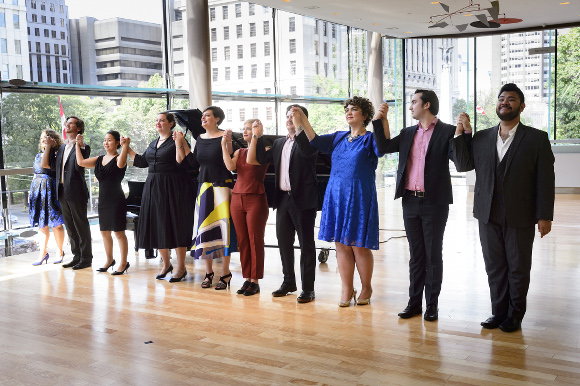
The tenth season at the Four Seasons Centre opened with the, by now traditional, lunchtime concert by the COC’s Ensemble Studio.  Six of the eight singers and one of the two pianists are new recruits which is unusual and more of a chance to level set than see how anyone has developed.

2016-09-27-fcs-ensemble-092

Continue reading

Rationing the rapture

Katharina Wagner’s take on Tristan und Isolde recorded at Bayreuth in 2015 is hard to unpack.  There are some hints in a short essay in the booklet accompanying the disk and a few more in the interview with conductor Christian Thielemann included as an extra but it still leaves the viewer with a lot to do.  It’s essentially unromantic and quite abstract.  A lot of stuff that happens in a traditional interpretation just doesn’t happen but there’s not really anything much to replace it.  What’s left is the story of two people who fall in love in a situation where that is bound to end badly and where, despite the best efforts of pretty much everyone else, it does.  It’s actually quite nihilistic.  Tristan, and maybe Isolde, seek a kind of transcendence in love/death but there is none.  At the end Isolde doesn’t die but something in her does.  It had me thinking of Bergman’s The Seventh Seal (but then so much in life does).

1.gantry

Continue reading

Schoenberg meets Mahler

Megan-Quick-Headshot-240x300At Walter Hall last night to see the Faculty Artists Ensemble with Megan Quick and Andrew Haji conducted by Uri Mayer perform the chamber versions of Das Lied der Waldtaube from Schoenberg’s Gurrelieder and Mahler’s Das Lied von der Erde in the Schoenberg arrangement.  The main reason for going was to get as chance to hear Megan in something more substantial than the things I’ve seen her in with UoT Opera.  Plus, a chance to hear Andrew is always very welcome.

The orchestration for both these pieces may be chamber scale but it’s heavy on the winds and it takes a fair bit of power to deal with that in a space like Walter Hall.  It was clear in Das Lied der Waldtaube that Megan has that.  Her instrument is a rich, darkish mezzo with significant beauty of tone and she has great control.  If I were to be picky, I’d say she has a tendency to focus on producing beautiful sounds at the expense of the text to some extent but I’d say that about a lot of successful singers.  It’s a matter of taste and maybe something she will feel differently about after a spell with the Ensemble Studio.  The basics are there for sure and the piece left me wanting to listen to Gurrelieder in full again.  It’s been a long time.   Continue reading

La belle Hélène from the GGS

Christina Campsall

Christina Campsall

The Glenn Gould School’s production of Offenbach’s 1864 operetta La belle Hélène opened at Koerner Hall last night.  Overall, it’s an enjoyable show with some strong performances though there are aspects of it that, in my view, rather missed the mark.  Certainly it made me realise just what a difficult piece to really bring off really well La belle Hélène is.  There are some very difficult singing roles and yet they need to sound effortless.  It needs the exquisite comic timing of a bedroom farce.  There’s also a difficult to define quality; very French and with a sexiness of the “I know it when I see it” variety.  I think it was a shortage of this last that was largely the problem last night.

Continue reading

La Monnaie, a python and the Holy Grail

There’s a bit at the end of the first act of Parsifal where Gurnemanz looks at Parsifal and says “you haven’t understood anything have you?” or words to that effect.  Watching Romeo Castellucci’s 2011 production for Brussels’ La Monnaie theatre my sympathy was very much with the Pure Fool.  This is one of the most incomprehensible productions I have seen.  Act 1 is very dark.  Most of the time only a tiny fragment of the stage is lit.  The first thing we see is a snake in its own tiny patch of light.  Then we are in a forest and the Grail Knights appear to be part of the forest.  Whether they are just wearing suits of leaves or are actually plants is unclear.  Kundry, in a white hoodie, and Parsifal in street clothes are recognisably human.  Titurel and his squires wear overalls and hard hats.  One of them carries a chain saw.  The “swan” appears to be a lit up tree branch though later it appears as a very decomposed skeleton.  The Grail Scene is played out with a white curtain, with a small black comma on it, across the entire stage.  The curtain is withdrawn and we see fluorescent lights above the greenery, which takes up much less space than one has so far imagined.  Is Monsalvat a grow-op and the knights marijuana plants?

1.snake Continue reading

Charming Vixen from the Glenn Gould School

ggsopera3_365sq_0This year’s opera offering from the Glenn Gould School at the Royal Conservatory is Janáček’s Cunning Little Vixen.  It’s a pretty good choice for a student production with a wide variety of roles and it’s a great vehicle for showing off  the excellent Royal Conservatory Orchestra.  The school has chosen to present the work in English translation which probably makes sense given the difficulties of training a whole new cast in Czech even though it somewhat undermines the composer’s extremely tight linkage of text and music.

Continue reading

Smart and sexy Don Giovanni

Last night saw the first of two performances of Don Giovanni by the students of the Glenn Gould School at Koerner Hall.  Koerner Hall isn’t the easiest venue to do fully staged opera since it is basically a concert hall with very limited lighting and stage facilities.  Ashlie Corcoran and Camellia Coo pulled off perhaps the most inventive staging I have seen there by using a giant staircase to link the part of the gallery that wraps around the stage to the stage itself.  Within this basic configuration they deployed a few bits and pieces of furniture, mostly couches. It made a very serviceable unit set for the various scenes.  The production was set in the 1960s and seemed to revolve around the basic idea of Don Giovanni as a “chick magnet”.  All the usual suspects are clearly attracted to him.  There’s no hint of coercion in the opening scene with Donna Anna and Zerlina is a very willing seductee.  The idea is reinforced in “Deh vieni” when, as Don Giovanni is serenading Donna Elvira’s maid, five or six women make their way to the staircase and down to the man himself.

Continue reading