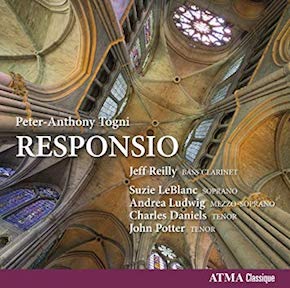
Responsio

responsioThis review first appeared in the print edition of Opera Canada.

Peter-Anthony Togni’s Responsio is sub-titled “A contemporary response to Guillaume de Machaut’s Messe de Nostre Dame” and that is exactly what it is. It weaves sections of Machaut’s 14th century mass with sections designated “Response one”, “response two” etc. which are a kind of commentary on Machaut’s music. What’s really interesting though is the way Togni arranges the source material. It’s scored for soprano, mezzo, two tenors and bass clarinet. The use of high voices seems to emphasise the originality of Machaud’s music, which must have sounded pretty radical to its original audience, and facilitates him somewhat twisting and shaping the vocal line to bring out some fairly weird rhythms and harmonies. So unmediaeval did some of these textures sound that I went off in search of the source material. There’s no doubt that Togni has arranged to bring out the strangeness but it is very much there in Machaut’s original score. Then alongside the vocals there is the bass clarinet which, part scored, part improvised provides a rather compelling, even disturbing commentary in a more obviously contemporary vein. The Gloria and the Hosanna sections in particular juxtapose the vocals, already making the familiar words of the mass seem strange, with an insinuating clarinet line in ways that are almost physically jarring. It is a piece of great originality; beautiful, thought provoking and even weird, and quite fascinating.
Continue reading

Pelléas et Mélisande in the Tanenbaum Courtyard Garden

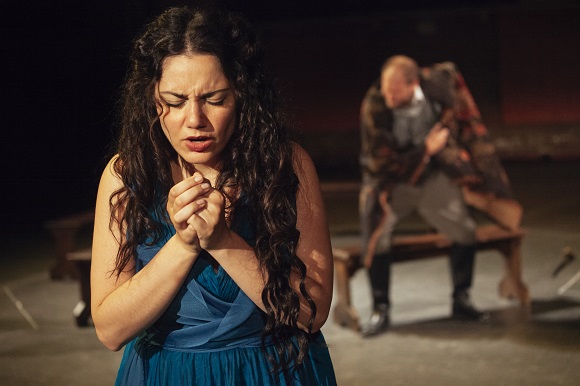
Hidden away up an alleyway behind the COC’s ioffice and rehearsal complex is a very beautiful garden.  I say hidden because I lived less than 200m away for 10 years before I discovered it.  Last night it made a rather magical setting for Against the Grain Theatre’s new production of Debussy’s Pelléas et Mélisande.  The piece is set in a gloomy castle and surrounding forest in Brittany.  The high, ivy covered walls and ironwork of the performance space, enhanced by Camelia Koo’s fractured flagstones forming patterns on the grass, evoked the essentially sunless world of Maeterlinck’s poem.  Costuming in the style of the period’s composition meshed nicely with the aesthetic of the roughly contemporary space.

blockd-3031 Continue reading

April in Toronto

RevolutionsPosterThe opening weekend of April is almost absurdly rich in opera going opportunities and I’ve already previewed it here.  There are updates on the Tapestry/Volcano show Revolutions.  This is going to be highly experimental and aims to “test the boundaries of how opera is presented in the 21st century.” by exploring the relationship between physical and musical expression.  Marie- Josée Chartier (contemporary dance), stage director Michael Mori, will work with four athletic young opera singers, Neema Bickersteth, Andrea Ludwig, Adrian Kramer and Andrew Love.  Unfortunately it’s one night only and I shall be at the opening of Peter Sellars’ production of Handel’s Hercules at the COC.  Eric Owens, Alice Coote, Richard Croft, David Daniels and Lucy Crowe are singing and Harry Bicket is in the pit.  If that’s not incentive enough the COC is offering a 25% discount if you buy tickets to any two of the three spring operas (the other two are Roberto Devereux and Don Quichotte).  Continue reading

Sundry announcements

khalilThe lovely Miriam Khalil and Acadian pianist Julien LeBlanc will bring their recital Airs Chantés to Toronto for one performance at Gallery 345 on Oct. 24, 2013. The program comprises French and Spanish art songs of the Impressionistic and 20th-century period.  The first half of the recital will include excerpts from Ravel’s Shéhérazade, Debussy’s Ariettes Oubliées and will conclude with Poulenc’s well-known song cycle Airs Chantés. The second half is rounded out by three French melodies by Massenet, Ravel and Delibes in a Spanish style, Jesus Guridi’s uncommonly performed Seis Canciones Castellanas and three songs from Obrador’s Canciones Classicás españolas.  The show begins at 7:30 p.m. with doors opening at 7:00 p.m. Tickets are $25 and are available at http://www.miriamkhalil.com and at the door.

Continue reading

More season announcements

suzieleblancToronto Masque Theatre has announced the line up for the 2013/14 season.  There are three main stage productions.  First up is Patrick Garland’s now classic play Brief Lives, based on John Aubrey with song and music from 17th century London. Second is a revival of Tears of a Clown, under a new title, Arlecchino Allegro. Finally, there is a reinterpreted classic from the world canon teamed up with a contemporary interpretation in the Myth of Europa.  Details for the shows are as follows:

Continue reading

‘Tis the season

Opera/concert season is pretty much done in the big smoke though there is the Toronto Summer Music Festival (see below).  Attention moves to various more rural venues and to some seriously eclectic programming.  Out in Northumberland County there’s the Westben Festival with concerts in a barn ranging fro Irish trad to Richard Margison.  The highlight, for me, here would be a recital by Suzy Leblanc and Julius Drake featuring French mélodies, Strauss lieder and English songs by Christos Hatzis.  That one is on July 30.  Westben also has the UBC Opera Ensemble doing Carmen and, for those so inclined, a programme of Broadway tunes from the ever reliable Virginia Hatfield, Brett Polegato and James Levesque.  No word on whether Brett’s cat is also performing.

Stratford Summer Music has three concerts by the Vienna Boys Choir, one including Michael Schade.  There is also the Bicycle Opera Project and a celebration of R. Murray Schafer’s 80th birthday.

Meanwhile, back in the smoke there is the Toronto Summer Music Festival which kicks off on July 16th with the Trio Pennetier Pasquier Pidoux in an all French programme.  The highlights for me are the Gryphon Trio with Bob Pomakov on the 18th and Philippe Sly with Julius Drake on the 23rd.


Smart and sexy Don Giovanni

Last night saw the first of two performances of Don Giovanni by the students of the Glenn Gould School at Koerner Hall.  Koerner Hall isn’t the easiest venue to do fully staged opera since it is basically a concert hall with very limited lighting and stage facilities.  Ashlie Corcoran and Camellia Coo pulled off perhaps the most inventive staging I have seen there by using a giant staircase to link the part of the gallery that wraps around the stage to the stage itself.  Within this basic configuration they deployed a few bits and pieces of furniture, mostly couches. It made a very serviceable unit set for the various scenes.  The production was set in the 1960s and seemed to revolve around the basic idea of Don Giovanni as a “chick magnet”.  All the usual suspects are clearly attracted to him.  There’s no hint of coercion in the opening scene with Donna Anna and Zerlina is a very willing seductee.  The idea is reinforced in “Deh vieni” when, as Don Giovanni is serenading Donna Elvira’s maid, five or six women make their way to the staircase and down to the man himself.

Continue reading