
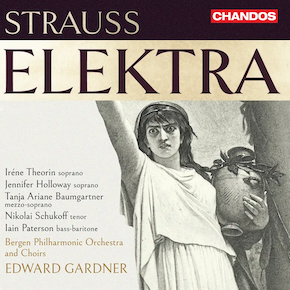
 Ed Gardner and the Bergen Philharmonic have produced some stunning recordings for the Chandos label. The new release of Richard Strauss’ Elektra is no exception. Indeed this is likely now the first choice audio recoding of this work.
It’s a very strong cast. Iréne Theorin has enough heft for the title role but she’s also surprisingly lyrical where appropriate, Jennifer Holloway is a sweet toned and sympathetic Chrysothemis and Tanja Ariane Baumgartner sounds suitably unhinged as Chrysothemis without sounding like her voice is past its sell by date. Iain Paterson is an interesting Orest. He’s kind of eerily creepy especially in his first scene with Elektra. I rather liked it. All the other roles are perfectly adequate too and so is the chorus.
But isn’t the real glory of Elektra the orchestral writing? Gardner gets the most out of it with a reading that’s both very dramatic and surprisingly lyrical. It’s taut too. The tension just goes on and on. The Bergen players respond splendidly.
The recording was made in the Grieghallen in December 2023 from live concert performances. It’s splendid and has been released as a hybrid SACD. The high resolution tracks are as good as any recording I’ve heard but this does mean that the dynamic range is realistically extreme! With the volume set to a realistic level for the voices, the orchestral climaxes are very loud indeed so unless you have no neighbours within miles you might prefer headphones. The climaxes though are super clean and detailed so not particularly fatiguing to listen to. There’s a booklet with useful info and full text and translation. The SACD physical release can, of course, be played like a standard CD on most CD players and the album is also available digitally as MP3 and lossless in 44.1kHz/16 bit and 96kHz/24 bit versions.
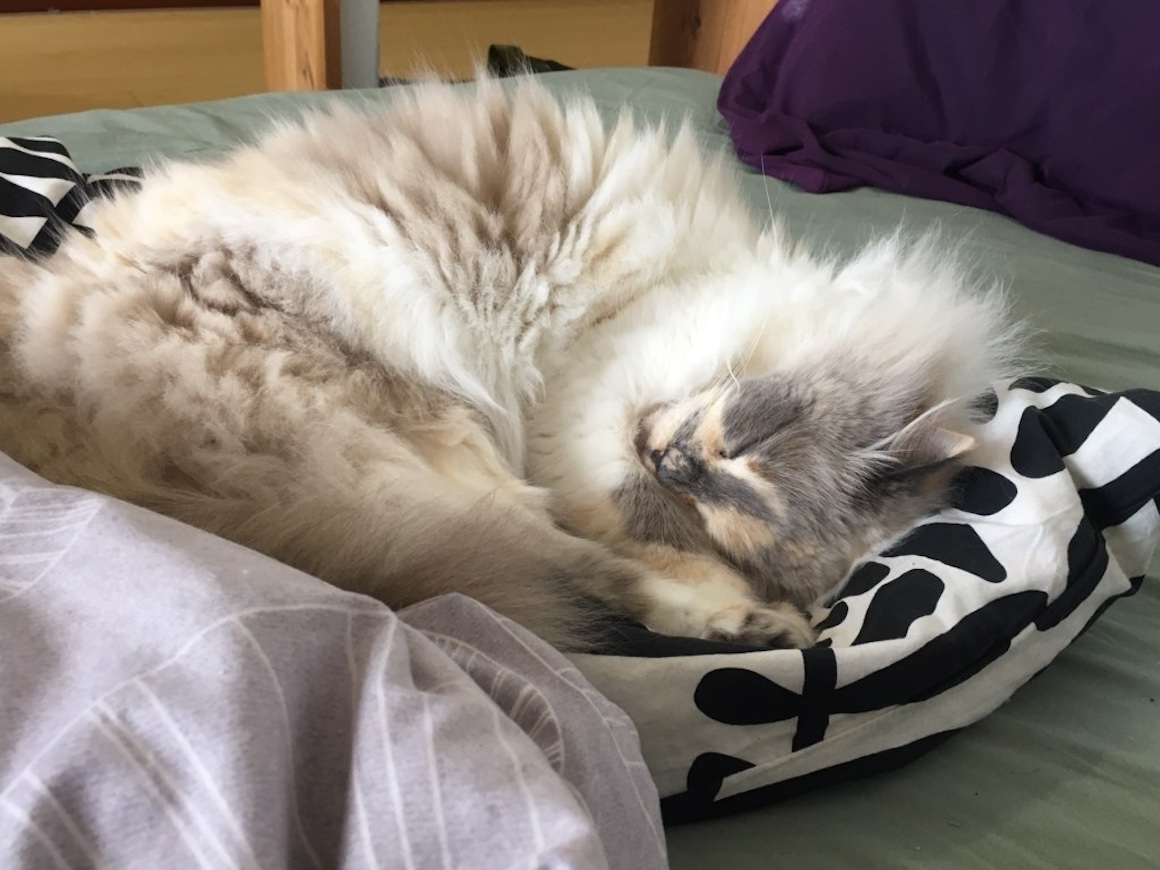
And what did my Elektra think? She thought it was perfect music for an extended nap!
Catalogue information: Chandos CHSA 5375(2)
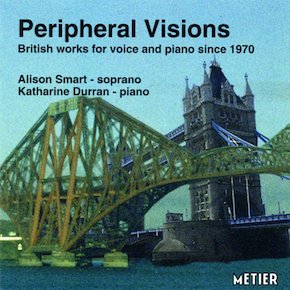 The first half of the 20th century was a sort of golden age for British art song unparalleled since the days of Purcell and Blow. There are works by, inter alia, Finzi, Britten Vaughan Williams and Butterworth that are still staples of the repertoire. After the second world war though it starts to tail off and I’m hard pressed to think of songs/song cycles from the last two or three decades of the century that have become at all popular. In fact, it seems to me, the most popular art song like works from this period are stage works which are based on a cycle of songs like Maxwell Davies’ Miss. Donnithorne’s Maggot. I was interested then to come across a 1999 CD of (actual) songs for voice and piano written since 1970. The CD is Peripheral Visions by soprano Alison Grant and pianist Katherine Durran.
 operaramblings