Haydn’s operas aren’t performed much but he has a champion in Nikolaus Harnoncourt In 2009, to celebrate the 200th anniversary of the composer’s death and his own 80th birthday, he was asked by der Theater an der Wien to pick a Haydn opera for performance. He chose the 1777 work, Il Mondo della Luna. It’s a quirky comedy composed for the marriage of one of the Esterhazys. Given it’s unfamiliarity, here’s a plot summary. The fake astrologer, Ecclitico, and the young gentleman, Ernesto, are in love with the daughters (Clarice and Flaminia) of the extremely misogynistic but rich, Buonafede who refuses to agree to the matches. Buonafede has designs on his maidservant, Lisetta, who is in love with Ernesto’s servant, Cecco. Ecclitico claims to have built a telescope that can see into the world of the moon and uses it to show Buonafede the “delights” of that place( i.e. how women are properly subordinated to men). Buonafede is entranced and when Ecclitico tells him that he has been summoned to the moon to serve the emperor he is easily able to persuade Buonafede to come too as long as the girls can come along later. An elaborate charade is played out in Eccletico’s garden whereby Buonafede is convinced by the open and honest dealings pf the moon people under their benevolent emperor (Cecco) to allow the marriage of his daughters. Cecco takes Lisetta as his empress. When the fraud is revealed Buonafede, after much huffing and puffing, takes it in good grace and they all live happily ever after. It’s silly but no more so than most Mozart operas and given its fine music its very enjoyable.
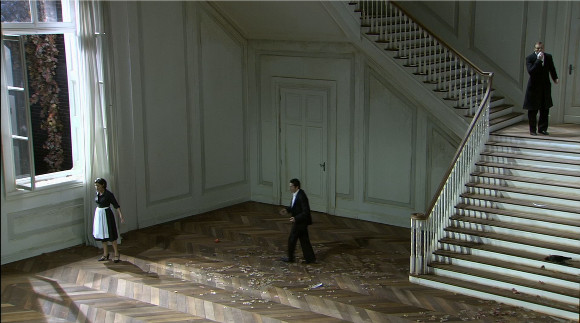
The Vienna production is directed for stage by Tobias Moretti and it’s given a modern setting. The “telescope” involves lots of computer screens and a “total immersion” helmet and so on. The sets help make it clear what is going on without being fussy. In places effective use is made of video projection. The video is particularly crucial during the telescope scene which is played out on two levels. Upstairs Buonafede is wired up to watch and, I think, what he thinks he is seeing is projected behind him. Meanwhile downstairs what he is “seeing” is being acted out in front of a camera. There seems to be a significant disconnect between the two but it’s almost impossible to be sure from the DVD which rarely gives us the whole picture at once. The videos also make a crucial appearance in the “ballet” at the start of Act 2. Here’s the scene with the Nymphs. In the accompanying interview Moretti is very clear that his production concept is driven by the music and I think he does a really good job of realising a pretty tricky piece for a modern audience.
 I don’t think I’d seen any of the cast before but they are all young, attractive and very good physical actors as well as very decent singers. The exception is Dietrich Henschel who plays Buonafede. He isn’t young but ypu wouldn’t know it as he throws himself into some of the toughest physical acting in the piece while singing in a very solid bass and being very funny. Bernhard Richter plays Eccletico and he, too, is excellent. He’s almost, but not quite manic, and he has a very pleasing lyric tenor voice. Cecco is played tenor Markus Schäfer. It’s a very broad, perhaps too broad, buffo interpretation with lots of eye rolling and the like. It might not look so extreme in the theatre as it does on DVD. The castrato part of Ernesto is taken by American mezzo Vivica Genaux. She’s technically very assured, especially in the coloratura passages, but the voice has a reedy quality I don’t much care for. Lisetta is sung by Maite Beaumont who manages to be very funny without being as eye rolling as Schäfer This is a Despina sort of role that relies more on acting skills than singing though she sings well enough. Flaminia (the good, dutiful daughter) is well sung by Anja Nina Bahrmann. She has one fiendish display aria, Ragion nell’alma siede which comes off pretty well but without perhaps the assurance that say, Schwarzkopf brought to Come scoglio (and it is that sort of aria!). Christina Landshamer gets to be the disobedient daughter, Clarice.
  She is very good especially in the first act where she is caught by her father escaping from the house (though we don’t get to find out why he is carrying a wooden coat hanger all through his confrontation with her). So all in all it’s a solid ensemble cast with really good acting and more than adequate singing.
Harnoncourt of course conducts and I imagine he’s also playing the harpsichord for the recitatives but it’s not credited. He gets just the right sound out of the Concentus Musicus Wien. The natural string tones and blaring horns are exactly right. This is not polite court music. This is mature Haydn experimenting at the boundaries as ever and Harnoncourt doesn’t duck bringing this out. I can see how conducted by someone like Karajan this could be a pretty dull score but not here!
The video direction by Felix Breisach is problematic. This cannot have been an easy production to film especially if the director were imagining it being watched on a fairly small screen. There’s a lot happening and yet a good deal of close in action going on too. As I indicated above there are crucial points where I don’t think the video allows us to follow the director’s intention which is unfortunate. For example, here’s one of Buonafede’s “fantasies” from Act 1. That said, it’s better filming than many opera DVDs. The picture itself is very good. It was filmed in HD and it shows. Sound options are PCM stereo and DTS 5.0. The latter is very good and sounds naturally balanced to me. The documentation is good and there’s a useful bonus interview with Morretti and Harnoncourt. It’s available as a 2xDVD9 package (which is what I watched) or Blu-Ray.
I’m converted. I want to see more Haydn operas.




 operaramblings