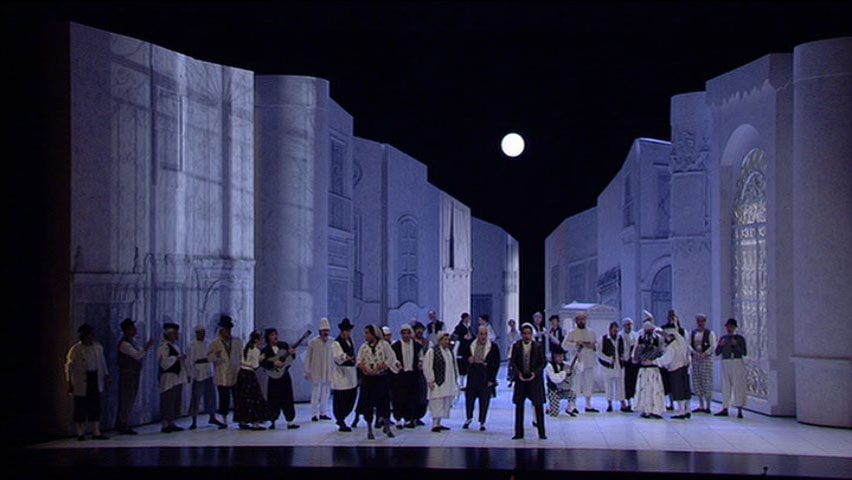
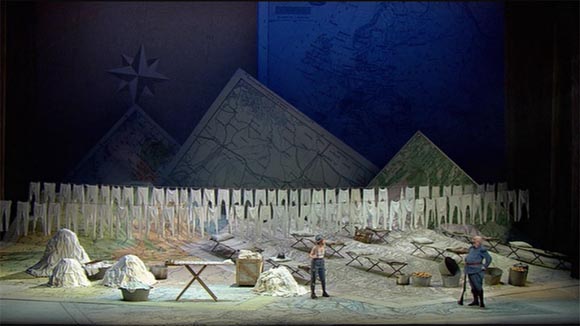
Exemplary Tales of Hoffmann from the Royal Opera

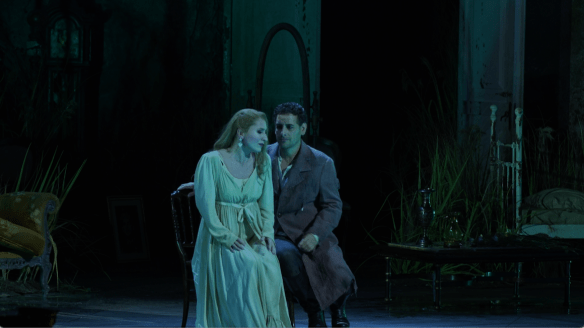
Offenbach’s The Tales of Hoffmann is a rather difficult opera to stage.  There’s no definitive performing edition and there’s a lot of (too much?) material to work with so decisions have to be made about what to cut.  There’s also the fundamental problem of how to frame the stories of Hoffman’s three great loves as he’s supposed to be recounting them in a bar, while drunk, some years after the events described.  Plus, there is some sense that all three are really just projections of his current infatuation; the opera singer Stella.

Continue reading

Minimalist (?) Barbiere

Herbert Fritsch’s production of Rossini’s Il barbiere di Sivigla filmed at the Wiener Staatsoper in 2021 is strangely ambiguous.  At first blush it looks like the sort of hyper traditional production the WSO might have had in repertory for fifty years.  There are big wigs, knee breeches and so on but it soon becomes apparent that something more (or less) is going on.  Tje costumes are exaggerated.  The fabrics are elaborate and shiny and very not early 19th century at all.  The wigs are odd colours.  Rosina’s dress shows rather a lot of leg.  There’s virtually no scenery and the only props I recall in the whole piece are a ladder and Lindoro’s sword at the end of Act 1.

1.serenade

Continue reading

Duelling tenors

Damiano Michieletto’s production of Rossini’s La donna del lago filmed at the Rossini Festival in Pesaro in 2016 has some odd features but at least it’s not as all around annoying as the Met production the year before.

1.elenauberto

Continue reading

Duelling tenors

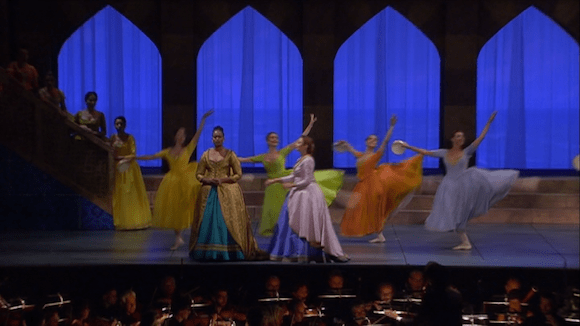
Rossini’s Ricciardo e Zoraide isn’t performed all that often but it has appeared a number of times at the Pesaro Rossini Festival.  In 2018 it got a new production there from the creative team of Opera Atelier with a rather starrier cast than is usual in their Toronto productions followed by a DVD/Blu-ray release.  It’s actually not too hard to see why the piece isn’t done more often despite its many good qualities.  It requires four tenors; at least two of which need to be absolutely top notch Rossinians and a soprano of equal quality.  None of the roles are easy.  It’s also a bit mixed dramatically.  The libretto is a rather convoluted crusader story set in Africa.  Agorante has captured Zoraide and wants to make her no.2 wife.  No.1 wife Zomira is unimpressed.  Ricciardo disguises himself to try and rescue Zoraide.  Zoraide’s father shows up.  Agorante is about to have essentially everyone executed when the crusaders, led by Ernesto, rush in and everybody makes up.  There are some really effective scenes and others that just seem to drag on.  Musically it’s pretty good though.  It’s never less than well crafted and at times; the first half of act 2 especially, there’s some great music including a crackerjack tenor duet, a fantastic display aria for soprano and some really good ensembles.

1.ballet

Continue reading

The actual Paris Orphée

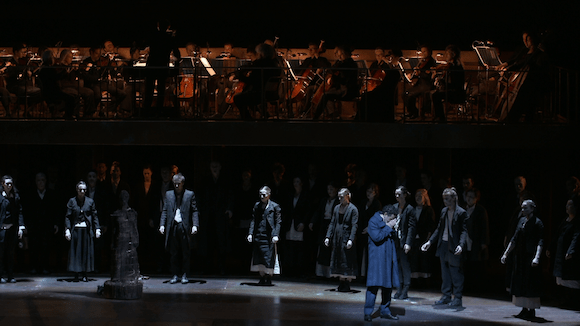
Gluck’s Orfeo/Orphée is one of those works where things get a bit complicated because an Italian and a French version wre produced and then all kinds of mash ups of the two versions.  It’s a bit like Don Carlo/Don Carlos or Guglielmo Tell/Guillaume Tell.  The original Orfeo ed Euridice, which premiered in Vienna is quite short and has Orfeo written for a castrato.  The Paris version spreads the piece out over three acts, adds both new vocal music and lots more dance music and has Orphée written for haut-contre.  Today, when people do the French version they usually cut some of the new music and use the higher Orphée music; casting either a mezzo or a counter-tenor.  This is true of both recordings  (Paris 2000 and Munich 2003) which have come my way in the past.

1.opening

Continue reading

Ossian meets Anne of Green Gables

Rossini’s La donna del Lago is based on the Walter Scott poem, itself a deliberately romantic view of Scottish history, simplified until not much is left but the rivalry for the heroine’s hand by her three suitors and a completely unexplained war between the king of Scotland and the Clan Alpine.  Dramatically it’s thin indeed but it’s Rossini so there is crazy virtuosic music and it’s very hard to cast.  One needs two mezzos; one a mistress of Rossinian coloratura, the other more dramatic, and two tenors; both of which can do the crazy high stuff.  The supporting roles aren’t easy either.  Realistically only a major house could cast this adequately.

1.anne

Continue reading

Guillaume Tell

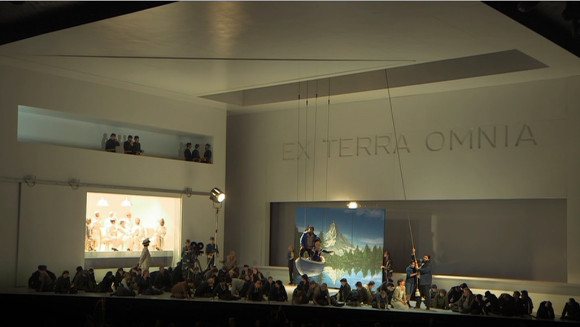
Rossini’s last opera, Guillaume Tell, was written for Paris and is an extremely ambitious piece of great musical sophistication.  It’s also very long.  Performed uncut, a rarity, it runs something like four hours including ballets.  It’s also hard to cast with the role of Arnold Melcthal in particular making unusual demands.  It’s a high tenor role combining the flexibility needs of a typical Rossini role with something much more heroic.  The soprano role of Mathilde has some of the same issues; signature Rossini coloratura is combined with the sort of dramatic heft one might more associate with early Wagner.

1.boat

Continue reading

Sher ham

Bartlett Sher’s concept for his production of Rossini’s Le Comte Ory is a theatre within a theatre setting with scruffy bewigged footmen types operating old fashioned stage machinery.  Throw in costume design that seems to cross the slutty middle ages with My Little Pony and one gets a production that would probably appeal to the average seven year old girl.  Fortunately the singing and acting is really rather fine with splendid vocal contributions from Juan Diego Flórez, Joyce DiDonato and Diana Damrau well backed up by the likes of Stéphane Degout and Susanne Resmark and it’s Maurizio Benini and the Met orchestra so no problems there either.  To be honest they are hamming it up for all its worth but that doesn’t seem unreasonable in this very silly piece.  The second act trio which features some mind boggling gender bending with the three principals swapping partners faster than Liz Taylor swapped husbands is hilarious.

1.hermit Continue reading

Cool and refined Barbiere

Emilio Sagi’s 2005 production of Il Barbiere di Siviglia is incredibly elegant and restrained. It looks like something by Robert Carsen.  The sets are all constructed and transformed in full view and just about everything is black and white until the final scene.  There is a lot of background action and commentary from a talented group of dancers who give a very Spanish feel to the piece.  The final scene bursts into vivid, even loud, colour and the finale is just gorgeous to look at. The direction of the actors is well thought out too though they do seem to sing from on top of furniture a lot of the time.

Continue reading

La Fille de Laurent Pelly

Laurent Pelly’s 2007 production of Donizetti’s La Fille du Régiment was a coproduction of the Royal Opera House, The Metropolitan Opera and the Wiener Staatsoper which one make expect to produce a stodgy snoozefest.  It’s not.  It’s a fast paced, energetic and funny production.  There’s nothing especially cleverly conceptual about it but its well designed, well directed and well played.  If one were to be hyper critical it would be that the humour in Act 2 is rather laid on with a trowel but it’s not too seriously overdone.  The setting is updated from the wars of the first Napoleon to something vaguely WW1 like.  In some ways this doesn’t make a whole lot of sense but it does provide a visual “Frenchness” that’s probably easier for modern audiences and, anyway, the libretto as originally written is about as historically accurate as the average piece of bel canto fluff.  Best not get into serious military history buff territory and get on and enjoy the show.

Continue reading