Gerry Finley’s Don Giovanni

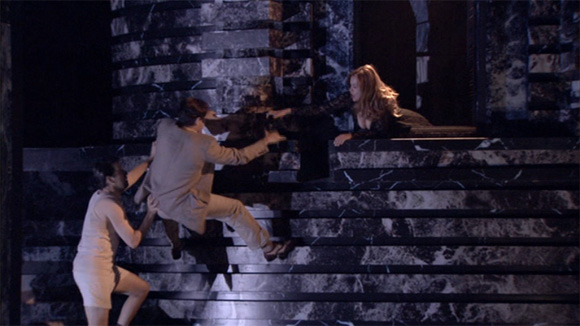
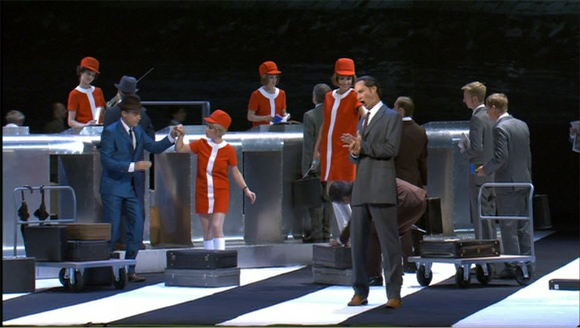
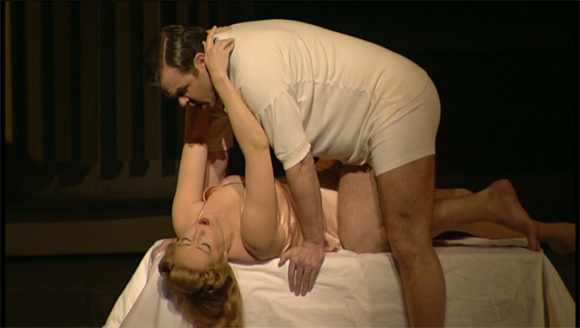
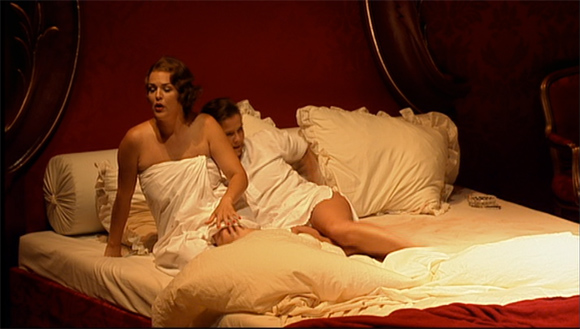
Jonathan Kent’s 2010 Glyndebourne production of Don Giovanni has a great cast and high ambitions but, ultimately, doesn’t really come off, largely because the relationships between the characters too often fall short of anything interesting.  The concept, as explained in the two short bonus segments, is that Don Giovanni is set in a society in transition and that the title character is a sort of harbinger of the new mores.  The “society in transition” chosen by Kent is a sort of hybrid of Fellini’s La Dolce Vita and the last years of Franco’s regime in Spain.  He might have done better to just pick one as the Fellini elements get pretty much reduced to the costumes and the Franco elements really don’t go anywhere.

window Continue reading

It’s the only Iphigénie in town

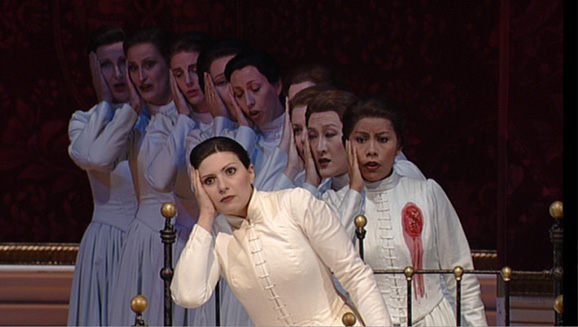
Claus Guth’s 2001 Zürich production of Gluck’s Iphigénie en Tauride is, rather surprisingly, the only video recording of the work currently available.  Fortunately it’s a very decent production much preferable to the Met’s over-stuffed overly literal version but not, I think, to be preferred over Robert Carsen’s stark and elegant version seen in Toronto, Washington and elsewhere.  The Zürich performance, led by William Christie, is very good but it’s rather let down by the video direction and the production for DVD.

Continue reading

Creepy and claustrophobic Wozzeck

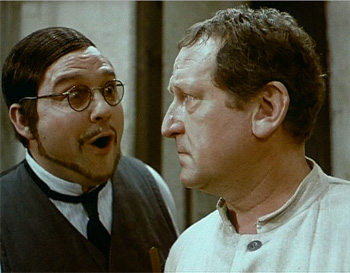
In 1970 Rolf Liebermann took the assembled forces of the Hamburg State Opera down to a castle in South Germany and made a film of Berg’s Wozzeck.  The production is pretty literal.  It’s set in Austria in the late 19th century and everything plays out very literally per the libretto but it’s far from being a routine or dull reading.  A combination of brilliant conducting, slightly over the top acting, pointing up the Expressionist elements in the music and really good cinematography make this a very tense, creepy and claustrophobic experience.  It’s simultaneously rather repellent and hard to watch and deeply engaging.  Continue reading

A gentler Lady Macbeth?

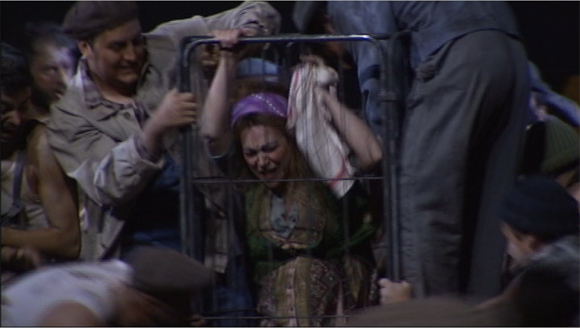
Stein Winge’s 2002 production of Shostakovich’s Lady Macbeth of the Mtsensk District at Barcelona’s Liceu is fairly straightforward in a minimalist sort of way.  The first scene establishes the tone for sets.  There’s a bed and a window and that’s about it.  The succeeding eight scenes are equally stark.  There’s an unusual, and disturbingly creepy, sexual tension between Katerina and Boris Ismailov; played here less boorishly than usual by Anatoli Kotcherga.  The three “difficult” scenes; the rape of Aksinya, the seduction and the death of Katerina are all handled pretty well.  It’s all less “in your face” than Martin Kušej’s Amsterdam production but it’s effective.  There’s also an element of “black slapstick”, especially in the scenes involving the police, that seems to fit the music rather well. Continue reading

Watching DVDs the Handel way

There’s been a bit of jokey banter in comments on posts about various Historically Informed Productions about Historically Informed Audiences.  The serious point being that we don’t watch opera in the same way the audience did in Handel’s day and, of course, we don’t perceive it in the same way.  There’s nothing one can do about the perception but it did occur to me that the way I watch DVDs is, in some ways, more like Handel’s audience than the way I watch/listen when I am at a live performance.  This struck me yesterday as I was watching a rather good production from Zürich of Handel’s Orlando.  I’ll be writing more about that later.  Continue reading

Chill out dude

The problem with reviewing Doris Dörrie’s 2002 Berlin production of Così fan tutte is that pretty much everything that can be said about it already has been.  It’s like trying to write about Willy Decker’s “red dress” Traviata.  So I’ll try and be brief and to the point.  On the surface the idea is a bit outlandish.  Mozart and da Ponte’s satire about sexual fidelity is updated to the 1970s though to me, who grew up in the 70s, it seems much more like the 60s.  That said, it works.  It’s lively, funny, musically top notch and the presentation on DVD is very decent.

Continue reading

Almost ideal Idomeneo

The 2006 Salzburg production of Idomeneo seems to me to be just about ideal.  The production is clean and consistently interesting without ever getting too far away from the core story and the pretty much unbeatable cast is backed up by the period sensibilities of Roger Norrington and the Salzburg Camerata and Bachchor.  The only fly in the ointment is the utterly heinous video direction.

Continue reading

Boulevard Solitude

My DVD of Hans Werner Henze’s Boulevard Solitude arrived the day before his death at the weekend and so went straight to the top of the reviewing pile.   It’s an intriguing piece.  It’s based on the same Abbé Prevost novel as all the other versions of Manon but updated to the period of composition (1952) and told from the viewpoint of des Grieux rather than Manon.  In this version des Grieux picks Manon up at a railway station while she is on her way to finishing school in Lausanne.  They run away to Paris but des Grieux is broke and Manon’s brother pimps her to a rich old man, Lilaque.  The brother robs the old man’s house which gets them both kicked out.  Manon has a brief fling with des Grieux before her brother pimps her out again; this time to Lilaque’s son.  By this time des Grieux has a pretty serious cocaine problem.  The cocaine, naturally, is supplied by Lescaut.  Lescaut is in the process of stealing a painting from Lilaque fils when Lilaque père shows up.  Lescaut hands Manon a gun and she kills the old man.  In the last scene we are back at the railway station where a disconsolate des Grieux waits for one last glance at Manon as she is taken to prison.

Continue reading

Rosenkavalier on the brink

Robert Carsen’s 2004 production of Der Rosenkavalier at the Salzburg Festival was apparently enormously controversial at the time.  In many ways that says more about the iconic status of the piece in Salzburg tradition than about Carsen’s production.  There are a few controversial elements.  He has updated the period to 1914 and the third act is set in a brothel with a fair amount of nudity.  Beyond that, the production is pretty faithful to the libretto and has, I think characteristic Carsen touches like long lines of tables and chairs and a certain geometric elegance.  He seems to be using the sides of the stage to comment on the action which tends to be fixed centre stage.  I say seems because the video direction (by Brian Large) is utterly perverse and makes it extraordinarily difficult to see what Carsen is doing, let alone decode it.  We see the whole stage, maybe, for three seconds in the whole piece.  Otherwise 99% of what we get is either close up and even closer up or apparently shot from the restricted view seats high up and close to the side of the stage.  The other 1% is just plain nuts and includes a section of the Sophie/Octavian duet in Act 2 where, on stage, Octavian is maybe twenty feet to Sophie’s right but on camera he’s standing right up close on her left hand side.  I could go on but I won’t.  Suffice it to say the video direction comes close to wrecking an otherwise excellent DVD.

Continue reading

Picture quality – DVD vs. Blu-ray

As regular readers know posts on this blog frequently feature screen caps from the DVD or Blu-ray disk reviewed.  In the process of garnering the screen shots I have found out one or two interesting things about the picture quality of the originating disk.  Using vlc to play disks gives a window the size of the image in pixels.  (I use vlc because for some reason screen caps from DVDPlayer come out blank.)  Older opera DVDs have a picture that is nominally 720 pixels wide giving a 720×540 window for 4:3 pictures.  In practice there are often black bars at the side of screen reducing this a little and sometimes older TV derived material isn’t even really up to even that quality so this really represents an upper bound on the amount of information available.  More recent 16:9 DVDs tend to be a bit more information rich; 830×468 pixels seems quite common and some HD derived material checks in at around 850×480.  It does mean though that very few operas will fit on a single DVD9 disk.  Continue reading