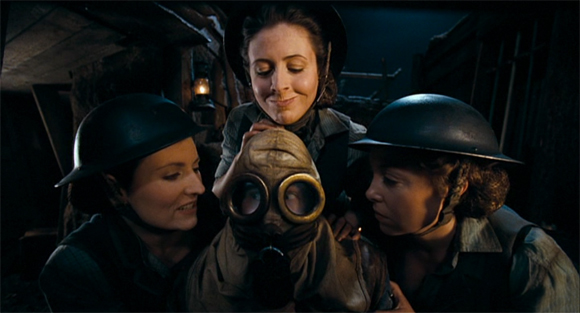
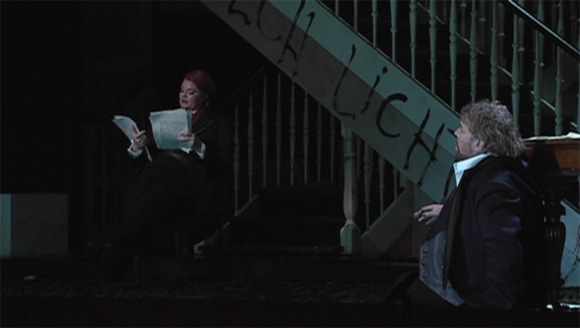
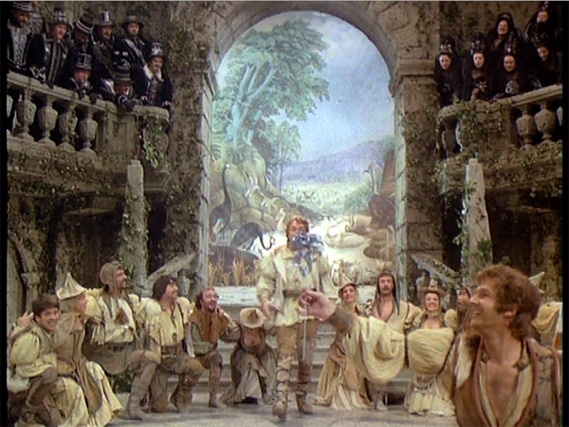
Various thoughts about the Channel 4 film of Britten’s Owen Wingrave led to me seeking out the original BBC TV version from 1970, now available on DVD. It’s extremely interesting and worthwhile. Britten himself conducts and the cast includes many of the people involved in the first productions of many other Britten operas. They include Peter Pears (General Wingrave/Narrator), John Shirley-Quirk (Coyle), Benjamin Luxon (Owen), Janet Baker (Kate), Heather Harper Mrs.Coyle) and Jennifer Vyvyan (Mrs. Julian). The quality of the music making is superb and I found myself constantly surprised and delighted by details brought out by Britten supported by the excellent English Chamber Orchestra. At the same time, the fluent and idiomatic singing pointed up the excellence of Myfanwy Piper’s libretto. This really is Britten at his best.
Tag Archives: dvd
The Copenhagen Ring – Siegfried
So, onto Siegfried. Now we are in 1968 but it’s a rather laid back Danish 1968. It doesn’t reference any of the canonical events of that momentous year though there is a bit of a youth vs experience vibe. Holten doesn’t let us forget that Siegfried is 18 and Stig Anderson, at 60, manages to pull off the look very well. James Johnson’s Wotan, on the other hand, is shown in decline; the elder statesman who can’t retire gracefully, like a Berlusconi or Murdoch. Mime is an ageing nobody hunched over his typewriter and still yearning for some “success”.
Musically satisfying Tristan from La Scala
I’ve been looking really hard for a video recording of Tristan und Isolde that I felt I could recommend because, frankly, nothing is worse than a badly executed Tristan as those who suffered through the Met HD broadcast a few years ago will know. In the 2007 La Scala recording I have found one I feel confident about. Is it perfect? No. A perfect Tristan is probably beyond mere mortals. I’m never sure whether I find it more astonishing that anyone can sing this music or that a composer might have imagined that he could find people who could. That said, the La Scala recording is very close to an ideal Gesamtkunstwerk.
Branagh’s Flute
It’s beginning to look like Keneth Branagh’s 2006 film of The Magic Flute will never be shown in Canadian cinemas and so, when I saw it on amazon.ca for $7.24 I couldn’t resist. Perhaps I should have.
Subtitles
Pretty much all opera video recordings have sub-titles. Some, usually older, recordings just have hard coded English subs but most have selectable subs in half a dozen or so languages. They almost always include English French and German but the others seem to be pretty much a crap shoot. Does anyone, maybe who works in the business, know how they are chosen? Italian and Spanish are quite common. Usually the native language of the house in which the recording is made features and so I have recordings with Danish, Dutch, Catalan and Flemish subs though my Helsinki L’Amour de Loin lacks Finnish and there’s no Norwegian on my Oslo La Bohème. Even more oddly there’s no Italian on the La Scala Peter Grimes even though the text within the DVD is all in Italian. Asian languages are totally random though Chinese, Korean and Japanese all show up from time to time. Enquiring minds want to know.
Elegant and Powerful Ulisse
Monteverdi’s Il ritorno d’Ulisse in patria hasn’t proved as popular as his other late work L’incoronazione di Poppea but, given as compelling a performance as it got at the Teatro Real, it’s a bit hard to see why that is. On this 2007 recording we have an elegant and interesting production by Pier Luigi Pizzi, an excellent cast headed by Kobie van Rensburg and Christine Rice and the incomparable William Christie and his Les Arts Florissants. It’s a compelling package.
From the House of the Dead
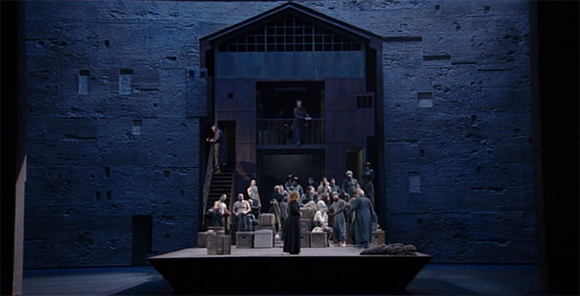
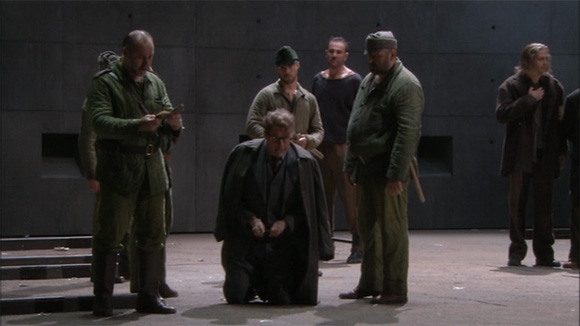
Janáček’s last opera, From the House of the Dead, is a curious piece. It sets certain episodes from Dostoevsky’s account of his life in prison into a collage of stories that doesn’t have a straightforward narrative arc at all. It’s quite brutal, as one might expect, and very male dominated. Few characters stand out as individuals and so the piece becomes very much an exercise in ensemble musical theatre. The music is unusual too. In Pierre Boulez’ words it is “primitive”. Certain phrases are repeated over and over with minimal development to create a sort of “expressionist minimalism”. It’s extremely interesting to listen to and a great sonic match for the brutal and repetitive nature of prison camp life.
Perplexing Tannhäuser
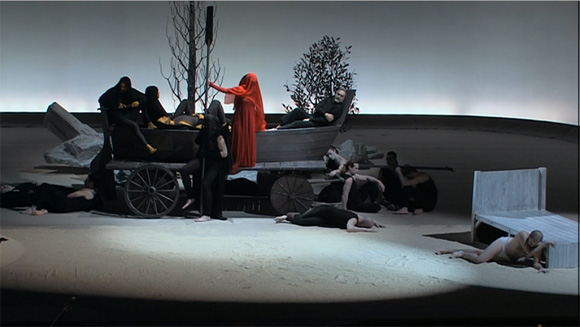
In Kasper Holten’s production, recorded at Royal Danish Opera in 2009, Tannhäuser is a poet torn between family and the conventional world of the Landgraf’s court and his creative processes symbolized by Venus and Venusberg. There are numerous visual clues that perhaps we are even supposed to identify Tannhäuser with Wagner himself. Far from being a young man, this Tannhäuser is middle aged, married to Eizabeth and has a son. He has withdrawn into a psychological world of his own and Venus, his muse, and Venusberg are in his imagination. Only after death is he recognized as a genius. Of the rest, how much is supposed to be external and how much internal to Tannhäuser’s imagination is a bit hard to grasp. If nothing else it goes some way to making the sixty year old Stig Andersen as Tannhäuser and the equally mature Susanne Resmark as Venus almost believable. The 1900ish setting works quite well for the sexually repressed court of the Landgraf von Thüringen though a chorus of pilgrims returning from Rome in full evening dress is a bit of a jar. The concept is quite interesting but really probably stretches further than the libretto can accommodate. This Venus isn’t remotely credible as a goddess of love and the matronly Elisabeth singing about being a pure, young maiden is just odd.
In which Dido doesn’t die
Oddly enough, given the post previous to this, Reiner Moritz’s essay in the booklet accompanying this recording of Cavalli’s La Didone brings up the Harnoncourt/Ponelle Monteverdi recordings as a precursor to what he sees as Bill Christie’s similar championing of Cavalli. I guess the big difference is that only three of Monteverdi’s operas survive while we have 27 of Cavalli’s. I think he may have a point though. It seems to me that 17th century Italian opera works on an aesthetic which is very in tune with today. The relative spareness and clarity of the music seems closer to Britten than to Verdi and the cynicism and explicit sexuality of the libretti closer to Anna Nicole than La Bohème.
Back to the beginning
Monteverdi’s L’Orfeo is one of the few 17th works still in the canonical opera repertoire though little performed before the “early music revival”. So it was quite a bold step when the Opernhaus Zürich in the 1970s staged all three extant Monteverdi operas in productions by J-P ponelle and with Nikolaus Harnoncourt leading an orchestra of period instruments. All three productions were subsequently made into lip-synched films and have been re-released on DVD by Deutsche Grammophon as a boxed set.