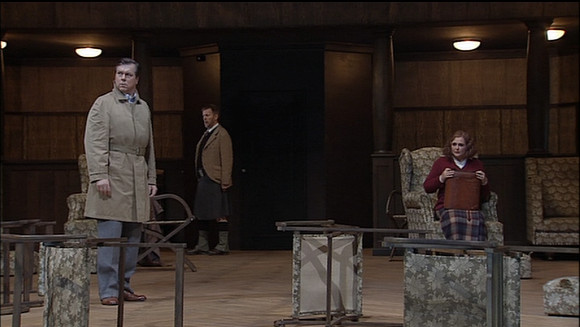
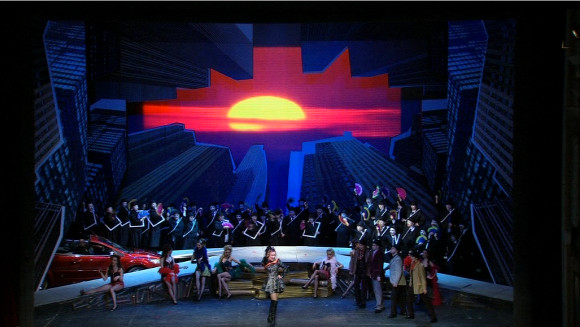
Death in Venice is a curious opera. Based on a Thomas Mann novella, it concerns the aging writer Gustav von Aschenbch and his meditations on aging and art, as well as his obsession with a Polish boy encountered at his Venice hotel. Very little actually happens. Aschenbach has a series of encounters with quotidien characters such as the hotel manager and a hairdresser but mostly he observes and what we hear are a series of inner monologues. To work as theatre Aschenbach must capture our interest and our sympathy. If he doesn’t the piece can be incredibly boring and irritating.
Tag Archives: dvd
Curiously aloof Tristan
Christoph Marthaler’s 2009 Bayreuth production of Tristan und Isolde is set in a sort of Stalinist brutalist aesthetic populated with stock figures from the 1950s. Passion is at a minimum and the characters all seem to be trying as hard as possible to be conventional representatives of their roles. The only one who shows any real human engagement is Kurwenal who comes across almost as a commentator on the action, or even a director. There’s also some fairly stylized gesturing in a sort of pseudo-Sellars manner. It’s epitomised by the costumes in Act 2 where Isolde and Brangäne look like dolls dressed as Hausfraus and Tristan wears a hideous blue blazer. This is all rather reinforced by Michael Beyer’s video direction which uses a lot of close ups but also has a curious stillness about it that seems to amplify the emotional void; if indeed one can amplify a void. Oddly though, in places this approach really works in that the distance, coupled with very precise blocking, gives space for the music’s essential intensity to come through. Act 2 Scene 2, perhaps the emotional crux of the piece, is very moving and the So stürben wir, um ungetrennt is quite impressive.
In the summer of seventeen hundred and ninety seven
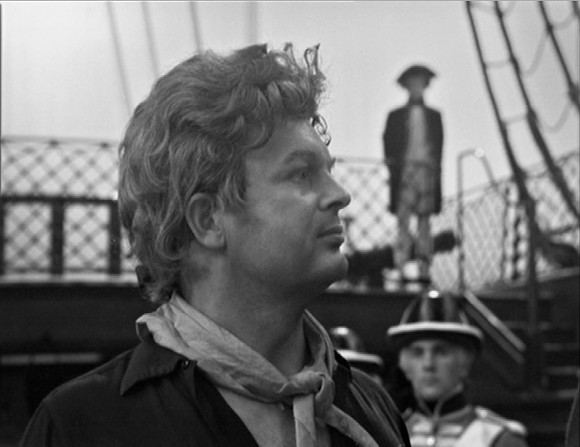
Billy Budd is the second of Britten’s large scale operas. Originally envisaged as a four act piece with prologue and epilogue it was later reorganised into two acts and that’s the version the BBC recorded and broadcast in 1966. That broadcast has now been released on DVD. Technically it shows it’s age. The picture is 4:3 black and white though there’s a remastered, and very decent, LPCM mono sound track. There’s also an enhanced Dolby mono track. The video too has been restored and looks pretty decent.
Cecilia and Bryn
Cecilia and Bryn at Glyndebourne is the DVD recording of a concert from 1999 featuring two of those singers who prove you don’t have to be dead skinny to be a great singer and have a commanding stage presence. It’s great fun, focussing on the lighter end of the repertoire for the most part. It’s mostly Mozart with some Rossini, Donizetti, Haydn and Handel thrown in. There are a couple of overtures and a few arias but the greatest pleasure comes in the duets. For the second time in a week I got to see Lá ci darem la mano sung by singers of extremely contrasting heights and where else is one going to see Mr. Terfel and Ms. Bartoli sing the Pa-pa-pa-pa duet from Die Zauberflöte. As ever Ceci’s coloratura is a thing of wonder and Bryn is no slouch. The accompaniment is ably provided by Myung-Whun Chung and the London Philharmonic. It’s the perfect antidote to a week of watching Wozzeck.
La voix humaine
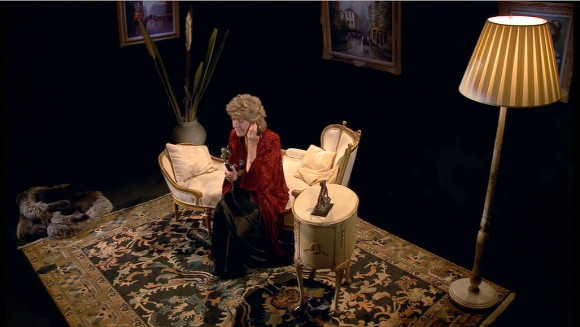
Poulenc’s La voix humaine is as a rather peculiar little piece. It’s only 40 minutes long and it features a single singer, a soprano. It’s not exactly a monologue as what we hear is one end of a telephone conversation with implied contributions from the woman’s lover, the telephone operator, the lover’s manservant etc. A lot of what happens is an artefact of the French telephone system at the time (1928) that Cocteau wrote the play that supplies the libretto with operators, party lines, dropped calls etc.
Continue reading
The three countertenors
Handel’s Giulio Cesare presents an interesting casting challenge. The piece has four high voiced male roles; Cesare, Nireno, Tolomeo and Sesto. The original production featured three castrati and a soprano en travesti. I have never seen Sesto cast as other than a trouser role and Nireno and Tolomeo are invariably sung by countertenors. Cesare himself though seems mostly to go to low mezzo/contralto types. Indeed it’s seen, I think, as something of a “plum” trouser role. (Which is interesting as in the production that i will get to describing in a minute, Cesare wears plum trousers). I’ve seen both Ewa Podleś and Sarah Connolly in the role. For their 2005 production Royal Danish Opera cast Andreas Scholl as Cesare. It’s a good choice. He’s a masculine looking and sounding counter tenor and at least he is taller than his Cleopatra. It also makes for an interesting set of countertenors. Tolomeo is sung by the much less masculine Christopher Robson and Nireno by the “more a male soprano than a countertenor” Michael Maniaci. Sesto goes, conventionally enough, to Tuva Semmingsen, who seems very much to specialize in these types of role. Apart from the countertenors the piece was cast from the considerable resources of the RDO ensemble with Inger Dam-Jensen as Cleopatra, Randi Stene as Cornelia, John Lundgren as Curio and Palle Knudsen as Achilla.
300
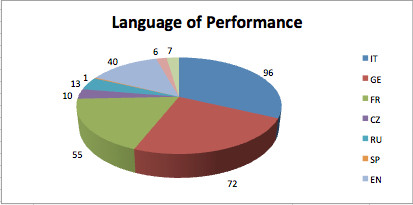
There are now 300 reviews of Blu-ray and DVD recordings in the database. (70 Blu-ray, the balance DVD) As I did at 200 I took a look at how they break out. I’ve pretty much exhausted the opera dvd resources of the Toronto public library system so recent and future reviews are more likely to be of things I’ve chosen to spend money on, bar the odd review copy from record companies.
The first thing I looked at was language of performance. It’s no surprise that Italian (96) and German (72) dominate the list. French is a strong third at 55. English comes in at 40, almost all 20th and 21st century works. Other (7) is quite interesting as it mostly reflects works in multiple languages such as Tan Dun’s Marco Polo. “Other” is very much a modern category. Continue reading
Fan – tastic
It was during the recent run of Cosí fan tutte at the COC that I realised that I really needed to get my hands on the M22 recording (Salzburg 2006). Specifically it was discussing the Salzburg reading of Ursel and Karl-Ernst Herrmann with Thomas Allen and Rachel Andrist; who is the on stage continuo player in the Salzburg recording. It sounded like there might be interesting parallels. And parallels there are. In both cases the girls are aware of the “plot” (in every sense). In both cases four attractive young singers have been cast as the lovers and Don Alfonso and Despina made much older and more cynical. There I think the parallels end. Egoyan’s vision is essentially a positive one about relationships. The Herrmans, I think, are more interested in exploring the psychologically destructive power of love and desire.
How can peace come from so much pain?
Making a film of an opera rather than filming an opera involves interesting choices and one of the strengths of the DVD of Penny Woolcock’s film of John Adams’ and Alice Goodman’s The Death of Klinghoffer is that includes 47 minutes of Woolcock, Adams and others discussing just how one takes a rather abstractly staged opera (the original staging was, inevitably, by Peter Sellars) and turn it into an essentially naturalistic film. Of course, naturalism will only go so far with opera but this goes a long way in that direction. The soloists are filmed mainly on location and they sing to the camera. The choruses, mainly backed by documentary footage, and the orchestra were recorded in the studio but the actors sing ‘live’. The one concession to “being operatic” is having a mezzo voice one of the Palestinians though he is played by a male actor.
Looks better than it sounds
Massenet’s Don Quichotte is one of those works where one does a double take on learning when it was composed. It dates from 1910 but sounds like it was composed at least 50 years earlier. It’s lushly romantic and dressed up with elements of flamenco but to nothing like as good effect as in de Falla’s La vida breve. There’s also plenty of schmaltz. The intro to Act 5, for example, being highly reminiscent of the Meditation in Thaïs. The plot’s pretty thin too. Don Quixote loves the unattainable Dulcinea. He goes off and encounters some bandits who eventually take pity on him and rather than killing him give him Dulcinea’s necklace, which they have stolen. He returns it to her. She is grateful but still not interested in marrying him. He dies. Great!