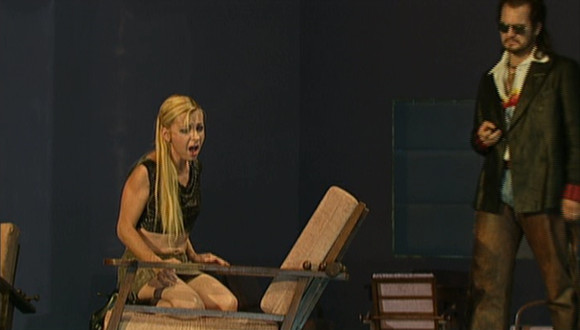
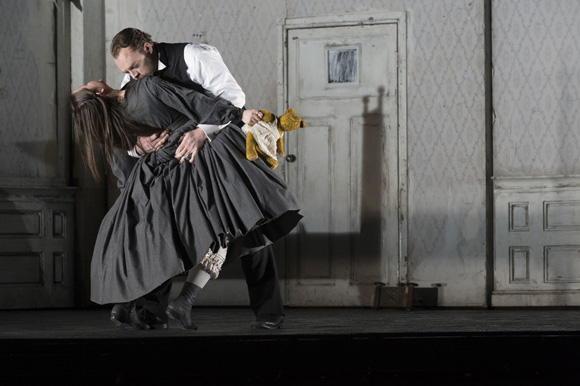
Le miracle d’une voix is a compilation of scenes from various recordings in which Natalie Dessay featured made between 1993 and 2003. It’s especially interesting in that a couple of pieces feature more than once. There are three Les oiseaux dans les charmilles; Olymia’s aria from Les contes d’Hoffmann and two Grossmächtigen Prinzessin from Ariadne auf Naxos. Thrse demonstarte what I have always believed to be Dessay’s greatest strength; her ability to recreate a character to fit in a particular production. The two Zerbunetta arias illustrate this perfectly. In the first, a Salzburg production from 2001, Zerbinetta is a depressed, heavy drinking, prostitute who celebrates a kind of deeply sad sisterhood with Ariadne before being dragged off by a very sleazy Russell Braun. In the second, from the Palais Garnier in 2003, she’s a bubble headed tourist in bikini and wrap who pesters poor Ariadne all around what looks like a Mediterranean building site. They are completely different characterisations but both highly effective. The same is true of the three Olympias who range from very conventional doll to inmate in some sort of asylum or home.
Tag Archives: donizetti
Routine Don Pasquale
Once in a while one comes across an opera DVD that’s so “ordinary” that it’s extremely difficult to write about it. The 2002 Cagliari recording of Donizetti’s Don Pasquale is one such. Stefano Vizioli’s production is set in 1750s Rome and plays the piece about as straight as a madcap comedy can be played. The singing is rather good and, if the acting is a bit Brian Rix farce that’s hardly inappropriate. At the heart of the piece is Alessandro Corbelli who must be close to being the ideal Pasquale. He gets good support from Eva Mei as Norina and Antonino Siragusa as Ernesto. Roberto de Candia is also quite good as Malatesta but he’s not Mariusz Kwiecien. The chorus is a lot livelier than the average Italian chorus and the orchestra, from Bologna, might be a bit thin on string tone but isn’t bad at all and Gérard Korsten’s conducting is perfectly OK.
Revisiting Devereux
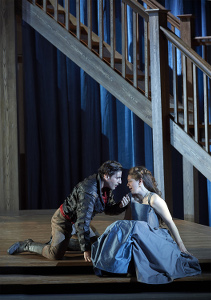
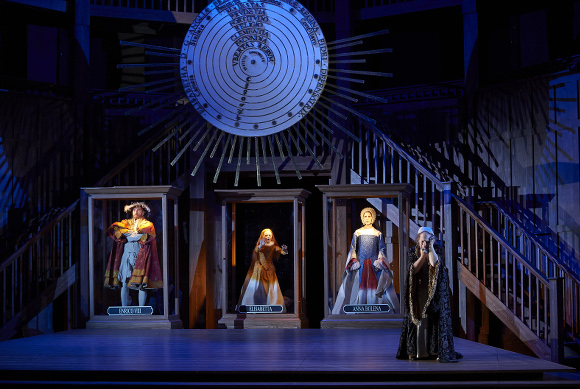
I went back for a second look at Roberto Devereux at the COC last night. My original impressions pretty much stand but this time I remembered my opera glasses and was able to focus more on some of the details of this quite intricate production. I do still struggle a bit with the music. There’s this jaunty little tune (doo de doo doo doo doo dooo) that crops up all the time and often at the least emotionally appropriate moments and there’s the interminable overture and thank goodness for Lawless’ allegorical prelude because listening to it in front of a closed curtain would have been intolerable. Still, the drama was pretty intense and Sondra Radvanovsky has, if anything, grown into the role. The last scene, portraying the dying queen’s emotional disintegration is worth the price of admission. I also got more of a sense of Russell Braun and Allyson McHardy being in role and having developed some chemistry that was a bit absent on opening night.
There are four more peerformances between now and May 21st with Giuseppe Filianoti now replacing the excellent Leonardo Capalbo in the title role.
Photo credit – Michael Cooper
Shakespeare vs. Donizetti
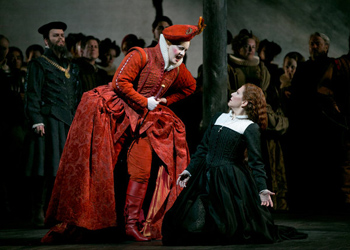
Stephen Lawless’ production of Donizetti’s Roberto Devereux opened last night at the Four Seasons Centre. It’s the last of the so called “Tudor Trilogy” and deals, ostensibly, with the last days of the reign of Elizabeth I. Events are loosely based on history. In this case the queen’s relationship with Robert Devereux, earl of Essex; his failure in Ireland, fall from grace, rebellion and execution for treason(1). Here the drama is turned into a simple story of royal jealousy featuring two fictional characters; The duke of Nottingham, Devereux’ bestie, and his wife Sara, confidante of the queen and in love with Devereux. It’s probably best seen as a logical continuation of the anti Tudor theme of the previous operas. There’s a bombastic, lustful monarch more concerned with his/her love life than affairs of state and there’s a scheming arch-Protestant minister responsible for the death of someone who doesn’t deserve for it for reasons of state (here the younger Cecil). The trouble here is that there is no obvious martyr. However one looks at it Devereux, brings about his own downfall.
Bel Canto bliss
It’s one of the nicer things about Toronto that from time to time a visiting star at the COC will agree to do a free lunchtime recital in the Richard Bradshaw Amphitheatre. Today was the turn of American coloratura Anna Christy who is currently singing the title role in Lucia di Lammermoor. It was an exceptionally fun sixty minutes.
I was a little worried when she and accompanist Liz Upchurch just took their places and started. I need not have been. We got a set of three bel canto art songs that were full of virtuosity and personality. The sheer technical skill was obvious but so was the range of tone colour. Those doomandgloomists who think modern singers can’t act with the voice should listen to Ms. Christy. It’s all there. After that opening she did open up and explain the middle part of her set; pieces by Bolcom and Copland that she sees as natural successors to bel canto. Sung with exquisite attention to the texts one can see her point. She was also very funny and very human. I do like modern divas so much more than the one’s who get in a snit because the caviar isn’t the right temperature.
She finished up with arias by Rossini, Handel and Donizetti, all sung stylishly and with tasteful ornamentation. It was really classy. And to round things out her parents were there and it was her dad’s seventieth and there are no prizes for guessing how things finished up.
Paedophilia di Lammermoor
David Alden chooses to set his production of Donizetti’s Lucia di Lammermoor, currently playing at Canadian Opera, in Victorian Scotland in a rather decayed country house. It’s all set up as classic Gothic schtick. The angle is that Lucia herself is very young and is being sexually abused by her brother Enrico. OK, I don’t have a problem with that. It’s a better solution than the idea that women are all just inherently unstable and liable to go from shrinking violet to shrieking murderess at the drop of a forged letter. So, it’s an interesting idea but it poses real problems about the nature of her relationship with her “fiance” Edgardo. If he’s the hero of this thing what is he doing having a clandestine relationship with a girl who’s not yet out of the schoolroom? (We can tell this by how she’s dressed). This is a major Victorian taboo. Respectable men don’t go after girls until they are “out”. Are we then to see Edgardo as as a big a cad as Enrico? Maybe. The trouble with that concept is then why do we care what happens to him? Edgardo kills himself. Goodbye paedophile creep. So what! So bottom line, I can take the groping and the creepiness that some critics have complained about but I wonder what Alden is really trying to tell us about the piece.
More Tudor queens
Today’s MetHD broadcast of Donizetti’s Maria Stuarda was a bit of a mixed bag. There were some really good performances. Joyce DiDonato in particular gave what may well have been a truly great performance and I would have loved to have seen it live. David McVicar’s production was much better than his Anna Bolena; visually interesting and with some strong dramatic ideas. However the good was pretty seriously undermined by another really awful piece of video directing by Gary Halvorson. I guessed it was him after about ten minutes. The incessant use of the nose cam and the incredibly irritating low level tracking shots were a dead give away. It was a big disappointment since the last two shows I saw, La Clemenza di Tito and Les Troyens, were filmed by Barbara Willis-Sweete and had given me some faint hope that the Met was capable of self analysis and improvement in this area. Hope that was, alas, sadly dashed today.
The silliest opera ever?
Even by the standards of bel canto comedies Donizetti’s Le convenienze ed inconvenienze teatrali is insubstantial fluff. It’s basically a farce about a no hope opera troupe failing miserably to rehearse an opera in the face of prima donnaish Prima Donna, her overprotective husband, a flaky German tenor and the overbearing mother of the Seconda Donna (played by a man, natch). Half of the jokes turn on cast members singing badly and the rest on standard opera clichés. None of them are particularly funny. The music is a bit non descript too. The best bits are when the Prima Donna and the tenor inexplicably decide to sing Rossini and Mozart in the middle of a rehearsal.
Babes in bodices
After a less than satisfactory introduction to Donizetti’s Anna Bolena in a MetHD broadcast last year it was with some trepidation that I approached the DVD version recorded at the Wiener Staatsoper and also starring Anna Netrebko. I need not have worried because it’s very good indeed. It has a stronger cast, Eric Genovese’s relatively simple production trumps David McVicar’s overstuffed effort and Evelino Pido doesn’t try and make the orchestra sound like it’s playing Wagner. The sound on the DVD is also way better than it was on that broadcast.
War in opera
As November 11th comes around for the 94th time since the guns were, very temporarily, silenced I thought it might be interesting to look at how war has been seen by librettists and composers over the years. Very early on we get a very gritty take on the subject in Monteverdi’s extremely compact Il combattimento di Tancredi e Clorinda but not so long after the path for the next three centuries is set with Purcell’s broadly comic King Arthur. As far as I can see from Purcell to 1945, with very minor exceptions, the message is largely “war is fun”. War is an excuse for a big parade (Aida; unless Tim Albery is directing!), an excuse for a drinking song (Faust), just plain comedic (La Fille du Regiment), a plot device (Cosí fan tutte) or a background event (Tosca, various versions of the Armida story). The only opera, pre 1945, that I can think of that deals with the horror of war is Les Troyens, and that of course takes place in a distant, mythical, past.