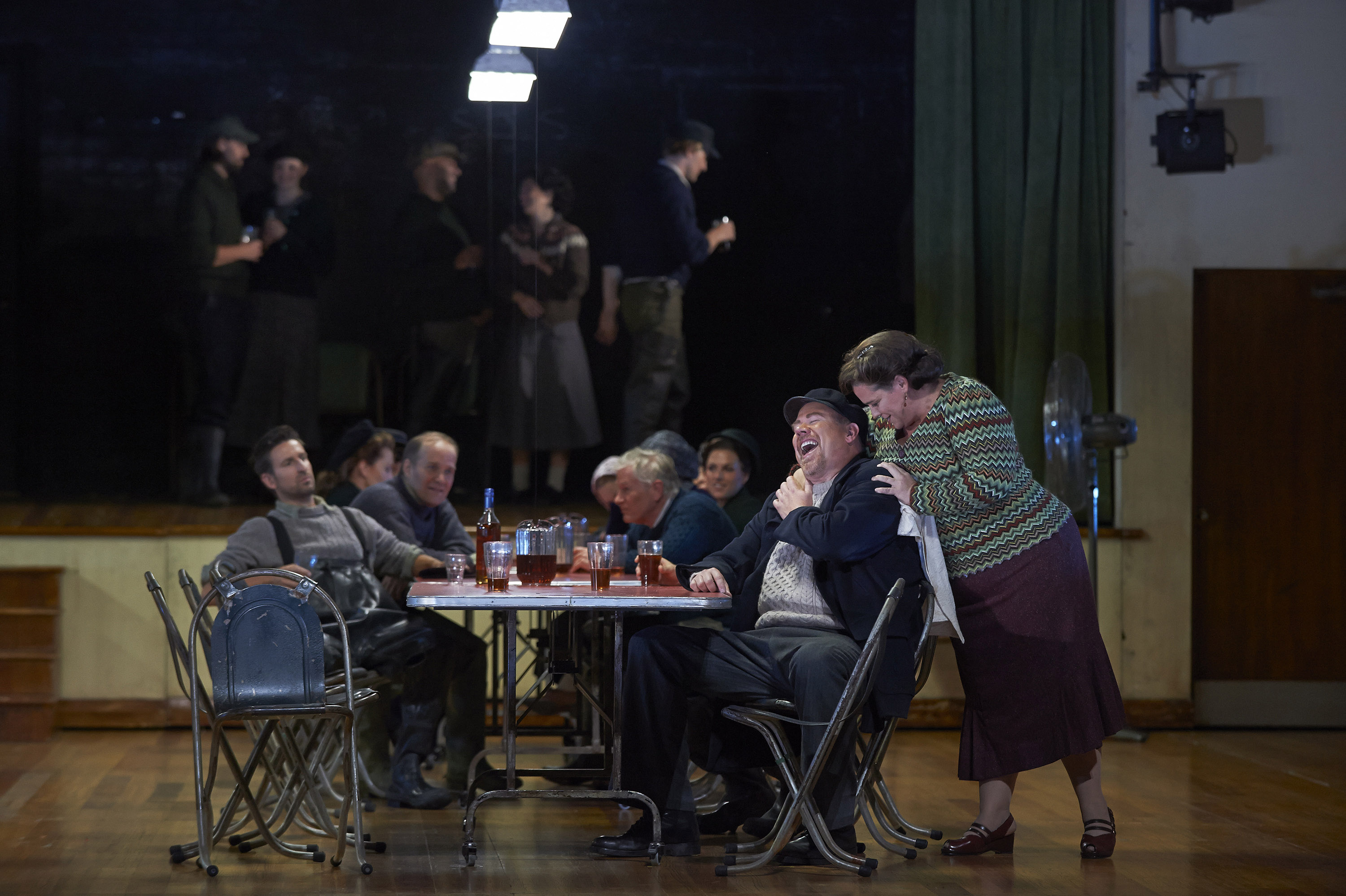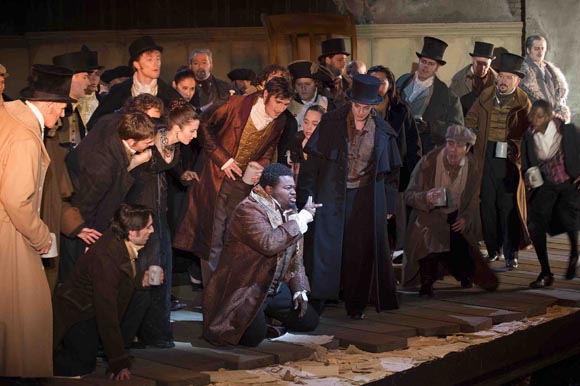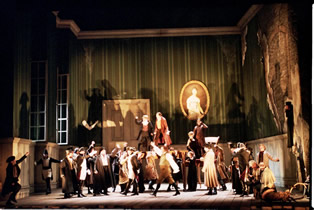
Readers of this blog will likely know that Peter Grimes is a very special opera for me. I’ve watched it live and on recordings a lot. I think about it a lot troo so the chance to see it live is rather special. It’s even more special when it’s done as well as at the Four Seasons Centre last night in the opening performance of a new run of Neil Armfield’s much travelled production, revived here by Denni Sayers.
Tag Archives: debus
Searing Carmélites from COC
Poulenc’s Dialogues des Carmélites is a strange and compelling piece. Dramatically it is very “slow burn” with a narrative arc that builds over almost two hours to a final scene of searing intensity. Without that final scene the piece would have no reason but it justifies all and only one “fit for treasons, stratagems, and spoils” could possibly leave the theatre unmoved. It’s not just moving, done well it’s emotionally devastating. And that’s the state I left the Four Seasons Centre in last night after a near perfect performance of Robert Carsen’s extraordinary production.
Cinematic Salome
It comes as no surprise that an opera by Atom Egoyan comes across as somewhat cinematic but it’s hard not to use the term of his production of Richard Strauss’ Salome at Canadian Opera Company. It’s quite a spare production. There’s a raked stage; the raised end providing a sort of dungeon for Jochanaan and the back and side walls used for projections, especially of a giant mouth prophesying (shades of Big Brother here) and shadow puppets. Costumes are simple and in shades of red, white and green. The concept is based on the idea that Salome is a very young girl who has a history of sexual abuse at the hands of Herod that explains her “monstrousness”. It’s most vividly explored during the dance of the seven veils where Salome rises above the stage on a swing and her robes form a scrim on which a video is projected. It starts with a very young girl in a garden and gets progressively darker until it finishes up with today’s Salome being raped by her stepfather’s entourage. Fittingly, the opera ends with Herod himself strangling Salome, perhaps more to silence her than out of disgust.
Highest, purest joy
After seeing Peter Sellars on Monday night I decided that (a) I had to see Ben Heppner as Tristan and (b) I couldn’t wait until next Friday when I have tickets to see Michael Baba in the role. So, I skipped out of the office yesterday morning and with a little help (thanks Sergey!) scored a standing room ticket for last night’s opening. (At $12 for nearly five hours music this was a remarkable bargain!). I’m back at my desk on five hours sleep and I’m still in shock. This will go down in legend.
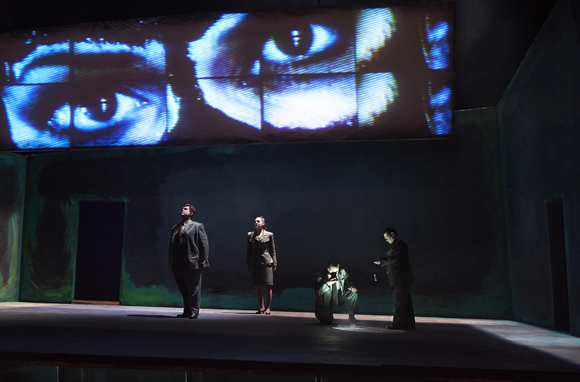
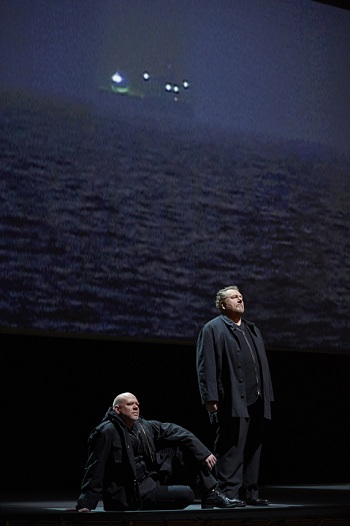
I’d only seen Tristan und Isolde once before, in a disastrous MetHD broadcast, which had been so irritating that the music left little impression. Other times I’d attempted it on DVD I couldn’t get past the nothinghappensness of it. Last night I finally got it. In Sellars’ production not much happens on stage. The singers, in non descript monochrome outfits, come and go or stand around in square light spots. They gesture in characteristically Sellarian fashion but it’s almost classic “park and bark”. But, and it’s a huge but, behind them there is a giant screen on which videos by Bill Viola play more or less continuously and through them he evokes time and place and we see the inner journeys of the characters. It’s really hard to describe but it works brilliantly. To counterpoint the long meditative sections, when there is action it often happens off stage. The chorus sing off stage from various parts of the house and characters, too, appear on the orchestra apron or high up in the Rings. These action moments are often accompanied by lighting that encompasses the auditorium and implicates us in the action (but not the dark inner journey of Tristan and Isolde). It’s great. (1)
All change!
The COC announced a bunch of line up changes for the upcoming winter and spring runs this morning.
- Johannes Debus replaces Jiří Bělohlávek, who has health issues, as conductor for Tristan und Isolde.
- Daniel Cohen will conduct La clemenza di Tito instaead of Debus.
- Michael Baba replaces Burkhard Fritz as the ‘B’ cast Tristan.
- Hanna Schwarz replaces Julia Juon as Herodias in Salome.
No reasons were given for the withdrawals of Fritz and Juon.
In the news
The good news this week is that Canadian Opera Company have extended the contract of Music Director Johannes Debus through 2017. This follows the announcement of a contract extension for General Director Alexander Neef. So, not only does COC get to keep a very good conductor who is well liked by the orchestra but it keeps the Neef/Debus team together for at least another five years. Neef and Debus seem to work together extremely well so this bodes well for a continuation of the combination of varied repertoire, interesting productions and starry casts that we have seen recently at the Four Seasons Centre. Continue reading
COC’s Fledermaus succeeds on several levels
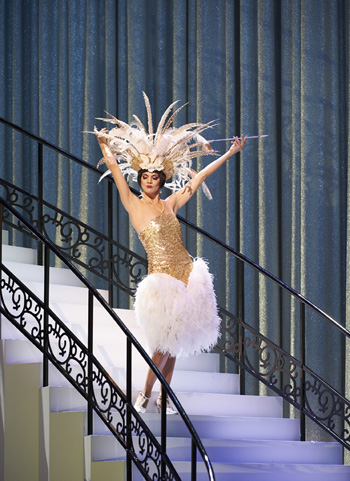
Christopher Alden’s recent productions in Toronto; Rigoletto and Der Fliegender Holländer, were controversial, rather cerebral affairs that delighted his fans but tended to puzzle, and even infuriate, the more conservative critics and opera goers. His Die Fledermaus, which opened last night at the Four Seasons Centre, has something for everybody. There are two main threads uniting the three acts. The first is the piece as an allegory of Austrian bourgeois society from an insecure pre WW1 period through a period of unbridled hedonism in the 1920s to the beginnings of Fascism. The second is a much more explicit depiction of Falke as the ringmaster of the whole circus. He goes from manipulative Freudian psychiatrist in Act 1 to Orlofsky’s confidante in Act 2 to, bat costumed, sitting astride the giant watch that hangs above the stage; the only character aloof from the takeover of the drama by the sinisterly Fascistic Frosch. All this is strung together by prefiguring later elements in earlier scenes. In Act 1 the party goers from Act 2 invade the scene via the fractured wall of Rosalinde’s bedroom as Gabriel imagines the delights to come. A silent but frenetic Frosch appears on stage at various points in the first two acts although his identity isn’t apparent until the coup de theâtre that carries us into Act 3. Additionally Alden does not shy away from bat imagery, including it’s darker overtones. There are bat shadows on the backdrop during the overture, Falke first appears as a Dracula look alike, the ‘ballet’ are batgirls and we close out with Falke, again dressed as a bat, overseeing the denouement. There’s a lot going on and I shall be very happy to see this again and delve deeper (a recurrent theme with Alden productions). Continue reading
Sneak preview of Die Fledermaus
There’s an event on in Toronto this weekend called “CultureDays”. The COC’s contribution last night was an open orchestra dress rehearsal of Christopher Alden’s new production of Die Fledermaus preceded by a talk in the Richard Bradshaw Auditorium by set designer Allen Moyer and costume designer Constance Hoffman moderated by the CBC’s Brent Bambury. The event was “first come, first served” and restricted to 500 tickets so we decided to be early. Doors opened at 1815 for a 1830 talk so the plan was to meet the lemur at the opera house at 1700, grab a bite to eat and then join the line-up. I got there early as I was through at work and preferred to sit in the sunshine at the Four Seasons Centre rather than at my desk so I got there around 1615. There was already a line up! By the time the lemur showed up just before 1700 there was quite a line up so we changed plan and the lemur went off to fetch burritos to eat in the line. Just as well as they ended up turning people away. Continue reading
Tales of Hoffmann at Canadian Opera Company
Last night saw the third performance in the current run of Offenbach’s Les Contes d’Hoffmann at the Canadian Opera Company.
It’s a peculiar work. It was Offenbach’s first and only foray into grand opera and he didn’t live to complete it. This leaves all sorts of performance issues regarding orchestration, sequence of the acts and spoken dialogue vs accompanied recitatives among others. The COC version uses the conventional act order; Olympia, Antonia, Giulietta, and recitatives with orchestral accompaniment which makes for a long night but is probably the best fit with director Lee Blakeley’s take on the piece, previously seen at Vlaamse Opera in 2000.
Spring in Toronto
It’s Spring in Toronto. The Canadian Opera Company has three productions in rehearsal and load ins and set building have started once more at the Four Seasons Centre. Here’s my take on what’s coming up.
Offenbach – Tales of Hoffmann April 10th to May 14th
This is a house debut for British director Lee Blakeley who brings his production previously seen at Vlaamse Opera. The production looks on the face of it fairly conventional but word from the rehearsal studio is that it’s fairly “out there”. The casting is a typical mix of “A list” talent, local favourites and Ensemble Studio members. Probably the biggest draw is local boy John Relyea who is playing the four villains. American tenor Russell Thomas sings the title role. The four main female roles will be sung by Andriana Chuchman, Erin Wall, Keri Alkema and Lauren Segal; all familiar faces to Toronto audiences. Johannes Debus conducts. More information.