The Ensemble Studio got to do their thing last night with their annual main stage performance; this year, of course, Joan Font’s production of The Barber of Seville. This year only one role was split; Andrew Haji singing Almaviva in Act 1 with Jean-Philippe Fortier-Lazure coming off the bench for the second half. The other main roles went to Clarence Frazer as Figaro, Charlott Burrage as Rosina, Iain McNeil as Doctor Bartolo, Gordon Bintner as Don Basilio and Karine Boucher as Berta. Ringer Jan Vaculik sang both Fiorello and the Officer.
Tag Archives: coc
All change for Seville
Last night saw the alternative cast for the COC’s Barber of Seville take the stage for the first time. Almaviva, Rosina, Bartolo, Basilio are all changed and, last night, owing to illness Joshua Hopkins was replaced as Figaro by Clarence Frazer which, in turn meant Jan Vakulik sang the Officer.
Back to Bartók
I was back at the Four Seasons Centre last night for another look at Duke Bluebeard’s Castle or, perhaps more accurately, another listen. I really enjoyed the production again and I don’t have much to add to my earlier review. It was the music that had much more impact this time. I often find that with “modern” scores I get much more out of them on a second listening and that was true here. First time round I felt so battered by the loud bits, especially the section where the fifth door (Bluebeard’s empire) is opened with it’s extra brass and JohnWilliams on acid crescendos, that my brain somewhat discounted the quieter bits. Last night I was struck mainly by the meditative nature of much of the music. The influence of Débussy, especially Pelléas et Mélisande, seems clear. The little repeating figures for the woodwinds; there’s one that’s usually given (I think) to the flutes and or oboes) and another descending figure in the bassoons, are quite haunting. It’s really quite lovely when it’s not being brutal.
I also appreciated the relationship between Bluebeard and Judith more. This isn’t Perreault’s tale of a brute and an innocent. Gubanova’s rather fierce Judith is running the show. Maybe there is an element of hubris in this Judith. Relyea’s Duke by contrast is almost an observer and commentator; acquiescing in what must be. Some of this, of course, is in the libretto. Bluebeard isn’t killed and Judith shares the fate, whatever it is, of the other wives. But here she seems to do so willingly.
I’m glad I saw this again.
Photo credit: Michael Cooper
Bluebeard’s Castle/Erwartung
Robert Lepage’s 1993 double bill production of Bartok’s Duke Bluebeard’s Castle and Schoenberg’s Erwartung was the iconic director’s first foray into opera and it has been argued tht it put the COC “on the map” as a serious international opera company. It was revived last night with François Racine directing.
Thirteen songs in search of an audience
This morning I went to the COC website to see what Josh Hopkins would be singing at lunchtime. Bottom line, he wasn’t. His recital had been replaced by a hastily put together program of pieces to be sung by Owen McCausland, Karine Boucher and Aviva Fortunata. Given that Liz Upchurch said it was pieces they were looking for an audience for I’d guess it’s audition/competition rep that they are working on and therefore, to some extent, work in progress.
The Futile Precaution
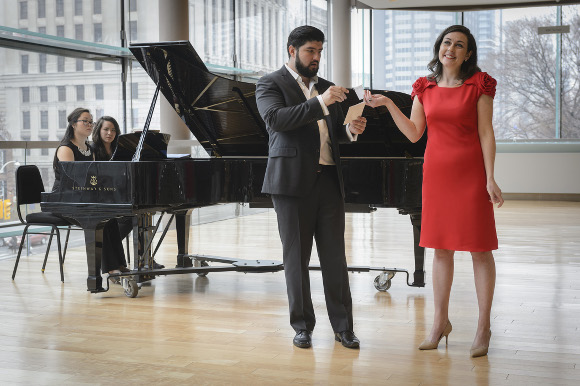
Yesterday lunchtime the Ensemble Studio gave us a preview of their upcoming performance of the Barber of Seville. The production, of course, will be the one currently on stage at the Four Seasons Centre and there were clear echoes of that in the way yesterday’s event was put on though they also played with the fact that Almaviva will be split between Andrew Haji and Jean-Philippe Fortier-Lazure with much pulling and pushing into place.
A glorious romp
The COC’s new production of Rossini’s The Barber of Seville opened last night at the Four Season’s Centre. The production is by the Catalan collective Els Comediants, the same team who did La Cenerentola a few seasons back, with direction by Joan Font and designs by Joan Guillén. It’s a riot in a good way. It’s bold, colourful and very well choreographed. There are giant props; for example a huge guitar from which Almaviva sings his serenade and a giant pink piano which serves for all kinds of shenanigans. A lot of the “sung action” is doubled by actors in a sort of on stage projection cube. Scene changes are “on the fly” and the curtain only comes down for the interval and the end. Bold, clever, slick.
Poetic Love
Today’s lunch time concert in the RBA was a lieder recital by two Ensemble Studio members; bass-baritone Gordon Bintner and tenor Andrew Haji. Both singers sang settings of texts by Heinrich Heine. Bintner, accompanied by Jennifer Szeto kicked off with selections from Schubert’s Schwanengesang to be followed by Haji and Liz Upchurch with Schumann’s Dichterliebe.
And the mainstream stuff…
Sometimes I forget the obvious… Here’s what the big kids are doing in April/May.
Opera Atelier are staging Berlioz’s 1859 version of Gluck’s Orphée. There are six performances from April 9th to April 18th. Mireille Lebel sings Orpheus, Peggy Kriha Dye sings Eurydice and Meghan Lindsay is Amour. This will be Tafelmusik’s furthest foray yet into 19th century repertoire. It’s at the Elgin and Marshall Pynkoski directs. Not sure who is conducting, presumably David Fallis.
Reflections on the recent COC run
How many Toronto lawyers does it take to change a lightbulb?
Two; one to fly to New York and the other to stand by the fax machine waiting for the instructions.
Today the COC’s winter run of Don Giovanni and Die Walküre comes to an end. It’s worth reflecting on what we’ve seen I think. Neither production could be called “traditional” and the Don Giovanni in particular produced a broad range of reactions, some of them quite extreme. I’m not really sure why as, by international standards, it wasn’t particularly extreme. And that’s the starting point for this “thought for the day”.