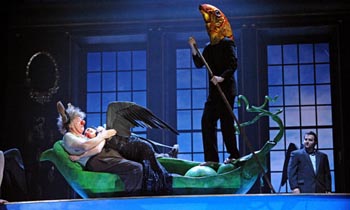
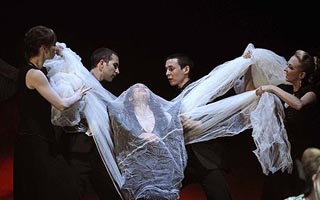
In which Dido doesn’t die

Oddly enough, given the post previous to this, Reiner Moritz’s essay in the booklet accompanying this recording of Cavalli’s La Didone brings up the Harnoncourt/Ponelle Monteverdi recordings as a precursor to what he sees as Bill Christie’s similar championing of Cavalli.  I guess the big difference is that only three of Monteverdi’s operas survive while we have 27 of Cavalli’s.  I think he may have a point though.  It seems to me that 17th century Italian opera works on an aesthetic which is very in tune with today.  The relative spareness and clarity of the music seems closer to Britten than to Verdi and the cynicism and explicit sexuality of the libretti closer to Anna Nicole than La Bohème.

1.cassandra Continue reading

Honest Injun?

I confess to having mixed, nay conflicted, feelings about the 2003 Palais Garnier recording of Rameau’s Les Indes Galantes.  On the one hand there is some really good music, idiomatically played and sung by musicians utterly at home in this repertoire, there’s some brilliant dance; both the choreography and the execution, and there is spectacle on a grand scale.  On the other hand there’s a nagging sense of cultural appropriation and, perhaps worse, a feeling that the whole thing may just be a giant piss take.  Actually in some ways it’s all of the above and if one can get into the spirit of the thing it sort of works.

1.danni Continue reading

Can’t get no Atisfaction

Despite also featuring William Christie, Les Arts Florissants and François Roussillon, the 2004 Châtelet production of Rameau’s Les Paladins could hardly be more different from the recording of Lully’s Atys that I reviewed yesterday.  The work is based on Orlando Furioso and is an utterly anarchic parody of pretty much everything that Rameau had previously written.  It was considered shocking in its day.  The production by José Montalvo with choreographic help from Dominique Hervieu is completely mad and tremendous fun.

animals Continue reading

L’opéra du roi

Lully’s Atys was, apparently, Louis XIV’s favourite opera.  It’s not hard to see why.  Within the rigid conventions of its time and place it really is rather fine.  The plot is classical and convoluted.  After an allegorical prologue celebrating Louis’ successful winter campaign in the Low Countries we get the story proper.  The hero Atys loves the nymph Sangaride, daughter of the god of the river Sangar, who returns his affection  She is betrothed to Celenus, king of the Phrygians.  The goddess Cybèle fancies Atys and makes him her high priest.  Atys uses his position to nix the wedding which upsets both Cybèle and Celenus. Cybèle blinds Atys who kills himself but is immortalised by being turned into a tree by Cybèle.  All of this takes over three hours with lots of ballets and other set pieces.  The music is French 17th century court music so it’s a bit unvaried but much of it is very fine indeed.

prologue Continue reading

It’s the only Iphigénie in town

Claus Guth’s 2001 Zürich production of Gluck’s Iphigénie en Tauride is, rather surprisingly, the only video recording of the work currently available.  Fortunately it’s a very decent production much preferable to the Met’s over-stuffed overly literal version but not, I think, to be preferred over Robert Carsen’s stark and elegant version seen in Toronto, Washington and elsewhere.  The Zürich performance, led by William Christie, is very good but it’s rather let down by the video direction and the production for DVD.

Continue reading

Orlando in Craiglockhart

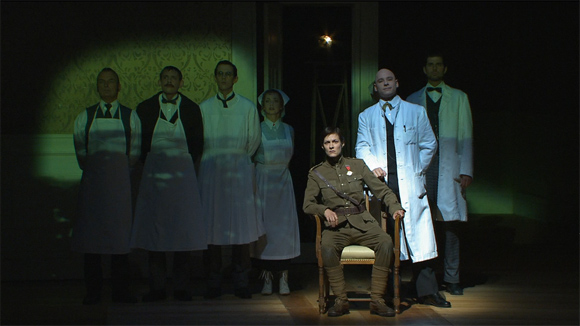
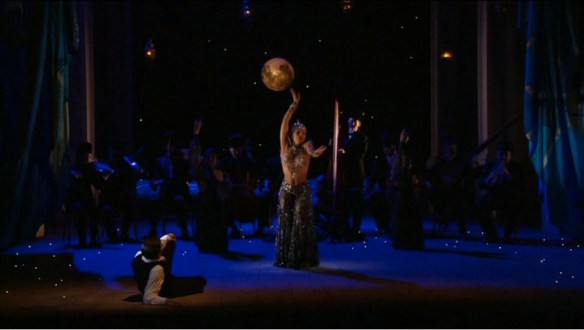
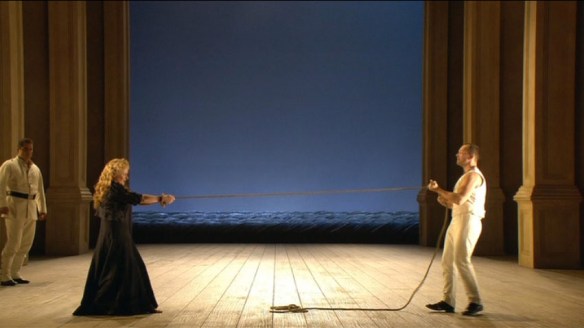
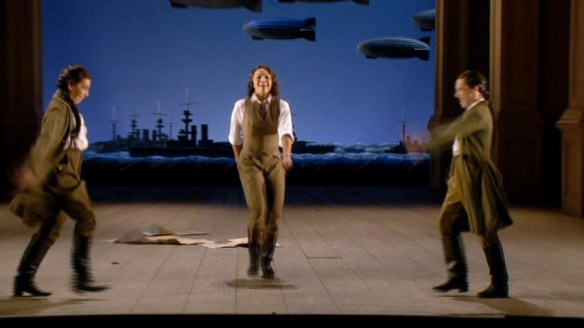
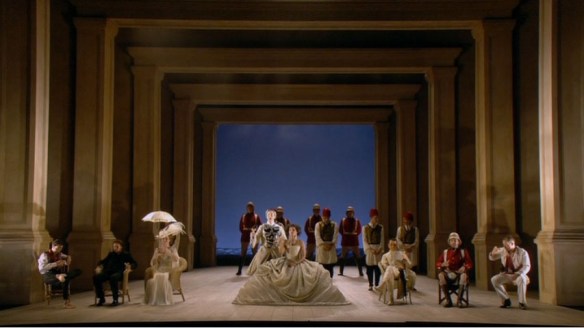
Handel’s Orlando is pretty classic opera seria stuff.  It’s based on an episode in Ariosto’s Orlando Furioso.  Orlando, a great soldier in Charlemagne’s army has lost his ardour for military glory because he has fallen desperately in love with the pagan princess Angelica, who is in turn in love with another man, Medoro. Orlando cannot accept this and he is driven to madness, prevented from causing absolute carnage only by the magician Zoroastro (who eventually restores his sanity).  There’s also a shepherdess, Dorinda, who is also in love with Medoro, but comes to accept her lot.  It’s all a bit daft and screams for a strong production concept.  In his 2008 Zürich production Jens-Daniel Herzog finds one.  He relocates the action to a military psychiatric hospital during, or just after, WW1.  Orlando is suffering from battle fatigue or PTSD and Zoroastro is a psychiatrist.  Angelica is still a princess but Dorinda has become a nurse.  It all works rather well.

Continue reading

Bartoli’s Semele

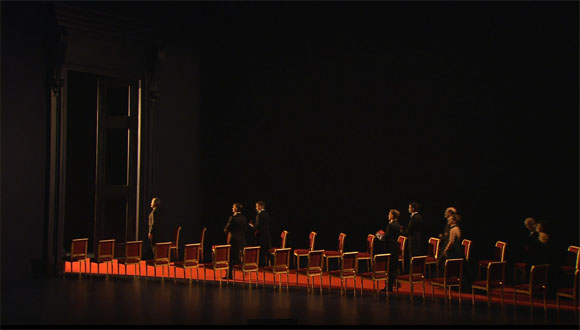
Robert Carsen’s clean, refined production of Handel’s Semele originated in Aix, was recorded in Zürich and eventually made it’s way to Vienna and Chicago.  In many ways it is classic Carsen.  It’s elegant and uncluttered, is strong on the detailed Personenregie, has a consistent design concept but isn’t really pushing a concept driven agenda.  It’s also quite funny without descending to priapic donkeys.  Also there are lots of chairs.

Continue reading

I came, I saw, I picnicked

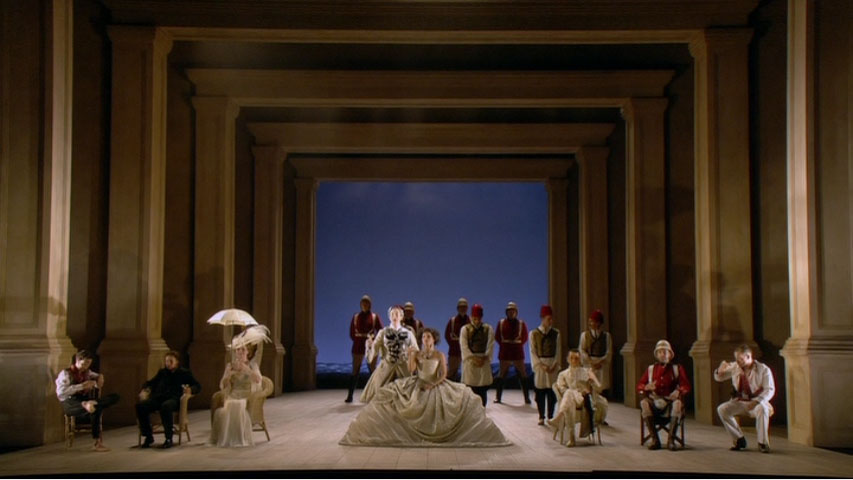
The DVD of the 2005 Glyndebourne Festival production of Handel’s Giulio Cesare in Egitto is one of the most satisfying that I have ever got my hands on. David McVicar’s production is a delight. The cast is consistently excellent with stand out performances from Sarah Connolly as Caesar and Danni de Niese as Cleopatra. William Christie gets wonderful playing from the Orchestra of the Age of Enlightenment. The production for DVD/Blu-ray is exceptional in every way. There’s even over an hour of worthwhile extras giving a total of over five hours of material.
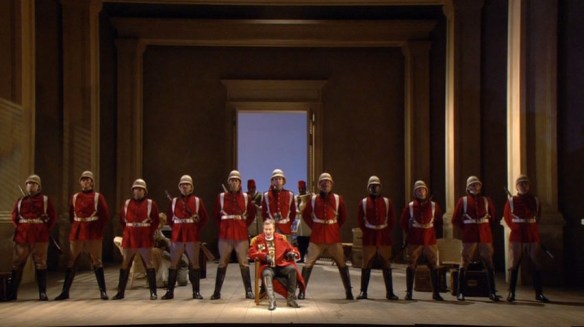
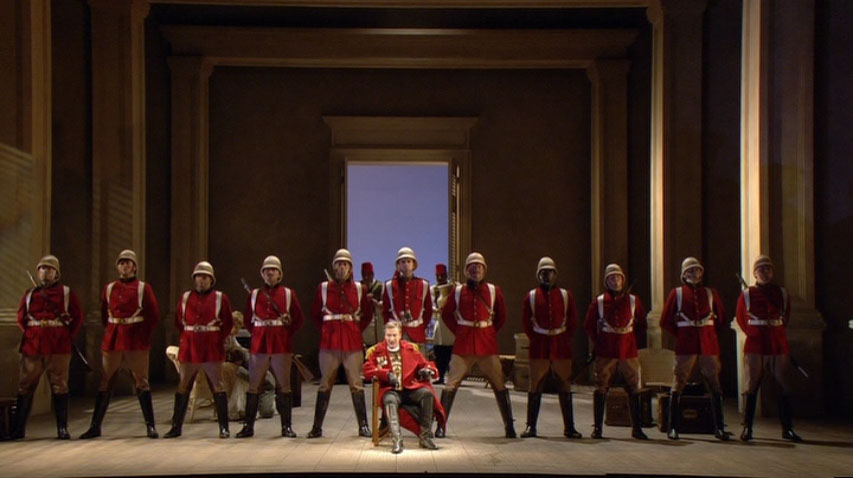
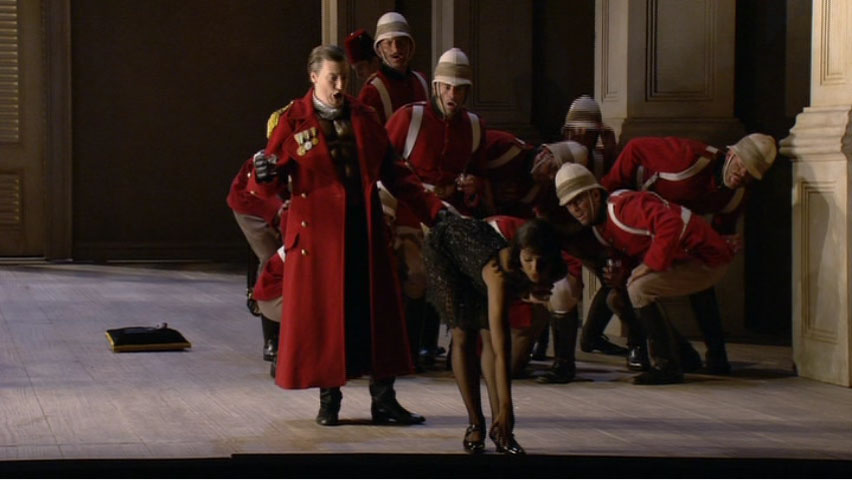
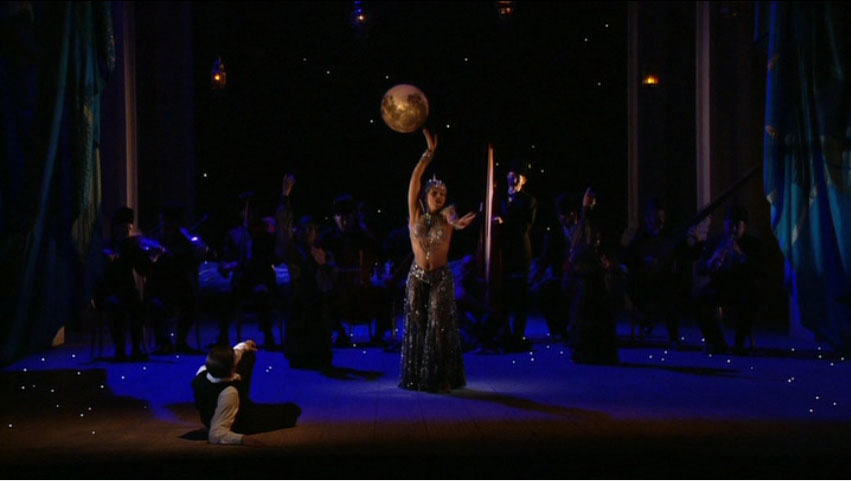
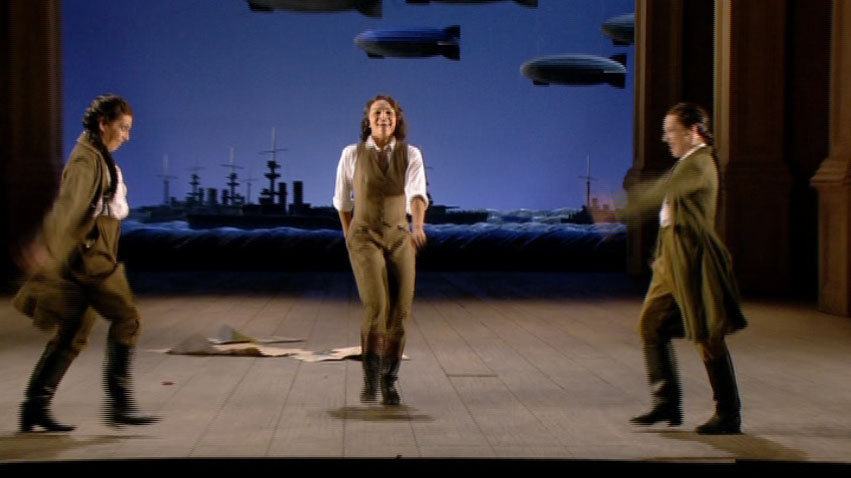
Let’s start with the production. McVicar and his design team have placed the action firmly in Egypt but moved the time period to the late 19th century with the Romans being portrayed in the manner of the British who effectively ruled Egypt at the time. There are a number of elements taken from Bollywood musicals which seems to have led some reviewers to dismiss it as not being “serious” enough to be a proper Handel production. I think this is misguided. The Bollywood elements are well integrated dramatically and musically and serve a dramatic purpose. They point up the cultural rift between the Romans and the Egyptians without getting into a crude and heavy critique of colonialism. There are a few places where Andrew George’s choreography is a bit over the top but mostly it works and, if nothing else, it’s tremendous fun. McVicar has obviously worked really hard on the and all the main characters and their interactions are clearly defined. The gulf between Romans and Egyptians emerges through these relationships though perhaps the rather overwrought Sesto of Angelika Kirchschlager somewhat undermines the chilly memsahib Cornelia of Patricia Bardon. Throughout there are neat little touches like Cleopatra ditching her cigarette in the urn containing Pompey’s ashes or the Roman/British warships sailing into Alexandria harbour with airship cover during Da tempeste il legno infranto. At the very end, Achilla and Tolomeo, blood soaked, (both are dead at this point) reappear and flank the line of seated dignitaries sipping champagne. It’s weird but works. Notably the production team got one of the biggest ovations of the night when they appeared for a curtain call.
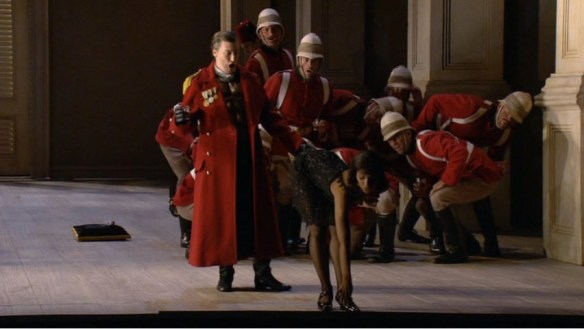
The individual performances range from very good indeed to spectacular. Musically the star is Sarah Connolly. She’s utterly brilliant with completely secure coloratura and ornaments that are far more than just decorative.  Right from Empio, dirò, tu sei where she manages to spit out her disgust while maintaining 100% musicality, to the very end she’s note perfect. Her acting is also really good. She covers a wide range of emotions and her physical acting is genuinely masculine. She really does not look or move like a woman in drag. Then there’s Danielle de Niese! Musically there may be subtler or more refined exponents of the art of Handelian singing but I doubt whether there are any who could handle the role Danni is handed here. (Jane Archibald maybe, just maybe). She sings very well in fact. Some of her big numbers are very well done indeed and Piangerò la sorte mia is very fine and she’s very clever vocally in Da tempeste il legno infranto here she works some ornamentation in to accompany miming firing a sub-machine gun. But singing is only a fraction of the work she gets through. She has a lot of physical acting and several major dance numbers. She’s a very good dancer and, of course, she really looks the part. It’s really quite a performance!
Patricia Bardon acts well in a chilly way and sings beautifully. Priva son d’ogni confortois a real tear jerker. Kirchschlager sings very well but is a bit overwrought in the acting department and doesn’t really come across as a young man set on revenge. Rachid Ben Abdeslam is wonderful as Nireno. He gets the basically scaredy cat (and somewhat effeminate) functionary spot on. Chris Maltman is an appropriately brutal and coarse Achilla without letting the coarseness affect his singing. Alexander Ashworth in a kilt, is a solid, if unexciting, Curio but that’s the role. Christophe Dumaux is brilliant as Tolomeo. He looks like Captain Darling from Blackadder Goes Forth and is similarly petty and petulant. He’s also a vicious, spoiled bully and narcissist. Dumaux brings out all these aspects while singing at the highest level. It’s almost up there with de Niese and Connolly. The musical direction and orchestral playing is of the highest order.
Glyndebourne has been really well treated on video in recent years and this Opus Arte release is no exception.  The production for DVD is both excellent and opulent. The DVD version is spread across three disks (the Blu-ray gets two which is remarkable!). The video direction, by Robin Lough, is sympathetic and unobtrusive. The production was filmed in 1080i (which is what one gets on the Blu-ray) and the DVD rendering of the picture is about as good as DVD gets. The audio choices on DVD are LPCM stereo and DTS 5.0 with the latter being superior. In fact it’s superb; maybe the best sound I’ve come across on DVD. The fidelity with which the brass and woodwinds are captured is exceptional. The Sinfonia just before the final scene is thrilling to listen to. I’d really like to hear what the PCM 5.0 track on the Blu-ray sounds like. There are English, French, German, Italian and Spanish subtitles. Besides a synopsis and cast gallery there are two documentaries incluced. There’s a “making of” called, appropriately “Entertainment is not a dirty word” and a feature on “Danielle de Niese and the Glyndebourne experience”. It’s rather touching as Danni gushes over what an amazing place Glyndebourne is and interviews Gus Christie about what it’s like to live there. I’d like to see the follow up with Mrs Gus Christie, chatelaine!
This really should be watched by anyone who thinks baroque opera is difficult and boring and needs to be dumbed down for the average audience. But I don’t suppose he’s listening.
Exemplary Blu-ray transfer for Glyndebourne’s Fairy Queen

I’ve reviewed two DVDs of Purcell’s semi-opera King Arthur on this blog. One was excellent and one was terrible and between them they went a long way to showing how difficult these semi-operas are to stage well but how rewarding when they succeed.

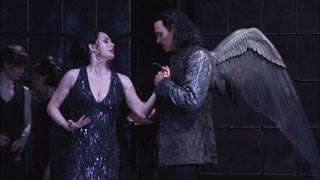
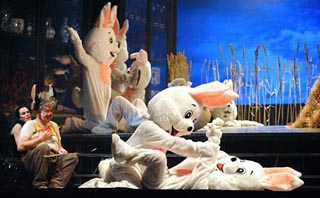
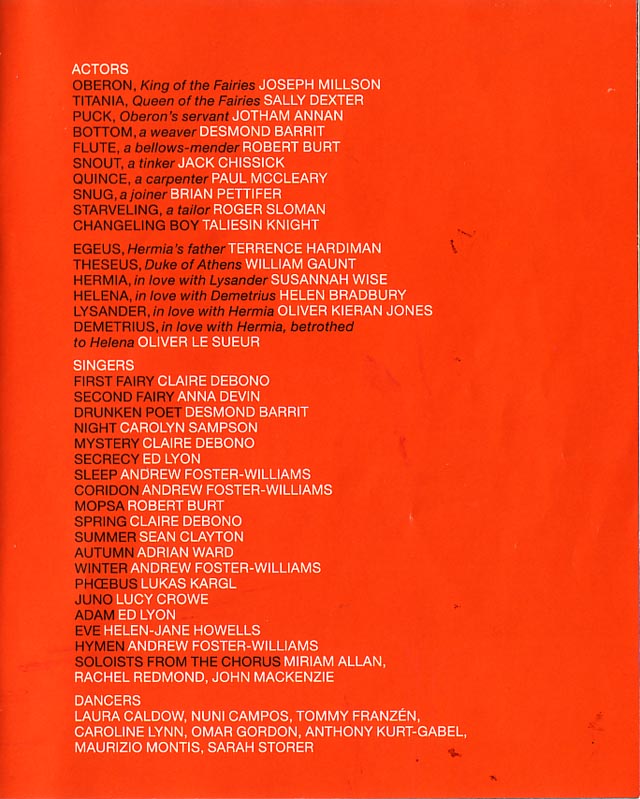
In 2009 Jonathan Kent and William Christie combined to produce a version of The Fairy Queen for Glyndebourne. It’s quite different in style from the successful Salzburg King Arthur but it works splendidly on its own terms. The Fairy Queen combines a libretto based on A Midsummer Night’s Dream with songs, masques and dances of a largely allegorical nature. Like the play itself they range from high flown allegory with classical elements to bawdy humour. It is very English. It almost epitomises what separates the English baroque from the French. Kent and Christie tackle this with a robust English sensibility, There are some changes to the dialogue and to the order of the numbers but it all makes sense (so far as this piece can). The allegorical elements are gorgeously and wittily staged making good use of a large circular lift at centre stage that allows fully formed tableaux to rise into our sight. The bawdy elements are tackled head on with a robustly TV Mopsa (Robert Burt) in the “Dialogue of Corydon and Mopsa” and the, by now, notorious bonking bunnies in the “Dance for the Haymakers”. The audience is totally engaged and one hears plenty of that commodity, rather rare in the opera house, uninhibited laughter. The team of designer Paul Brown and lighting designer Mark Henderson make all of this look quite spectacular. The dramatic action is played out in fairly long segments and the parts are taken by actors rather than singers. The fairies are appropriately sinister with wings that look inspired by contemporary prints of fallen angels. The Rude Mechanicals are rude and not too mechanical.  The “humans” are credibly 17th century in manner though dress gets less formal as the action proceeds.  The disparate elements are integrated very well.  There’s plenty of dance and it’s choreographed by Kim Brandstrup in a style that is robustly muscular but solidly in the classical ballet tradition.

The cast of actors, singers and dancers is huge and consistently excellent.

I was particularly impressed with Sally Dexter’s Titania and Desmond Barrit’s Welsh accented Bottom among the actors.  Barrit even got to do some singing with a not too over the top version of the “Song of the Drunken Poet”.  The singing stars were the wonderful, sweet toned Lucy Crowe; her “if love’s a sweet passion” was a delight, and the robust bass-baritone Andrew Foster-Williams who, among other sings, sang a truly chilling Winter.  Singling out individual performances isn’t the point though.  This is very much an ensemble performance.  Christie directs the Orchestra of the Age of Enlightenment from the harpsichord and is as idiomatic as one could possibly hope for.

So, how well does the stage production transfer to disc?  Extremely well!  The video director is François Roussillon.  Unlike most of his peers he appears to have realised that opera lovers are not, for the most part, watching on tiny screens anymore.  He makes sure we can see what the designer and director intended.  Sure, there are close ups but never at the expense of the bigger picture.  The technical quality is of a very high order.  There are two formats available; a two DVD set and Blu-Ray.  I watched the latter but I doubt most people would see a huge difference.  It was filmed in 1080i HD and the picture is clearly better than my first generation HD TV can fully do justice to.  The sound is incredibly good.  On Blu-Ray it’s DTS-HD Master Audio (DTS 5.1 on DVD).  The quality is apparent even as Christie is walking to the pit.  The applause simply sounds as if one is in the house rather than the usual muffled fluttering noise.  The balance, clarity and spatial depth are exemplary throughout.  Both formats also have LPCM stereo.  There are English, French, German and Spanish subtitles.  There are useful extras.  The disc includes interviews with Kent and Christie which are well worth watching and the booklet includes an informative essay by Kent as well as a track listing and synopsis.

All in all this is an excellent production given an exemplary transfer to disc.  Here’s the official trailer, unfortunately in less than exemplary Youtube quality:

Umbrellas and underpants

I’m not a huge fan of French baroque opera but I am a huge fan of Robert Carsen which is why I had a look at the DVD recording of his 2003 Paris Garnier production of Rameau’s Les Boréades. I’m still not a huge fan of French baroque but Carsen certainly makes the most of the work on offer.

1.leaves Continue reading