
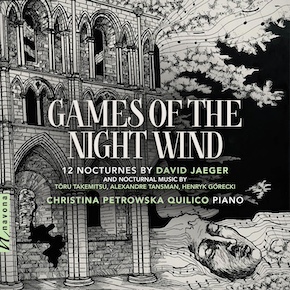
 Games of the Night Wind is a record of nocturnally inspired piano music played by Christina Petrowska Quilico. Much of the record is taken up by twelve nocturnes from Ontario composer David Jaeger. They are interspersed with pieces in similar mood by Polish composers Alexandre Tansman and Henryk Górecki and there is also a solitary piece by Tōru Takemitsu.
The Jaeger pieces were each inspired by a different piece of poetry dealing with some aspect of nocturnal experience. What they have in common is an abstracted, dreamy quality. Some are darker than others, some gentler and more lyrical and they are all interesting. Listening I was reminded of a comment of Brian Current’s to the effect that sometimes listening for things like melody, harmony and rhythm is less useful than listening for texture and I think that’s true of these pieces. They are all deeply textured but in different ways. They are played with great sensitivity.
 Project Earth: The Blue Chapter is the first in a projected series of CDs from the Iris Trio (Christine Carter – clarinet, Anna Petrovna – piano, Zoë Martin-Doike – viola) dealing with environmental issues. This one blends music by Florian Hoefner with poems by Don McKay. The longest piece on the CD is the multi-movement Bird Island Suite inspired by the bird life of nesting islands around Newfoundland but really dealing with broader issues of how we interact with and influence the natural world for good or ill. Usually the latter.
  Les Génies ou les Caractères de l’Amour is an opera/ballet of 1736 by one Mademoiselle Duval who was 22 at the time. Almost nothing is known about Duval except that she was at one time a chorus member at the Royal Opera in Paris. It seems reasonable to deduce that she was from a family of professional musicians and that’s how she got her training. FWIW Les Génies was only the second opera by a woman to be produced by the Royal Opera. It’s recently been recorded for CD under the auspices of Château de Versailles Spectacles.
  Saint-Saëns Déjanire, of 1911, was his last opera. The plot is basically the same as Handel’s Hercules. Déjanire is infuriated by Hercule’s infatuation with Iole so he gives him a poisoned robe; itself a gift from the Centaur Charon, which kills him. There are a few plot tweaks. Iole is in love with Philoctète and agrees to marry Hercule to save his life. But, basically classic, simple plot.
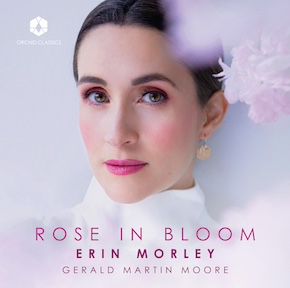 Rose in Bloom is a new recital CD from coloratura soprano Erin Morley accompanied by Gerald Martin Moor. It’s a bit of a mixed bag. There’s some really nice singing and playing but some of the music choices leave me a bit cold.
 Serious Cabaret is an album by singer Mary Carewe and pianist Philip Mayers who is also responsible for the arrangements. It’s an eclectic mix of cabaret material from the 1920s to the 1970s. There’s classic material from the Weimar Republic, including songs by Hollaender (“Oh just suppose”) and Spoliansky (“Maskulinum/Femininum”, “It’s All a Swindle”) and one I hadn’t heard before; Zemlinsky’s “Herr Bombardil” about a man who eats until he explodes.
  love to my liking is an album of 13th century Trouvère music from Brooklyn based ensemble Alkemie. It’s in many ways similar in style to the music of the troubadors of what is niow Southern France but being from the North the texts are in medieval French rather than Occitan. There’s a range of songs, dances and motets on the record including some in a form I hadn’t encountered before; where two, or even three, distinct texts are sung simultaneously by different singers.
 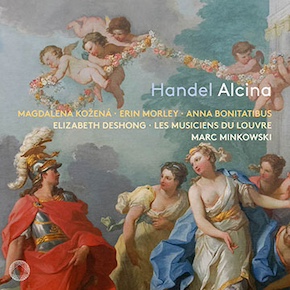 The new recording of Handel’s Alcina from Marc Minkowski, Les musiciens du Louvre and a rather starry line up of soloists is very good and quite interesting. It’s very complete. As far as I can tell all the ballet/dance music is included and so are all the Oberto scenes and all his arias. In all the staged performances I’ve seen (live or video) one or both are usually heavily truncated and I have seen versions where Oberto doesn’t feature at all.
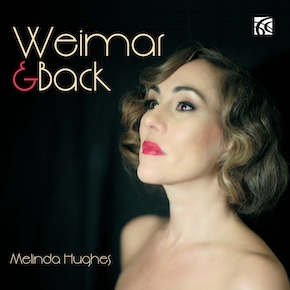 After discovering a rare Viktor Ullmann video, the Shoah Songbook concert and seeing Ute Lemper live I decided to go off and have a look for more music from Weimar, the Holocaust and resistance to Nazis; past and present. It was an interesting haul and included a 2018 album from English cabaret singer/comedienne Melinda Hughes.
 Handel’s Theodora is probably performed more nowadays as a staged opera than as an oratorio. The same is true for several of his other English language oratorios; notably Semele. It was in that format I was introduced to Theodora by
