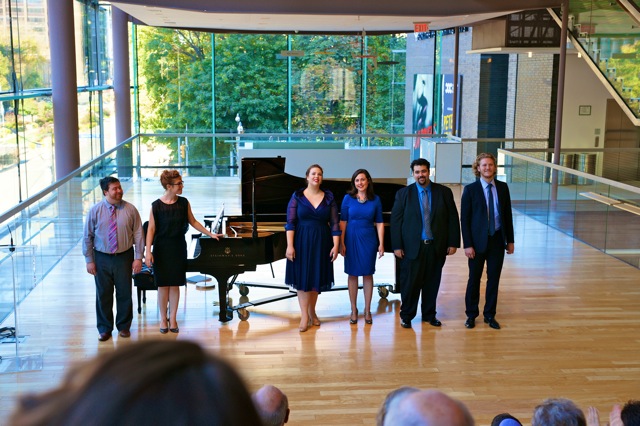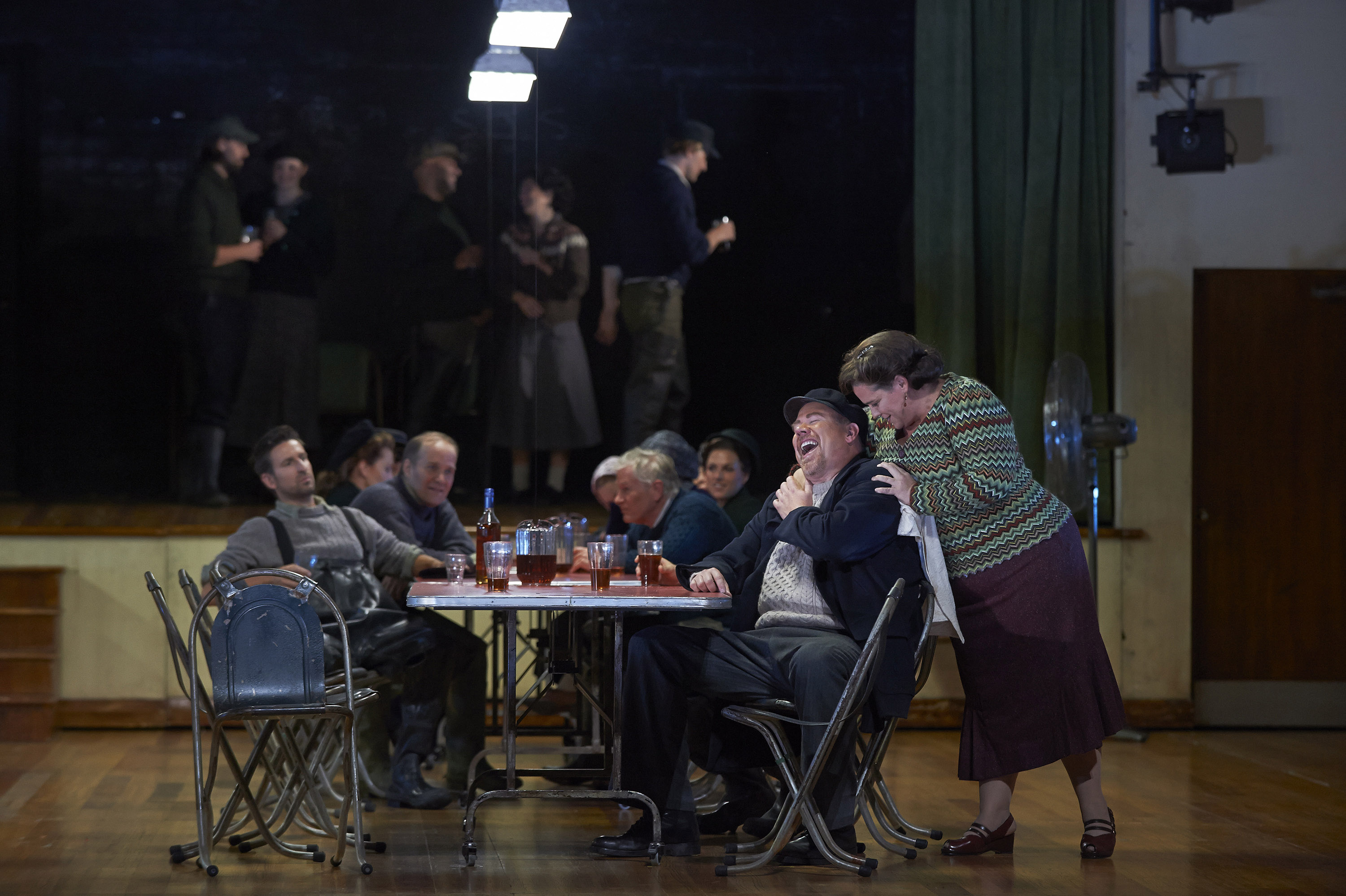
Readers of this blog will likely know that Peter Grimes is a very special opera for me. I’ve watched it live and on recordings a lot. I think about it a lot troo so the chance to see it live is rather special. It’s even more special when it’s done as well as at the Four Seasons Centre last night in the opening performance of a new run of Neil Armfield’s much travelled production, revived here by Denni Sayers.
Tag Archives: britten
Ben Heppner at Toronto Reference Library
Last night’s event in the Star Talks series at the Toronto Reference Library involved Richard Ouzounian interviewing Ben Heppner who is in town to sing the title role in Peter Grimes. It was a very genial interview; no tough questions about elitism or whether opera was dying. Rather it was very much the tale of the kid from Dawson Creek who beats Renee Fleming and Susan Graham in the Met auditions and becomes a superstar. It was curiously like Desert Island Discs without the music.
There were a couple of interesting stories. The best concerned Heppner and Richard Jones’ production of Lohengrin (available on DVD/Blu-ray with Jonas Kaufmann in the title role). It’s the one where Lohengrin and Elsa build a house then Lohengrin burns it down. Well it turns out the the three year old Ben Heppner managed to burn the family home down and during the dress of Lohengrin had a pretty strong repressed memory reaction at the point where he had to set the cradle alight. It says a lot for his professionalism that the first night went off without incident.
I did get to ask him for his views on different kinds of tenor singing the role of Grimes. After all it was created for one of the most ethereal operatic tenors ever but ids frequently sung today by full on heldentors. He said he didn’t think the voice was as important as how fully the singer inhabited the character and singled out Philip Langridge in that regard. I have to agree with him. I love Langridge’s Grimes. It’s a real pity the video recording of it is so awful.
Peter Grimes runs for seven performances at the COC starting October 5th.
Albert Herring
Britten’s Albert Herring is mysteriously under represented in the DVD catalogue. The work is performed quite often being relatively inexpensive to mount and suitable for smaller venues but the many productions haven’t led to many recordings. I have only been able to find one and that dates back to 1985 when it was recorded at Glyndebourne. That’s appropriate enough as that’s the house the piece premiered in in 1947. At least it’s a fair and effective representation of the work. Peter Hall’s production takes few liberties with the libretto and is a rather literal and effective, if necessarily somewhat caricatured, representation of life in a Suffolk village. The sets and costumes are evocative; especially the hall of Lady Billows’ house which really evokes a 17th century Great Hall and, as the view through the window tells us, is set in or close to the village, not in an isolated park. There’s quite a lot of that kind of attention to detail in this production.
Jealousy, rage, love and fear
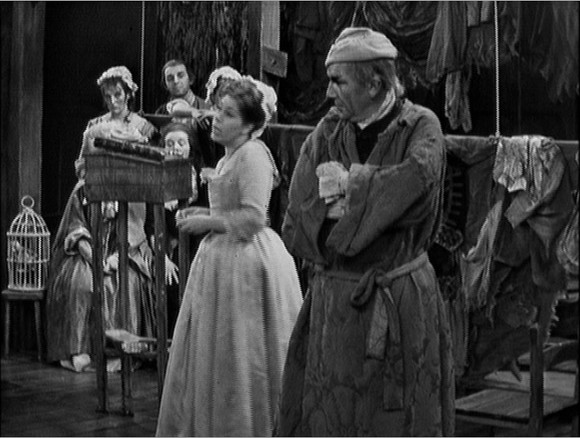
It’s a curious thing how some works get over recorded and others are almost entirely neglected. For example, there’s only one video recording of Weill’s Die Dreigroschenoper and that a 1931 film that omits huge chunks of the stage work. It’s inspiration fares little better. There’s only one video recording of The Beggar’s Opera by Johann Pepusch and John Gay. It’s a 1963 BBC TV production of Benjamin Britten’s reworking of the piece for the English Opera Group based on a stage production by Colin Graham. [ETA: There are actually two other versions; a 1953 movie version with Lawrence Olivier and a 1980s version with Roger Daltrey and John Eliot Gardiner].
Season announcements
Announcements for the upcoming season in Toronto are starting to come in. Voicebox: Opera in Concert have announced a thee show season at the St. Lawrence Centre for the arts. The season opens on Sunday, November 24, 2013 at 2:30 PM with Benjamin Britten’s Gloriana. This isn’t a work one gets to see very often so even a piano accompanied concert version is very welcome. Musical Director and Pianist will be Peter Tiefenbach. Soprano Betty Waynne Allison will sing Elizabeth I with tenor Adam Luther as Essex. The cast also includes Jennifer Sullivan, Jesse Clark and Mark Petracchi.
Paramore shall welcome woe
Various thoughts about the Channel 4 film of Britten’s Owen Wingrave led to me seeking out the original BBC TV version from 1970, now available on DVD. It’s extremely interesting and worthwhile. Britten himself conducts and the cast includes many of the people involved in the first productions of many other Britten operas. They include Peter Pears (General Wingrave/Narrator), John Shirley-Quirk (Coyle), Benjamin Luxon (Owen), Janet Baker (Kate), Heather Harper Mrs.Coyle) and Jennifer Vyvyan (Mrs. Julian). The quality of the music making is superb and I found myself constantly surprised and delighted by details brought out by Britten supported by the excellent English Chamber Orchestra. At the same time, the fluent and idiomatic singing pointed up the excellence of Myfanwy Piper’s libretto. This really is Britten at his best.
Paramore revisited
Great though my admiration for Benjamin Britten’s music is I wouldn’t consider him a creator of memorable female characters. There’s Ellen Orford, of course, but one struggles to find a Tosca, Lucia or Violetta in his oeuvre. I open with this because what struck me watching the 2001 Channel 4 film of Owen Wingrave for a second time was how generally unsympathetic the female characters are. This is an opera with a female librettist (Myfanwy Piper) and the film has a female director (Margaret Williams) yet, with the exception of the fairly ineffectual Mrs. Coyle, the female characters embody an unthinking militarism and behave with extreme malevolence towards Wingrave; none more so than his “girlfriend” Kate. The filming reinforces this with close up scenes of groups of the women spitting venom at young Wingrave.
Grimes on Blu-ray
There is, finally, a recording of Britten’s Peter Grimes on Blu-ray. It’s a Richard Jones production with a largely British cast, recorded at La Scala in 2012. The sound and picture quality are first rate. Unfortunately the production and performances aren’t so much.
Richard Jones has chosen to set the piece in the 1980s and to portray the inhabitants of the Borough as a sort of inbred hive mind fuelled by prejudice, alcohol and drugs. Actually it’s not a bad concept but it comes off as exaggerated with cast and chorus repeatedly making more or less coordinated middle aged disco moves. He also portrays the nieces as the sort of permanently stoned bubble heads one wants to avoid on the last train home. There are some neat touches. The Moot Hall, The Boar and Grimes’ hut are all formed by box like spaces that are tilted and rotated to good effect. The lighting is effective too. Unusually for a modern production Jones doesn’t provide any staging for the interludes, leaving the theatre dark with the curtain down. Overall, it’s a production I’d want to take a second look at but I suspect it’s just painted too broadly to be really effective.
All the Grimes that’s fit to print
It will come as no secret to regular readers that I am something of a Peter Grimes completist. Until recently this blog was probably the only place one could find detailed reviews of all the available video recordings of that great work. Now the recent La Scala production has been released on Blu-ray and I am no longer complete. Fear not though, the disk is in the mail as they say and the divine order will shortly be restored.
In other Grimes news, the Aldeburgh Festival is staging the work on the beach. The estimable Chris Gillett, Horace Adams both there and at La Scala, is blogging about it in his usual inimitable style. In some ways I really wish I could go but I know that coast. Even on a good day the wind will freeze one’s soft bits off. Definitely a challenging place to perform or even watch opera. It’s also just off the A12 and I still have the after effects of 24 stitches on my face from a rather unfortunate encounter on that highway in my youth. I shall patiently await Ben Heppner, Alan Held, Ileana Montalbetti et al at the Four Seasons Centre in the fall.
What’s green and blue and Carsen all over?
Robert Carsen’s production of Britten’s A Midsummer Night’s Dream is as visually striking as any of his productions. It’s also one that’s done the rounds, playing in Aix and Lyon before being recorded by a strong cast at the Liceu in Barcelona in 2005. The challenge with Dream is to create visual worlds for the Fairies and the Mortals that are different but work together. Carsen and his usual design team do this very well in this case. The Fairies are given striking green and blue costumes with red gloves. The mortals mostly run to white and cream and gold and they seem to spend a lot of time in their underwear. The lighting, as always with Carsen, forms an important part of the overall design. Carsen completists will also notice certain other characteristic touches like starkly arranged furniture.