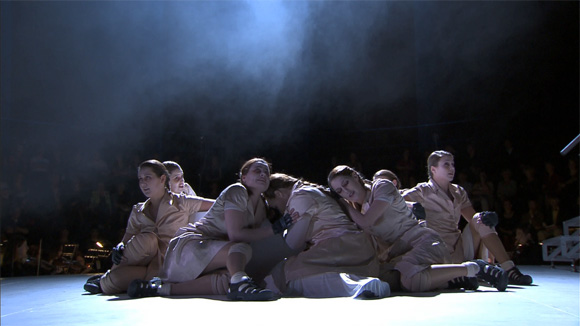
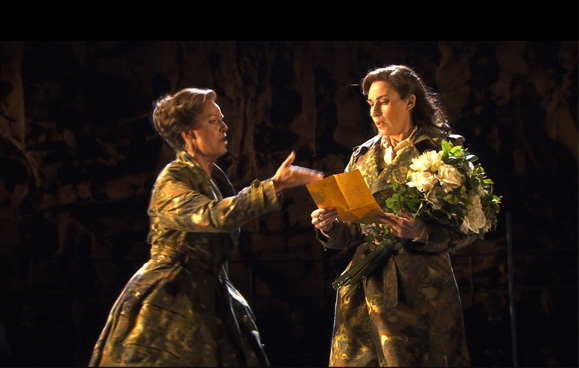
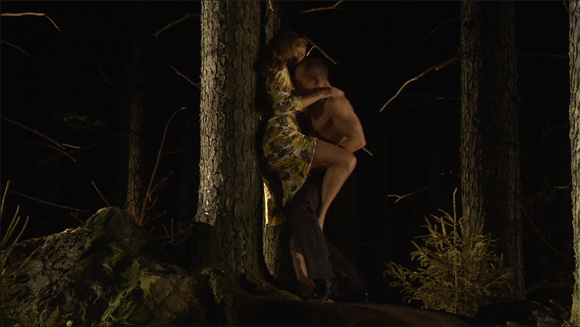
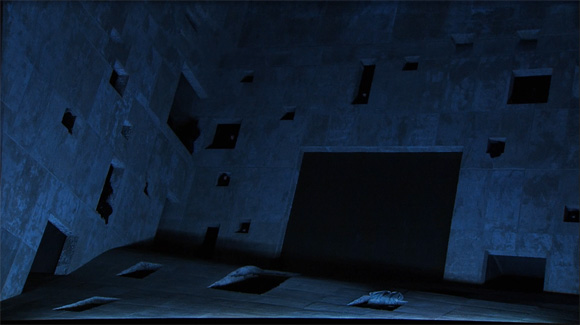
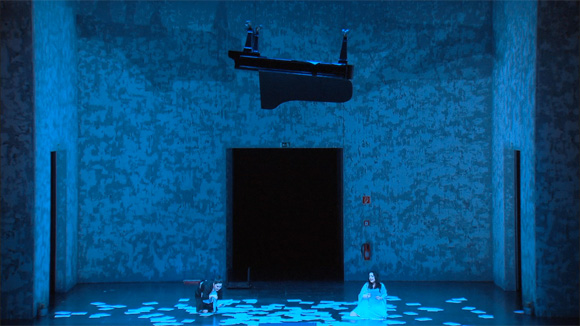
The second half of the Amsterdam double bill that opened with Iphigénie en Aulide is, of course, Iphigénie en Tauride. In this piece the more usual version of the Aulis story, where Diana substitutes a stag for Iphigenia on the altar and whisks the girl off to be her priestess among the savage Scythians of Tauris, is assumed. So the piece opens with Iphigenia and six other Mycenean priestesses (how they got to Tauris is a mystery) in Diana’s temple at Tauris where their job is to sacrifice any strangers who show up. Almost at once the capture of two Greeks is announced. They turn out to Iphigenia’s brother Orestes and his sidekick Pylades and the the next 90 minutes turns on Iphigenia failing to sacrifice either of them.
Tag Archives: blu-ray
Iphigénie at last
Gluck’s Iphigénie en Aulide is finally available on Blu-ray and DVD. It was staged and recorded as a double bill with Iphigénie en Tauride at De Nederlandse Opera in September 2011 in productions by Pierre Audi. It’s excellent in just about every respect. The cast is to die for, the production is interesting and so is the staging in the rather challenging space of The Amsterdam Music Theatre, which also poses problems for the video director. Backed up, on Blu-ray, by a 1080i picture and DTS-HD-MA sound it’s a pretty compelling package.
Love is stronger than death
Peter Sellar’s production of Handel’s Theodora has long been one of my favourite video recordings of opera. It’s brilliant in so many ways and I don’t think I’ve ever made it through the whole thing without tearing up. It’s now been remastered from the original tape and reissued on Blu-ray. The video and sound quality are distinctly better than previous DVD releases though not, inevitably, in the same class as the best modern recordings. It’s also still a depressingly bare bones release with no extras and minimal documentation but don’t let that put you off.
My original review is here. I thought about rewriting it but for the most part I stand by my original comments. The only judgement I’d change is that, on greater experience, I do think this is one of Handel’s best works.
200 disks
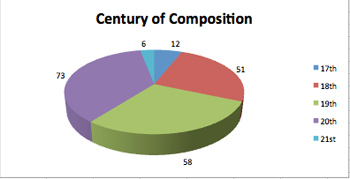
I’ve now reviewed 200 opera performances on DVD and Blu-Ray. They range alphabetically from Adams to Zemlinsky and chronologically from Monteverdi to Reimann. The oldest performance is a 1931 film of Die Dreigroschenoper and the latest a 2012 recording of Arabella. Just for fun I did some quick stats on four parameters; century of composition, decade of performance, language of performance and place of performance.
The century of composition stats show, perhaps unsurprisingly, that my tastes don’t lie in opera’s temporal sweet spot, the 19th century. My most popular century is the 20th with lots of Britten and Richard Strauss contributing a good chunk of the 73 disks. The 19th does come in second at 58 but it’s only just ahead of the 18th at 51 with strong contributions from Mozart (of course), Handel and Rameau. Continue reading
Sister swap
Richard Strauss’ Arabella is a bit of a peculiarity. The music is top notch Strauss and the libretto is by von Hofmannsthal so it ought to be quite superb. It doesn’t quite get there though. It’s hard not to think that if von Hofmannsthal had lived a little longer he would have tightened up the libretto. Act 1 works fine but Acts 2 and 3 seem rather contrived and could definitely use a few cuts. I’m not sure that the whole Fiakermilli thing works either. It’s almost as if Prince Orlofsky’s party mislaid Johann and found Richard by accident. That said there is some very beautiful music. Aber der Richtige, wenn’s einem gibt is going straight onto my list of top soprano duets.
Into the woods
Claus Guth’s 2008 Salzburg production of Don Giovanni divided the critics along entirely predictable lines. It’s a very unusual treatment of Don Giovanni but the concept is stuck to with real consistency and it works to create a compelling piece of music theatre. The treatment on video too is not straightforward and, in a sense, the DVD/Blu-ray version is as much the work of Brian Large as it is of Claus Guth.
There were rats
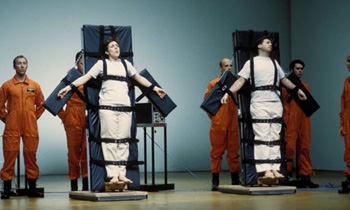
I guess Lohengrin is one of those operas that’s so loaded up with symbols it just begs directors to deconstruct it. Well that’s what Hans Neuenfels’ Bayreuth production, recorded in 2011, does and then some. There is so much going on in this production that I think it would take many viewings to really get inside it. The bit most critics have fastened on is the costuming of the chorus as rats or, on occasion, half rat, half human. It’s visually interesting and since there are also ‘handlers’ in Hazmat suits it’s clear that some sort of experiment is being alluded to. Add in bonus rat videos at key points and there’s a lot to think about. One thing this does do is solve the Teutonic war song problem. A chorus of rather timid looking rats singing with martial ardour is a good deal less Nurembergesque than a similar chorus in armour or military uniforms. Rats aside the story is really told in a quite straightforward and linear way while providing all sorts of moments that one might want to interrogate further,
Staging Messiah
It’s a rare and valuable experience when a performance makes one reconsider a perhaps overly familiar work. That’s the effect that Claus Guth’s 2009 staging of Handel’s Messiah had on me. I don’t think that there is any piece I’m more familiar with than Messiah. I feel like I’ve known it all my life. I’ve sung it. I own a vocal score (rare indeed for me!). I couldn’t begin to count how many times I’ve heard it. And yet here it came up entirely fresh and had me thinking about it in completely new ways.
Full of sound and Furies
When I first encountered Richard Strauss’ Elektra as a teenager I found the music almost unbearably harsh. The more I listen to it the more erroneous that judgement seems. It has its “tough” moments to be sure. How could an opera about Elektra not? But it is also full of lush romanticism and there are some really quite lovely passages. In the 2010 Salzburg Festival recording Daniele Gatti explores both sides of the music in a rather thrilling reading of the score aided and abetted by the Wiener Philharmoniker and a pretty much ideal cast.
We’ll meet again in a better world
Richard Strauss’ last opera Die Liebe der Danae has a pretty chequered production history. It was scheduled to premiere at the 1944 Salzburg Festival but that was scuppered when all theatres were closed following the July bomb plot. A special exception was made for Die Liebe der Danae in that a single, public dress rehearsal was allowed at the conclusion of which Strauss is said to have bid farewell to the Wiener Philharmoniker with the words quoted in the title. It then remained unperformed until the 1952 festival where it got its true premier followed by productions over the next two years in most major European houses. After that it pretty much dropped out of the repertoire with occasional performances in Germany but apparently the production recorded at the Deutsche Oper Berlin in 2011 is only the sixteenth production all told. It’s a bit hard to see why it has been so neglected. The music is perfectly good Strauss though maybe it lacks a headline aria of the “Es gibt ein Reich” variety. Maybe the subject matter was just too frivolous for the immediately post-war world; it’s described as “A Joyful Mythology in Three Acts”. In any event, I was happy to discover it.