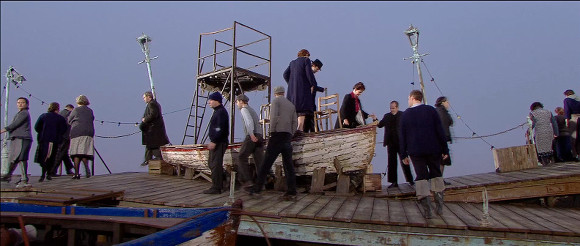
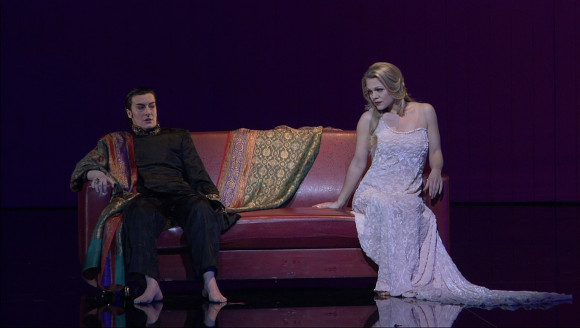
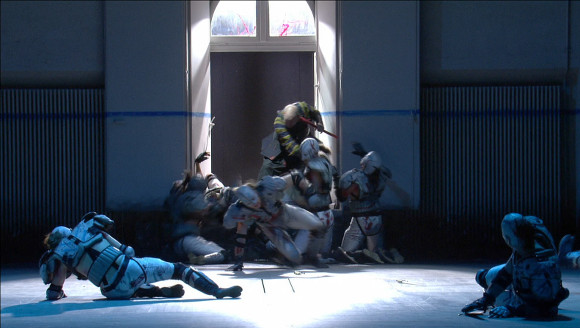
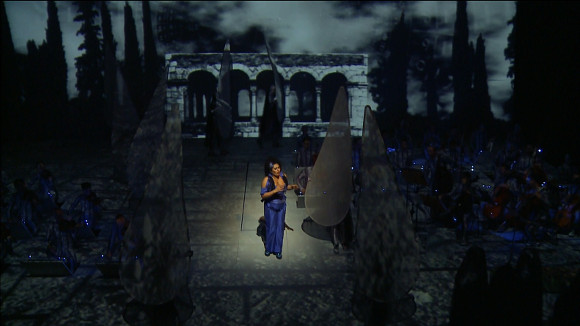
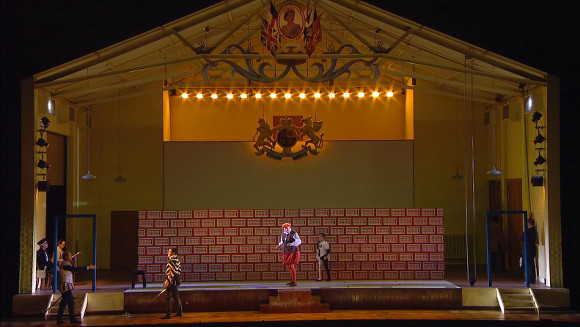
A performance of Peter Grimes in Aldeburgh to celebrate the Britten centenary seems loike one of those things that had to happen. The snag, of course, being that none of the performance venues there is remotely suitable. The idea of staging it on the beach was a brilliant, if problematic, idea and it’s good that it was captured on film and is now available on DVD and Blu-ray.
Continue reading
Tag Archives: blu-ray
Kupfer/Barenboim Ring – 2. Die Walküre
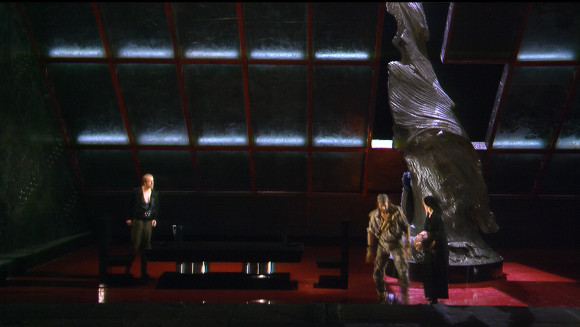
The Kupfer/Barenboim Ring continues very strongly with the second instalment, Die Walküre. It opens in quite a straightforward, more or less realistic way. Hunding’s hall is slightly abstracted with a recognizable tree. It’s quite spare though which creates space for the strong interpersonal dynamics between Siegmund and Sieglinde. Poul Elming is a very physical, almost manic Siegmund and Nadine Secunde’s Sieglinde is almost as physical. It’s all very intense and beautifully sung. Matthias Hölle as Hunding is no slouch either.
Kupfer/Barenboim Ring – 1. Das Rheingold
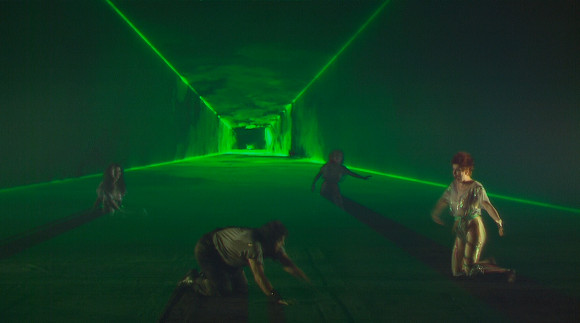
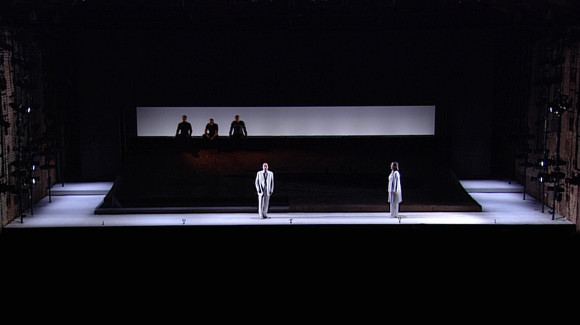
The 1991 Bayreuth Ring cycle is one of those productions that has become a historical landmark, as much as Chereau and Boulez’ 1976 effort, or maybe even more so. For many people it is the Ring. So what is it like? The staging is very bare and much reliance is placed on effects like lasers and smoke. It also makes considerable acting and athletic demands on the singers. It is, in many ways, a very modern production for 1991.
Static Elektra
For the performances of Elektra at the 2010 Baden-Baden festival the Powers that Be chose to revive Herbert Wernicke’s 1997 Munich production with Bettina Göschl directing. The production concept seems to have been inspired by classical Greek drama. Sets and costumes are very simple, even austere, and the singers often address the audience directly. On stage this probably worked quite well as the overall effects are visually striking and the relative lack of interaction between the characters is perhaps appropriate for a work that is so much about alienation.
An eternal will
What follows, eventually, is a review of the Blu-ray recording of Busoni’s Doktor Faust recorded at the Opernhaus Zürich in 2008. First I feel the need to digress somewhat about the work itself.
David Alden’s Poppea
I’m never quite sure what to expect from David Alden. Some things are predictable; striking images, bold colours and a degree of vulgarity, but beyond that it’s hard to be sure. Sometimes he seems to be trying to be deep (his Lucia for example), sometimes more kitschy (Rinaldo) and there’s always a slight undercurrent of him thumbing his nose at the audience. His production of L’incoronazione di Poppea at Barcelona’s Liceu is a curious combination of all these things and I think it works pretty well.
Quirky Idomeneo
Dieter Dorn’s production of Idomeneo, filmed at the Bayerisches Staatsoper in 2008 has some interesting ideas and some arresting images but ultimately it’s hard to figure out where he is trying to go. There’s a lot to like. He clearly places Elettra as a member of the House of Atreus which makes her more believable. He also creates credible personalities for Ilea, Idamante, idomeneo and Arbace. No mean feat. Some of the images are quite arresting too. There is lots of blood and plenty of stage action. The sets are chaotic piles of stuff. Idamante gets a killer sea monster hunting rig. Then there is the ending. Instead of finishing on the “final chorus” the chorus drape the set with white sheets and for ten minutes the orchestra play what is listed in the booklet as a ballet but there is noone on stage and nothing is happening. Going out on ten minutes of the most boring music in the opera is just bizarre.
High tech Orfeo marred by artsy video direction
La Fura dels Baus mounted a spectacular production of Gluck’s Orfeo ed Euridice at the Festival Castell de Peralada in 2012. The concept has the orchestra in costume, on stage and fully involved in the action. There are lots of video projections and spectacular lighting effects. In fact at times the whole thing resembles a son et lumière. There’s also lots of aerial action. It’s all rather exciting. Great work from director Carlus Padrissa.
Let trumpets blow
A new recording of Britten’s Gloriana is to be welcomed, even when it’s less than perfect. It’s an unusual work for Britten. It’s very grand. The orchestra is large and the music doesn’t seem to be as transparent and detailed as much of his work. This is especially true in Act 1 where I almost wondered whether Britten was sending up “grand opera”. It’s also a grand opera sort of plot. The libretto is based on Lytton Strachey’s Elizabeth and Essex and deals with the late life romance between the queen and the young Robert Devereux, earl of Essex and deputy in Ireland. It has some fine moments; notably the lute songs in Act 2 and the choral dances in Act 2. Act 3 is also dramatically quite effective; dealing with Essex’ abortive rebellion and execution. Curiously, in the final scene, Britten resorts to a lot of spoken dialogue, as he does briefly with Balstrode’s admonition in Peter Grimes. It’s almost as if he has no musical vocabulary for the highest emotional states; a sort of anti-Puccini.
The Rape of Lucretia
Britten’s Rape of Lucretia, which premiered at Glyndebourne in 1946, is an interesting work in a number of ways. Musically it marks a distinct break from Peter Grimes and anticipates the later operas in a number of significant ways. It’s written for much lighter forces than Grimes; string quintet, wind quintet plus harp, percussion and piano and there’s no chorus (in the conventional sense). It’s also not a “numbers” piece. There are no set pieces here. The orchestral writing is spare and somewhat dissonant with that absolute clarity that is so characteristic of Britten. Sometimes this almost distracts from the drama on stage.