Vlad Disney does Tsar Saltan

Rimsky Korsakov’s The Tale of Tsar Saltan doesn’t get a lot of performances outside Russia and there’s only one video recording in the catalogue.  It was recorded in 2015 at the Mariinsky Theatre in St. Petersburg in 2015 and is now available as a dual format DVD/Blu-ray package.  It’s a curious work.  It’s based on a Russian folk tale based poem by Pushkin turned into an opera libretto in a prologue and four acts by Vladimir Belsky.  It’s quite odd in that much of it is in a simple strophic form similar to the “wedding song” that Mandryka sings in Strauss’ Arabella.  I have no idea if this is typical of Slavic folk song but it’s a bit repetitive especially when coupled to Rimsky-Korsakov’s colourful but not especially interesting music.  The music is actually rather better in the orchestral interludes, notably the famous Flight of the Bumblebee and some of the choruses which are grand in the Russian manner.

1.sisters

Continue reading

Reflecting on Lucio Silla

I just got my hands on the La Scala recording of Mozart’s Lucio Silla.  It’s the Marshall Pynkoski production that was done at Salzburg, then La Scala, then in somewhat modified form at Opera Atelier in Toronto, which I saw.  It has provoked lots of thoughts about the work itself, how well the OA aesthetic transfers to another house and how seeing a production on video differs from seeing it live.

1.landscape

Continue reading

Forest of the imagination

Malmö might not seem the most obvious place to record Debussy’s Pelléas et Mélisande but in 2016 the opera there assembled a mostly French cast and two young French rising stars; Maxime Pascal as conductor and Benjamin Lazar as director.  The result is interesting, rather good and very French.

1.melisandegolaud

Continue reading

Carmen at Bregenz

One has to recalibrate when reviewing productions from the lake stage at Bregenz.  The challenges for set designer and director are very different from designing/directing in a conventional theatre.  There’s an interview with Es Devlin on the disk of the 2017 production of Bizet’s Carmen that explains the issues very well but broadly it’s a question of creating a single, giant set that can be used throughout the opera and which makes a statement that integrates the work with the environment of the Bodensee.  The challenge for the director, as well, as the usual ones, is to communicate the characters and story when they are rather dwarfed by the setting.  S/he also has to figure out how to fit the lake itself into the story.  I think Devlin and director, Kasper Holten, manage this remarkably well.

1.girls copy

Continue reading

Updated La Bohème

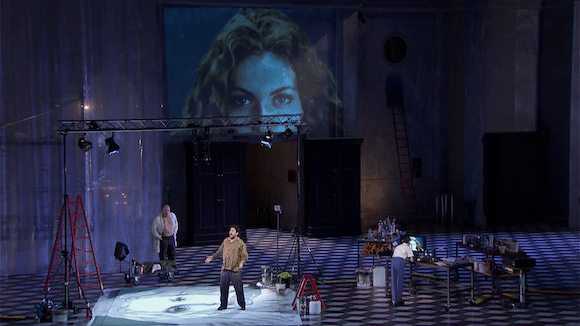
The catalogue is full of La Bohèmes from regional houses sung by serviceable casts.  The version recorded at the Teatro Regio Torino in 2016 is another.  My reason for wanting to look at it is because the production was directed by Àlex Ollé of La Fura dels Baus and I hoped it would prove as insightful as Stefan Herheim’s Oslo production.  It doesn’t really.  He gives the piece a fairly gritty modern setting but I don’t think it speaks to our modern insecurities the way Herheim does.  Rather it plays pretty much as a gritty 19th century setting, which is, admittedly, vastly preferable to Zeffischenk excess or ne0-Broadway tweeness.

act1

Continue reading

A serious take on Les Indes galantes

I’m not really sure that it’s a good idea to take Rameau too seriously, especially a work like Les Indes galantes but that’s what Sidi Larbi Cherkaoui does in his production for the 2016 Münchner Opernfestspiel.  As written, the piece has five separate parts; an allegorical prelude and four scènes, each telling a love story in an “exotic” setting; Turkey, Peru, Persia, among les sauvages of North America.  It’s a spectacle but it uses the exotic settings to poke fun at certain aspects of Western culture in Rameau’s usual irreverent way.  There’s no linking narrative and the characters in each scène (the goddesses Amour and Bellona aside) only appear once.

1.class

Continue reading

A different take on Tosca

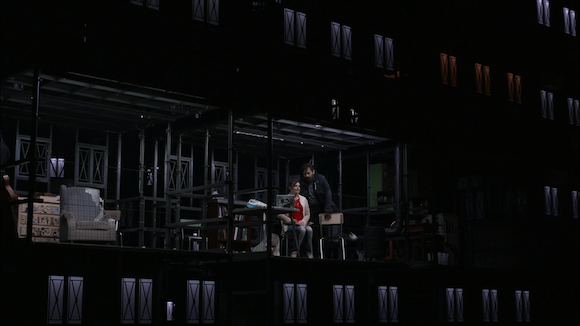
For quite some time I have wondered whether it’s possible to reinterpret Puccini’s Tosca or whether the specificity as to time and place in the libretto makes it effectively impossible?  Indeed I had never even seen it tried.  All this despite the many and obvious anachronisms in the libretto.  All the Toscas I had seen were clearly set in Rome in that one week in 1800 (or at least the implausible version of it that’s contained in the libretto)!  Phillip Himmelmann’s production for the 2017 Baden-Baden Easter Festival breaks the mould in giving it a contemporary, or perhaps near future, setting.

1.church

Continue reading

Faccio’s Amleto

Franco Faccio’s 1865 work Amleto disappeared from the opera repertoire after the disastrous opening night of its 1871 revival at La Scala only to be “rediscovered” in recent years and featured at the 2016 Bregenz Festival.  It was Faccio’s second, and last opera, though he enjoyed a career as a conductor, that included eighteen years as Music Director at La Scala before being institutionalized due to the effects of syphilis.  So, one naturally asks, is it any good?  The answer is an emphatic “yes”.  It’s not only good but seems quite advanced for an Italian opera of that date.  It’s closer in spirit to Puccini than bel canto.  Indeed the soliloquy Essere o non essere sounds curiously like E lucevan le stelle.  It’s similar to later Verdi and, indeed, Puccini in that it’s through sung with recitative like passages and set piece arias and ensemble numbers and it’s more conventionally tonal than its contemporary Tristan und Isolde.  Arguably the orchestral writing is more interesting than that for voice (Ophelia’s funeral march is very fine) and certainly the weakest parts are the ensembles.  It’s probably also fair to say that there is no big hummable melody.  Still, Faccio was twenty five when he wrote it and there aren’t many better operas by twenty five year olds.

1.dance

Continue reading

Dani’s Rosina

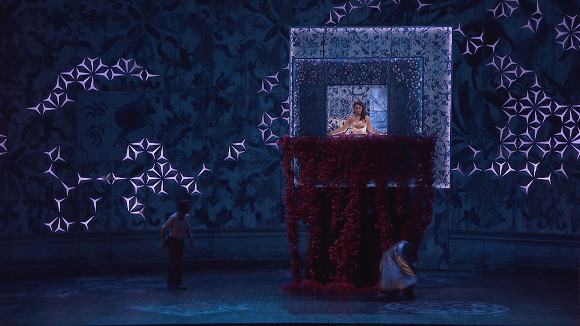
One rather gets the feeling that the 2016 Glyndebourne production of Rossini’s Il barbiere di Siviglia was built around the lady of the house.  It makes a lot of sense.  There may have been better singers in the role of Rosina but I doubt there has ever been a better mover than Danielle de Niese.  She’s matched move for move, eye candy for eye candy by the guys; Björn Burger as Figaro and Taylor Stayton as Almaviva.  There’s more mature comedy from the always fantastic Alessandro Corbelli as Bartolo and the irrepressible Janis Kelly as Berta.

1.balcony

Continue reading

Faust as you have never seen it before

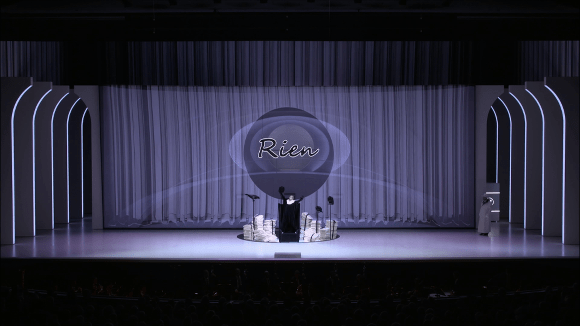
The 2016 Salzburg recording of Gounod’s Faust is challenging.  Perhaps the nine pages of the booklet given over to a concept discussion with the directors should have given me sufficient warning that this was not going to be Faust à la Met.  It’s not.  It’s extremely complex and I’m not sure I fully understand it or whether all the ideas work but I did find it fascinating visually and dramatically, and musically it’s top notch.  That said, traditionalists can save themselves a trip to the ER by walking away now.

1.rien

Continue reading