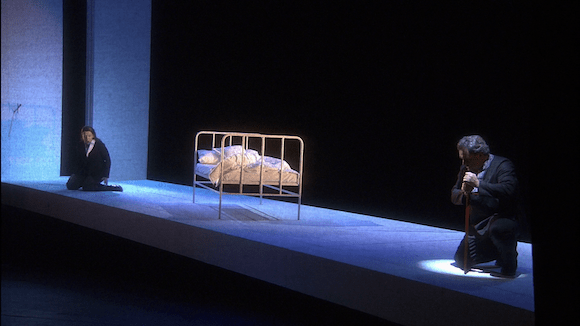
Multi-layered Così

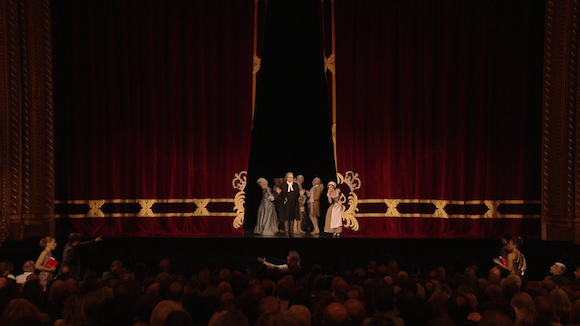
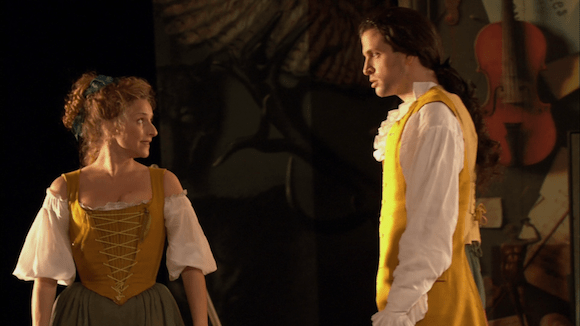
What’s Mozart’s Così fan tutte about?  I doubt there’s a good answer to that question but one element of what it’s about is artifice.  That appears to be Jan Philipp Gloger’s jumping off point for his Royal Opera House production filmed in 2016.  I have pages of notes on how the setting changes and who is singing to whom about what at which point in the opera.  It starts with the “cast”, in 18th century dress, taking a curtain call during the overture but it soon turns out to be a bit more complex.  Dorabella, Fiordiligi, Ferrando and Guglielmo appear in the auditorium in smart modern dress as late comers taking their seats.  Soon the boys are on stage in front of the curtain with Don Alphonso (for some reason dressed as a 17th century divine) while the girls hide in embarrassment behind their programmes.
1.opening

Continue reading

Brisk and attractive Figaro

This recording of Mozart’s Le nozze di Figaro was made in 2004 and released on DVD, which won a Grammy.  It’s now been remastered and released on Blu-ray.  It was recorded at the Théâtre des Champs Elysées in Paris and directed by Jean-Louis Martinoty.  The production is visually attractive and well thought out but not concept driven in any way.  The sets are largely made up of 16th century paintings while the costumes are the operatic version of the 17th or maybe 18th century; low necklines, full skirts, breeches etc.  There are a few interesting touches.  Act 3 is set in the count’s curio room with dead reptiles, skulls and so on and it seems somehow to provoke extreme nostalgia in the countess during Dove sono.  For the most part it’s a highly competent, well paced effort though with nothing new or different to say.

1.figarosusanna

Continue reading

If you are going to be crazy, do it properly

In 1884 Ludwig II of Bavaria put on a spectacular outdoor show for his guests at Herrenchiemsee.  It featured perhaps the first use of electric light outdoors in a spectacular lighting plot designed by Edison trained Alois Zettler.  That’s the jumping off point for Des Königs Zauberflöte.  So now imagine, as was not uncommon in the 19th century, that the aristocratic guests had decided to put on a spectacular amateur performance of Die Zauberflöte.  Ok, it’s not that probable that Emperor Franz Joseph and his wife, let alone Otto von Bismarck,would have performed but hang in there.  Now suppose, through some warp of time, space and imagination that the “real” Papageno had shown up and pointed out loudly, and at length, that’s not really what happened.  And so we get Enoch zu Guttenberg’s reimagining of Mozart and Schikaneder’s iconic work that played at Munich’s Prinzregententheater in 2013.

1.ladies

Continue reading

The Dark and the Light

David Pountney is rarely afraid of taking risks in pursuit of an idea and that seems to be what’s going on in his 2008 Wiener Staatsoper production of Verdi’s La forza del destino.  The basic concept seems to be to draw as much distinction as possible between the piece’s predominantly dark tone while making the ‘scherzo’ like elements as mad as possible.  And occasionally mixing up the two to create deliberate confusion.  To this end he uses a lot of moving set elements and projections; often fuzzily superimposed on stage action.  Preziosilla and the camp followers are hot pants clad cowgirls.  The full effect is seen in the Act 3 “orgy” where hospital patients, some on drips etc, interact with cow girls and a marching band while giant fuzzy B&W projections of WW2 armour play on the scrim.  It’s really busy and takes some decoding.

1.bedroom

Continue reading

Cogent Parsifal

Wagner’s Parsifal has been served rather well on Blu-ray and DVD in the last few years.  The 2016 Bayreuth recording is another interesting addition to the list.  Uwe Eric Laufenberg’s production is not exactly traditional but it’s not “in your face” conceptual either.  The setting is contemporary and various visual clues locate it where Europe meets Asia; perhaps the Southern Caucasus.  The grail temple is run down.  There are soldiers and refugees and tourists, as well as the Grail knights.  There’s plenty of Christian symbolism around.  The “swan scene” is played straight.  The “communion scene” uses Amfortas as the source of the communion blood; an idea which seems common enough.  Here he’s wearing a crown of thorns (and not much else) and there’s lots of blood.

1.swan

Continue reading

Straightforward Otello from the Met

In 2015 the Metropolitan Opera premiered a new production of Verdi’s Otello directed by Bartlett Sher.  It was broadcast in the Met in HD series and subsequently released on Blu-ray and DVD.  It’s a bit hard to judge the production on video because of the video direction.  I don’t think there are any big ideas but it’s decorative enough with arrangements and rearrangements of plexiglass wall/rooms and some effective video projections for things like the storm scene.  Only Act 4 breaks the mould with a sparse stage with just a bed and a few chairs.  I strongly suspect though from the occasional wide angle shot that there was a lot more going on visually than one sees on the video.  Costumes are 19th centuryish and quite decorative.

1.storm

Continue reading

Never forget, never forgive

It’s the 73rd anniversary of the liberation of Auschwitz by troops of the Red Army and I’ve been watching a recording of Miecyslaw Weinberg’s The Passenger.  The opera was written in 1968 but the political climate in the then Soviet Union meant that, despite the advocacy of Dmitri Shostakovich, it had to wait until 2010 before it was given a fully staged performance. That happened, and was recorded, at the Bregenz festival in a production directed by David Pountney.

1.deck

Continue reading

Norma with string

I rather like recordings from the Macerata Festival where the performances take place in the enormous amphitheatre of the Arena Sferisterio.  Bellini’s Norma is a good choice for such as setting and the 2016 production directed by Luigi di Gangi and Ugo Giacomazzi makes good use of the space.  It also uses string.  The sets are stringy.  The very scruffy Gauls wear shapeless tunics with lots of string over them.  The slightly smarter Romans also wear string.  And everybody plays with string.  There are more strings than in the Princeton Physics Department. There’s lots of face paint too.  The production also makes use of a spectacular multi-coloured lighting plot but, apart from the visuals, is pretty conventional and straightforward.

1.green

Continue reading

I due Foscari

Verdi’s sixth opera, I due Foscari, is probably not well known to many readers so a brief description may be in order.  It’s a rather grim tale of injustice and revenge.  Francesco Foscari is the aged Doge of Venice.  His son, Jacopo, has been stitched up by the family rival Jacopo Loredano and exiled to Crete.  He returns to try and clear his name but is fitted up again.  This time for the murder of one Donato.  Despite torture he refuses to confess and is sentenced to return to exile in Crete.  The first three quarters of the opera is mostly either father or son bemoaning their fate (Francesco has already lost three sons.  Lady Bracknell would be unimpressed) or Lucrezia, Jacopo’s wife, pleading for mercy to anyone who will listen.  Then there’s a final scene where Francesco receives proof of his son’s innocence, closely followed by news of his death, closely followed by news that the Council and Senate are sacking him.  Loredano gloats.  Foscari dies.  Structurally it’s very much a “numbers” opera with a succession of short scenes mostly featuring various combinations of the three Foscaris and the chorus.  There are a lot of quite sophisticated ensemble pieces as well as a couple of solo arias for each of the principals.  It’s musically rather distinguished in fact.  The three Foscari roles are big sings.  Nobody else has much to do.

1.gondoliers

Continue reading

Puritans in Madrid

I keep trying with Bellini’s I Puritani.  People I respect admire it a lot but I just cannot find a way to like it despite there being, undoubtedly, some very fine music in Acts 2 and 3.  I think there are, essentially, two problems and I could maybe cope with either in isolation but taken together my brain just starts to turn off.  The first is plot and there are two huge problems with this piece.  It’s complete garbage historically.  It makes Donizetti’s Tudor operas look like Geoffrey Elton.  But worse, it makes no sense in it’s own terms.  It’s just a string of improbable coincidences.  The second problem is emotional dissonance.  Too often the emotional tenor of the music is just way inappropriate to the stage action.  This is common to all bel canto of course and on its own I can deal.  I just can’t take the two things together.

1.weddingdress

Continue reading