This year’s fall opera offering from the Glenn Gould School was a double bill of short chamber operas. It played at Mazzoleni Hall on Friday and Saturday evenings with Liza Balkan directing and Jennifer Tung conducting.
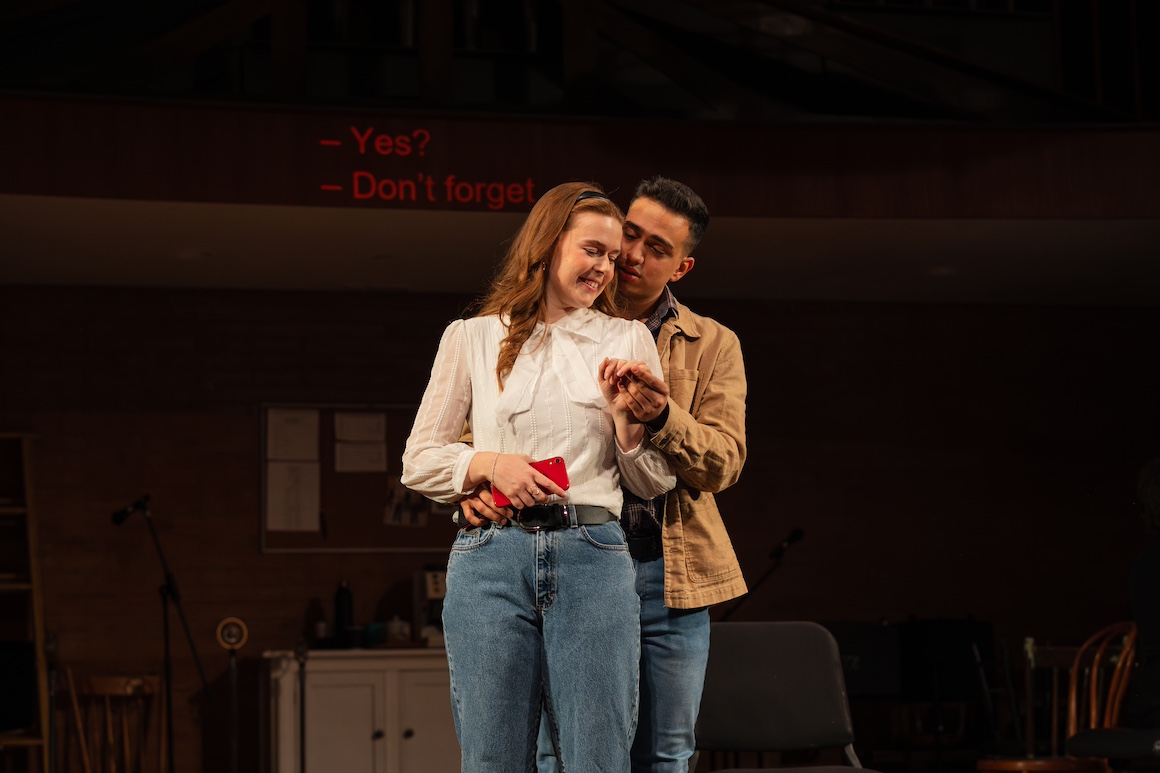

This year’s fall opera offering from the Glenn Gould School was a double bill of short chamber operas. It played at Mazzoleni Hall on Friday and Saturday evenings with Liza Balkan directing and Jennifer Tung conducting.
Divine Monster, by Elena Kaufman, directed by Mary Dwyer, is currently playing in the RBC Finance Studio at Soulpepper as part of the Fringe. Martha, a young, lesbian Canadian rock singer has just split up with her girlfriend on the Paris leg of a backpacking trip. She finds herself in Père Lachaise, chez Sarah Bernhardt, late at night. It’s one of the rare nights when an ancient ritual might free Bernhardt from her incorporeal existence if the right “victim” can be found. Martha, who has basically decided that she is a failure with no future might be the ideal candidate. At least she can see and talk to Sarah though not the other ghosts who lurk around.

The Glenn Gould School gave the first of two performances of Mozart’s Die Zauberflöte at Koerner Hall on Wednesday evening. The production is directed by Allison Grant and is pretty straightforward, though quite heavily cut. The “look” is maybe Miyazaki animation (costumes by Alex Amini) with a minimalist backdrop (Kim Sue Bartnik) which is enlivened by interesting projections by Nathan Bruce and quite striking lighting by Jason Hand. There’s a sort of dumb show during the overture that the Director’s Notes imply is something to do with the opera being about a dysfunctional family (what opera family isn’t?) but the idea isn’t developed at all.
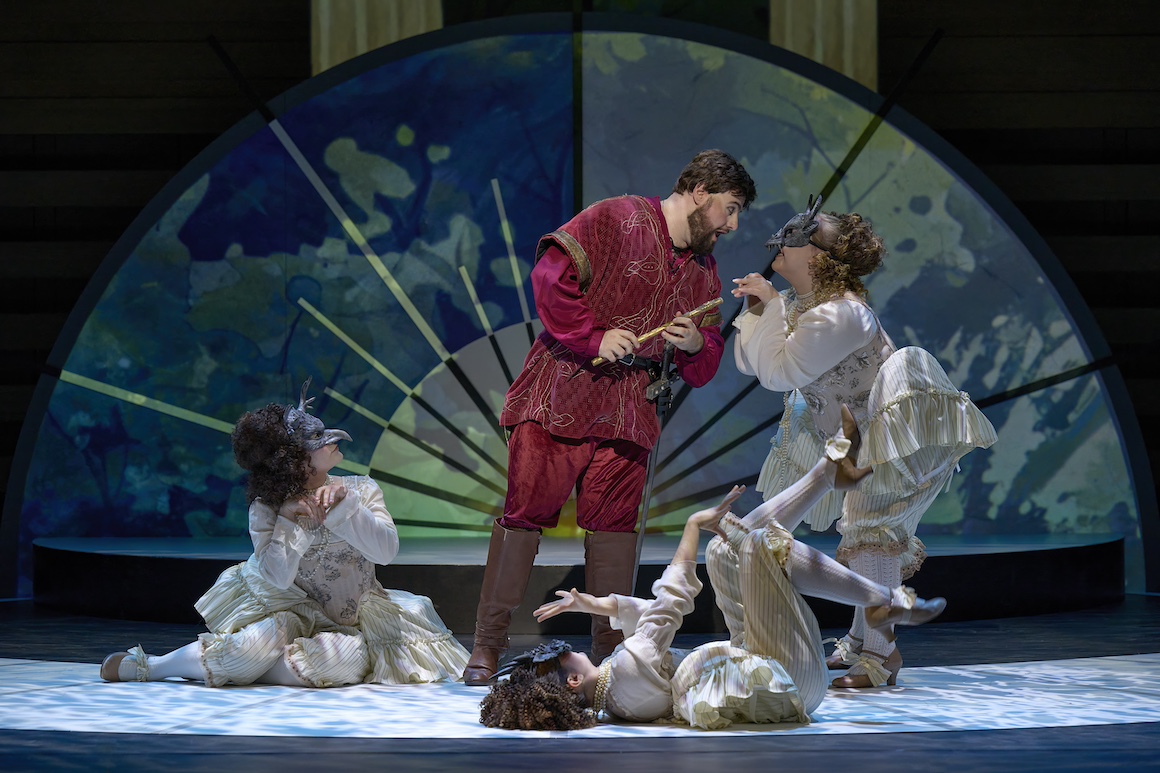
It’s the rub that makes the difference, not the sauce. Or so we are told by Fancy’s stepfather and uncle who now runs the family BBQ restaurant somewhere far south of Elsinore in James ljames’ Fat Ham which opened on Wednesday at Canadian Stage, Berkeley Street. Director Philip Akin describes it as an “overlay” on a well known play by Shakespeare and that’s probably as good a way of looking at it as any.

 What She Saw is a new album of vocal music by New York composer Douglas Anderson. There are two works on the record. There’s a cycle of eleven Cassandra Songs for mezzo-soprano and piano and a monodrama for mezzo-soprano, piano and percussion called Through/In.
The Cassandra Songs each set an episode in Cassandra’s life dwelling, inevitably, on the “always right but never believed” motif and the ill treatment that gets her. The texts, by Andrew Joffe, are really rather good and they get a somewhat atonal setting; especially in the piano line. The vocal style varies from conversational to declamatory. The settings are actually quite varied though very much in the same sound world. It’s well performed by mezzo-soprano Rachel Arky and pianist Elizabeth Rodgers. The recording. was made in 2023 at Martin Patrych Memorial Studios in the Bronx an it’s clean and well balanced.
Saturday night’s show in the West End Micro Music Festival continued the theme of combining chamber music with other influences. This time it was rock; specifically NYC 80’s rock. It was really varied, stimulating and, at times, bordering on sensory overload. Brad Cherwin riffed with pre-recorded clarinet and electronics on a version of Steve Reich’s New York Counterpoint to open the show. Then came what might have been my favourite bit. It was a version of Julia Wolfe’s East Broadway for electronics and toy piano. Watching the usually soft spoken, even demure, Nahre Sol go completely manic and beat the crap out of a toy piano was a blast.
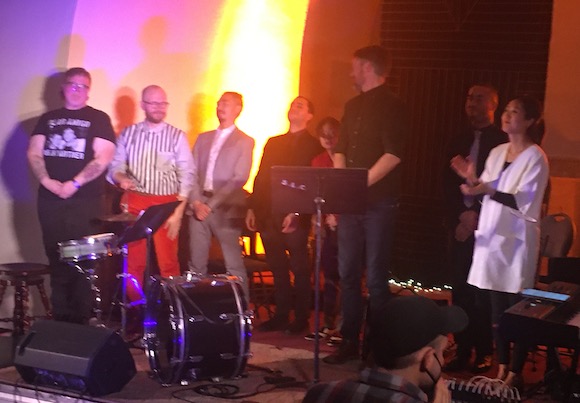
There was more Julia Wolfe (Blue Dress for drums and cello?) and a David Lang arrangement of Lou Reed’s Heroin with Cormac Culkeen on vocals and a fairly large ensemble and more vocals with a version of Laurie Anderson’s Let X=X and It Tango. The final number was a killer version of David Lang’s Killer with Hee-Soo Yoon playing mad distorted violin while kicking a bass drum.
So, again, WEMMF hit the spot with an intriguing and (over) stimulating blend of rock, classical technique, minimalism and, frankly, sheer lunacy of a kind surely not heard before at Redeemer Lutheran! Great fun much enhanced by Billy Wong’s evocative lighting and Dave Grenon’s sound work.
The final concert is next Friday, also at Redeemer Lutheran, QUARTET PLUS PAPER V2 will feature, inter alia, a new multimedia work for pianist, clarinetist/visual artist, video projection and electronics composed and performed by Nahre Sol and Brad Cherwin.
 Back to relative quiet! The main event in the coming week is the GGS spring production. They are doing Handel’s Alcina. The cast includes Meghan Jamieson, Irina Medvedeva, Christina Campsall, Lillian Brooks, Joanna Burt, Asitha Tennekoon and Keith Lam. Leon Major directs and Ivars Taurins conducts. The publicity material suggests a 1920s setting. Anyway it’s at Koerner Hall at 7.30pm on Wednesday and Friday.
There are a couple of kid friendly March break concerts in the RBA. Tuesday sees what seems to have become an annual event; Kyra Millan’s Opera Interactive. This year she is joined by Tina Faye and Charles Sy. Then on Thursday Cawthra Park Chamber Choir and conductor Bob Anderson, one of the GTA’s leading school choirs, present various choral traditions and styles from the Renaissance to contemporary Canadian works. Charles Sy, a Cawthra Park alumnus also features in this one. Both at noon of course.
Then at the Newmarket Theatre on Saturday at 7:30pm and Sunday at 2pm opera Luminata are performing. This is a rather odd spectacular thing with taped orchestra and pyrotechnics. I haven’t seen them but they got a rather more positive reception than I expected last time around. www.operaluminata.com for details.
So, onto Siegfried. Now we are in 1968 but it’s a rather laid back Danish 1968. It doesn’t reference any of the canonical events of that momentous year though there is a bit of a youth vs experience vibe. Holten doesn’t let us forget that Siegfried is 18 and Stig Anderson, at 60, manages to pull off the look very well. James Johnson’s Wotan, on the other hand, is shown in decline; the elder statesman who can’t retire gracefully, like a Berlusconi or Murdoch. Mime is an ageing nobody hunched over his typewriter and still yearning for some “success”.
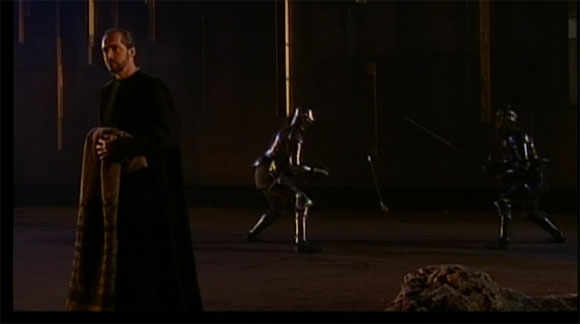
Monteverdi’s Il combattimento di Tancredi e Clorinda must be, at twenty two minutes, one of the shortest operas around. In typical Monterverdi style though it crams a lot of music and emotion into a very short space. Based on a story by Torquato Tasso, it concerns a Christian knight, Tancredi, and a Moorish princess, Clorinda. Somehow they have managed to fall in love but are still fighting on opposite sides They meet on the battlefield but as each has their visor down they don’t recognize each other. They fight a long and bloody single combat in which Tancredi mortally wounds Clorinda. When their helmets are removed they recognize each other and Clorinda asks Tancredi to baptize her so they can be united in heaven. It’s pretty dodgy theology but great theatre.
There’s lots to like in the 2003 Glyndebourne recording of Die Fledermaus. Let’s start with Stephen Lawless’ production. It’s attractively designed, quite slick and has a few good new gags without going overboard. The sets are designed with striking diagonals and staircases and gantries. Rotation is used both as a device to change the setting and as an element in the scene composition. The overall effect is that the scene changes from drawing room to a sort of “gilded cage” for Orlofsky’s party – which opens out to create space for the action – to a prison with minimum disruption to us or the action. Spots are used to create stagey effects and at one point Jurowski in the pit ostentatiously upstages the actors on stage. Lawless never lets us forget this is a “show”. Continue reading

 operaramblings