A Christofascist Tosca

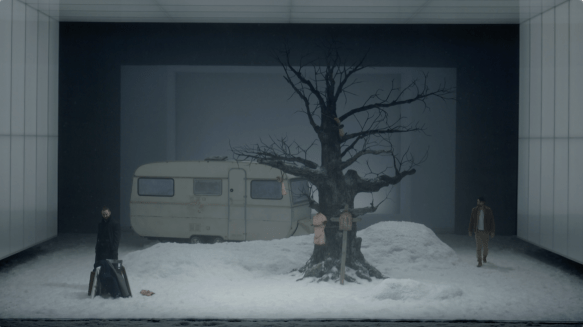
Puccini’s Tosca is a work that seems to turn the boldest directors conservative.  Up until now the only one I had seen that wasn’t set in Rome in 1800 was Philip Himmelmann’s production in Baden-Baden.  That starred Kristine Opolais and so does Martin Kušej’s 2022 production at the Theater an der Wien.  And like the Baden-Baden work this sets the piece in some sort of Christofascist dystopia but a very different one from Himmelmann.
1.caravantree

Continue reading

Der Schatzgräber

Franz Schreker’s Der Schatzgräber premiered in Frankfurt in 1920.  It was his last and most successful opera but it disappeared from the repertory under the Nazis and performances have been rare since WW2.  Christof Loy directed it for Deutsche Oper Berlin in a new production in 2022, marking the 100th anniversary of the first performance in Berlin.  It was also a continuation of Loy’s project of bringing less well known opera with “strong female characters” to DOB, following his production of Korngold’s Das Wunder der Heliane and Zandonai’s Francesca di Rimini.

1.foolqueen

Continue reading

The other Humperdinck opera

Humperdinck’s second “fairy tale” opera; Königskinder, is unusual in that, although it includes traditional fairy tale elements, it isn’t based on a traditional fairy tale but rather on a play by Else Bernstein-Porges.  It’s, of course, also performed much less frequently than Hänsel und Gretel.  It was given at Dutch National Opera, in a production by Christof Loy, in 2022 and recorded for video release.

1.hut

Continue reading

Das Wunder der Heliane

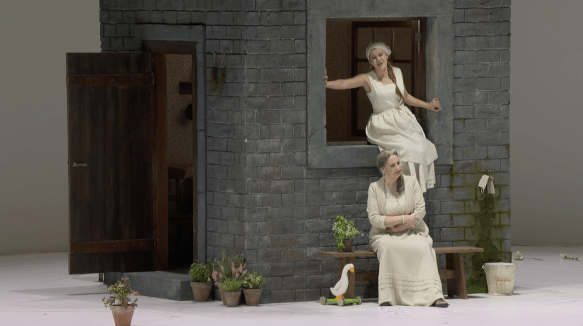
The video recording, made at the Deutsche Oper in 2018, of Korngold’s rarely seen Das Wunder der Heliane is yet another lesson in holding off on making judgements on an opera or production until one has seen the whole thing.  I still don’t think it’s a lost masterpiece but I’m feeling a lot less derisive than I was at the end of Act I.

1.dress

Continue reading

Creepy Wozzeck

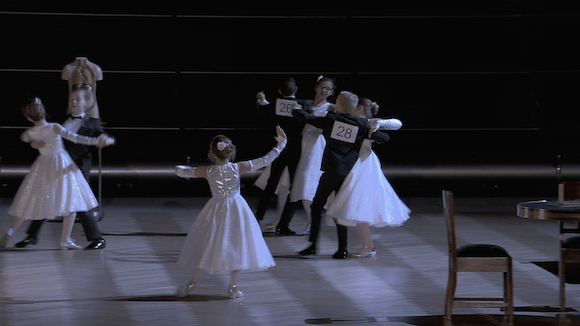
Alban Berg’s Wozzeck seems to attract just about every possible treatment from directors other than a straightforwardly literal one.  Krzysof Warlikowski’s approach, seen at Dutch National Opera in 2017, is to go back to the original story on which the Büchner play, in its turn the source for the opera, is based.  Wrapped around that are several interesting ideas which I can’t fully unpack but which make for a rather creepy but compelling production.  Alas, the disk package has nothing to say about the production so, interpretively, one is on one’s own.

1.dancers

Continue reading

Petitbon’s Lulu

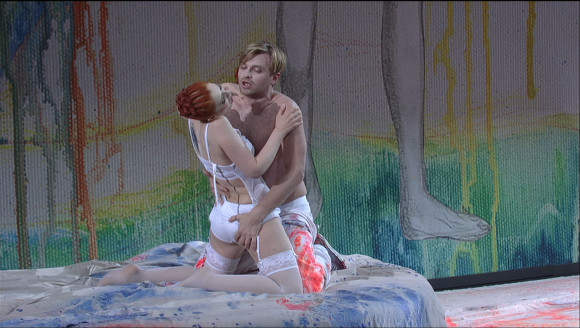
Vera Nemirova’s production of Berg’s Lulu was recorded in the Haus für Mozart at Salzburg in 2010.  It’s presented in the now conventional three act version completed by Friedrich Cerha.  The sets are painterly, including in Act 1 a giant painting of the title character.  Lighting is used to create a very distinct palette for each scene and the detailed direction of the actors is careful and effective.  I didn’t see any big ideas but then on this video recording, if there had been any, they would likely have been lost in the incessant close ups and strange camera angles.  One “trick” perhaps is that much of the action in Act 3 Scene 1 takes place in the auditorium with a fair bit of confusion as the actors hand out fake cash to the punters.  This is, of course, the scene where the glitterati go broke so perhaps some irony is intended.

1.ass Continue reading