Être ou ne pas être

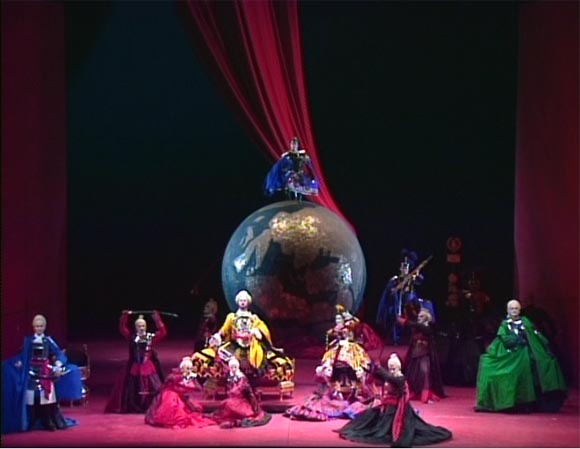
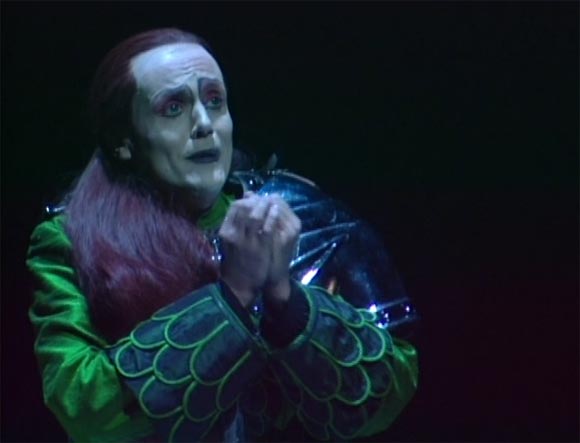
Ambroise Thomas’ Hamlet is a very grand French opera based loosely on various (loose) French adaptations of the play by Shakespeare. If one discards any notion that one is going to see Shakespeare with music and takes the piece on its own terms it’s really pretty good. In recent years it’s been doing the international opera circuit in a production by Patrice Caurier and Moshe Leiser that originated in Geneva in 1996 and was, for example, seen in the Met HD series a year or two ago. Most productions have featured Simon Keenleyside as Hamlet and Natalie Dessay as Ophélie. The available DVD version, recorded at the Liceu in Barcelona in 2003 features both of them.

Really all this opera needs to work is a baritone with exemplary French who can sing with power and lyricism for three hours and really, really act. That, I guess, is why Keenleyside owns the role. He’s superb. He probably peaks in the really quite amazing second act where he does a sort of mad scene as the “play within a play” misfires but he’s superb throughout. The second requirement is someone who can do a compelling mad scene with lots of blood and coloratura. Natalie Dessay seems to have trouble cutting her wrists but is otherwise brilliant and is rewarded with what is probably the longest applause for a single aria ever committed to DVD.
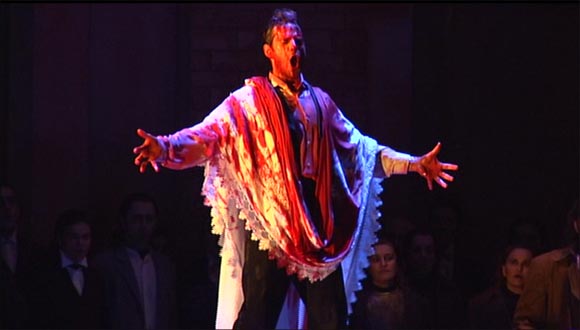
The rest of the cast is mostly very good. Alain Vernhes’ Claudius is very strong, vocally and dramatically; certainly much better than James Morris at the Met. Béatrice Uria-Monzon is occasionally a bit squally as Gertrude but acts really well, especially in the confrontation with Hamlet in Act 3. I didn’t care much for Daniil Shtoda’s Laërte. he sounded too “Italian” and not at all idiomatic. Overall though really great singing backed up by a very crisp performance from the orchestra under Bertrand de Billy. They sounded more lyrical and less bombastic than in the Met version.
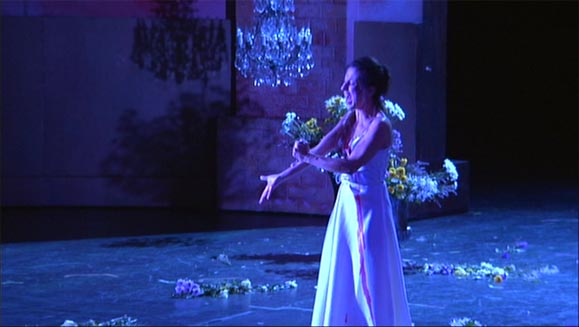
The production is not especially exciting. It’s very plain with just a few moving “faux marble” walls. Most of the scenic effects are left to the lighting plot which is effective though hard to film (see below). Costumes are a sort of generic late 19th century with breastplates thrown in in odd places for some reason. It all provides an effective enough backdrop for some carefully directed and well executed acting. There’s no high concept here but the story gets told.
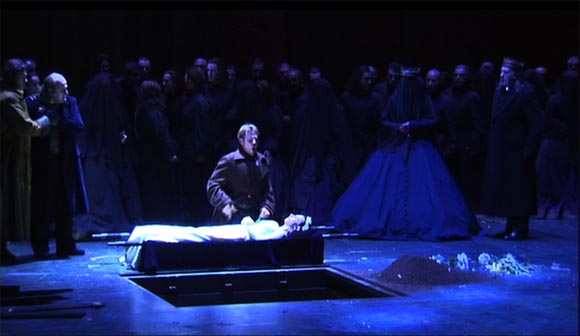
The video direction by Toni Bergallo is pretty good. It’s a tough ask. Often the light levels are low with a really brutal lighting focus on a single character. The Act 2 scene between Hamlet and the ghost is a great example. It’s very hard to make something like that look good on video. The cameras start to lose definition with the low light levels and then the high local contrast sort of blurs out. I found myself watching from quite close up even on a sixty inch screen! The DTS 5.1 sound track is OK but not demonstration quality. There’s not a lot of spatial depth and sometimes the singers sound as if they have been miked too close. The Dolby surround and LPCM stereo mixes aren’t any better. It’s not bad overall technically but it’s not up with the latest from a label like Opus Arte. There are subtitles in English, French, German, Italian, Castilian and Catalan. The only extra is EMI’s standard teaser reel.

Overall, this is well worth seeing. It’s a pretty good little known work, Keenleyside is exceptional and the production for DVD is pretty decent.
Disenchanted Island

The temptation to review this afternoon’s MetHD broadcast of The Enchanted Island in McGonagallesque (or perhaps more accurately, Samsesque) doggerel is strong but I think I’ve had enough of it for one day and do you really want to read stuff like:

Ten great singers get to sing trash
‘Cos Peter Gelb wants lots of cash
Jeremy Sams goes for broke
Which almost rhymes with baroque
For real baroque would too jazzy
for the New York bourgeoisie

Unfortunately that’s about as good as the libretto gets most of the time.

There are a few moments when one half suspects an opera is about to break out. The lovers’s quartet in Act 1 set to “Endless pleasure” is pretty good and Act 2 starts well with strong arias from Hermia (Liz deShong) and Sycorax (Joyce diDonato). Throughout the excellent cast sing and act with technical excellence and great commitment but the overall effect is still of the Royal Shakespeare Company doing panto with the funny bits left out.

It’s perfectly possible to do baroque in a way that is funny, engaging and accessible. The Glyndebourne production of Purcell’s The Fairy Queen and Salzburg’s hilarious and subversive production of Purcell’s King Arthur show what can be done. The Enchanted Island doesn’t cut it, being one more proof that the Met’s formula of throwing lots of money at a bad idea doesn’t work.

Camera work and sound quality were no better than usual.

If you feel the need to read a proper review Olivia Giovetti’s is very good.

Mozart’s Mitridate – ROH 1993

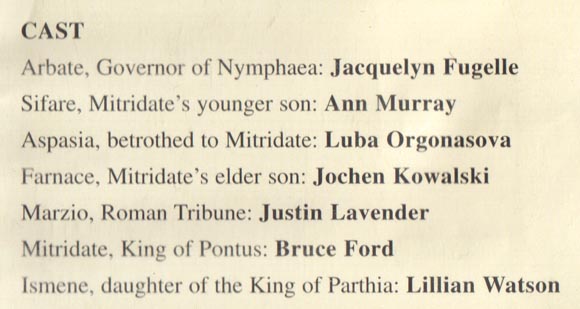
Mitridate, rè di Ponto is a three act opera seria by a fourteen year old kid called Mozart with a libretto based on Racine. Like most operas with a libretto based on Racine, and there are many, it isn’t exactly a barrel load of laughs. While it’s fair to say that the music may well be the best ever composed by a fourteen year old and it is recognisably Mozart it’s still not really quite enough to carry three hours of recitative and da capo arias about the troubled love life and familial relations of a first century BC King of Pontus and his fractious sons. In short, it gets a bit tedious. For a modern audience it’s not improved by the fact that all the male voices are high. Originally the score called for three castrati and two tenors. In the 1993 Royal Opera House production two of the three castrato roles were taken by mezzos and the third, inevitably the baddy, by a countertenor. For the record, here’s the full cast:

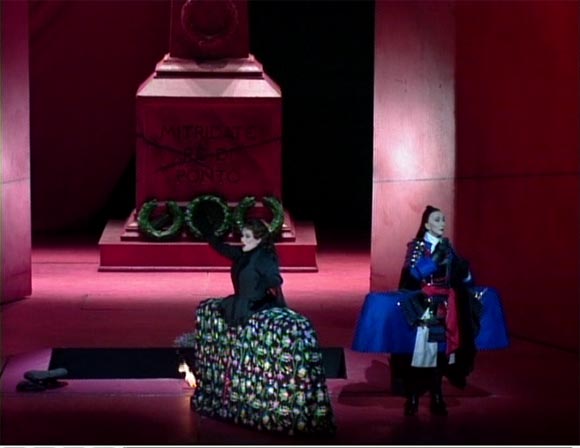
The director – Graham Vick, designer – Paul Brown and choreographer – Ron Howell do a pretty good job of injecting some life into the production with fairly extreme use of colour in the costume design, sets and makeup. The choreography and blocking is also quite striking at times but it still ends up being rather a wash of coloratura. The singers too do a worthy job but after a while it all starts to sound the same. Good work too from conductor, Paul Daniel, and the ROH orchestra but ultimately a bit blah.

Video director Derek Bailey does a pretty good job for the period. It’s hard to object to closing in on the singer during a da capo aria and he does pull out when there is stage wide action. He’s not helped by pretty average picture quality that lacks the definition needed to make long shots fully effective. Technically it’s a typical Kultur release of the period. The less than brilliant picture is coupled with so-so Dolby 2.0 sound, hard coded English sub-titles and minimum documentation. It’s also a bit quirky in that the overture comes on, with lead in credits, as soon as the disc is inserted. There’s no “set-up” menu.

One for the Mozart completist.

Ein Volk, Ein Opera Company, Kein Opera

Forgive the grammar, you get the idea.

So at today’s COC season launch there was an exchange that went roughly like this:

Alexander Neef: Any questions?

Bald academic dude in jacket and tie: I’d like to ask about progress on the two commissions (unannounced) to Margaret Atwood and [somebody else] and more generally when are we going to see a Canadian opera on the Four Seasons stage? makes unflattering comparisons to the SF Opera announcement yesterday.

Clique of Canadian Academic Composers: Here, here, rhubarb etc.

Alexander Neef: That’s become a ritual question so I’ll give you my ritual answer “When we have something concrete to announce we’ll announce it”.

Grumpy female: Claims that there are “many” Canadian composers who could compose something better than L’Amour du Loin (though mentions no names).

More rhubarb etc.

In principle I can see that it’s part of the remit of a national opera company to produce operas by its nationals though to what extent the Canadian Opera Company is a national company is well open to question. It only plays in Toronto. It raises just about all its funding there and it gets next to no support from either the federal government or the hockey channel which masquerades as a national public broadcaster. That said, I doubt one Canadian in a million could name a Canadian opera composer and if they could it would likely be one that no sane opera house would consider working with. So there’s a problem. No company can afford to give a seventh of its season to a guaranteed flop and no-one in Canada is going to pay for a vanity production by an unknown composer even if the libretto is written by Atwood or Ondaatje. I don’t hear solutions. I just hear over-entitled academics demanding that someone else throw away a couple of million bucks.

Rant over. Normal service will now be resumed.

Canadian Opera Company season announcement 2012/13

So this morning I was at the Four Seasons Centre for the press conference to announce the COC’s 2012/13 season.

Board President Philip Deck started off with a strong statement about continuing to improve the quality of the product on the Four Seasons Centre stage and striving for “uncompromising and inspiring” programming with a goal of becoming “one of the world’s great opera houses”. There are crucial words here. If General Director Alexander Neef is to meet these goals he will need a supportive Board. It looks like they are there with him at least for now and that’s very good to hear.

There was a very good “teaser video” with contributions from the many Canadians who will feature next season. I guess this will be available on line at some point. Then we got to the main business with Alexander presenting the line up. It’s pretty exciting so here it is in all its glory and with my commentary.  Continue reading →

Opera 101 – Tosca

Opera 101(I) at the Duke of Westminster last night was more interesting than I expected. Besides the usual host, Brent Bambury, we had the director of the current production Paul Curran, Mark Delavan, who is singing Scarpia, and Julie Makerov, one of two Toscas. Delavan and Makerov were engaging and funny if not specially revelatory though both revealed a taste for country music which is a bit disturbing. Most of the interest came from Curran. He’s an intense little Scot who tells it how he sees it. He grew up in the less salubrious parts of Glasgow (I’m reliably informed that there are salubrious bits!) and the first opera he saw was Wozzeck which he describes as the story of his life. I was struck by his emphasis on the role of the music in his directorial process. He described himself as a “musician first” and talked at some length about his role in making sure that the singers can sing to their best ability. He’s also no literalist. I asked him whether the very specific time and place setting of Tosca was constraining or liberating and he went on a bit of a rant which I loved! He listed off the historical inaccuracies with the Tosca libretto with encyclopaedic accuracy peppered with expressions like “complete bullshit” basically ending up at “so I feel I can do pretty much what I like with it”. He’s also not one for the pretties. He told a story about being criticized because Tosca’s dress in Act 2 was inelegant. His response “It’s a rape scene (F word not far away here we feel). I don’t think she’s asking ‘does my bum look big in this?'”. I liked his take on “Vissi d’arte” as a Jewish aria too. He’s alluding to it’s sense of a contractual relationship with God as opposed to Tosca’s over Catholicism (he’s from a very Catholic family). All in all good value.

We had a brief chat afterwards about Britten, ‘difficult’ operas and stuff. I want to see his Peter Grimes but, unfortunately, Santa Fe isn’t exactly next door.

In a couple or three hours it will back to COC for me for the third time in 24 hours. This time for the 2012/13 season announcement.

fn1. Opera 101 is a pub based series of fairly informal talks by members of the creative team for various COC productions.

COC Ensemble Studio – Works by female composers

It feels good to be back listening to live music after a bit of a drought. Today I was at a lunchtime recital in the Richard Bradshaw Amphitheatre given by members of the Canadian Opera Company Studio Ensemble. It was very good indeed. I want to start with the undoubted highlight; Jacqueline Woodley‘s performance of Judith Weir’s piece for unaccompanied soprano, King Harald’s Saga. It’s a complex, fascinating and very difficult piece requiring the singer to switch between voices and to pull off a range of singing styles. Woodley was awesome. I’ve heard her now in quite a few contemporary pieces, though perhaps none as hard as this, and she has always impressed.

Almost as impressive was Ileana Montalbetti’s performance of Libby Larsen’s Donal Oge. It’s a work that requires considerable power from the singer and Ileana, unsurprisingly delivered. She’s got a big voice and she knows how to use it. Neil Craighead gave us two songs by Cecile Chaminade. He sounds a good deal more powerful than last time I heard him. He has a lovely tone and now the power too. He hasn’t quite got the knack of throttling it back yet but that will come I expect. We also got some fiendishly difficult Alma Mahler songs which clearly taxed tenor Chris Enns. They would have taxed anyone I think. Mireille Asselin gave a pleasing unaccompanied performance of a piece from Hildegard von Bingen and the programme was rounded out by two duets by Fanny Hensel sung by Asselin and Craighead and Montalbetti and Enns.

The pianists were the excellent Jenna Douglas and the even more impressive Timothy Cheung. All in all, this was as good a concert as I have heard in the COC’s free lunchtime series.

Joan Sutherland in Toronto

It’s a pet peeve of mine that, alone among state funded TV broadcasters in the industrialised world, CBC doesn’t broadcast opera on TV. There are many other reasons why the CBC is a national embarrassment but this one rankles. That said, there have been a couple of CBC broadcasts over the years and they did make it to DVD. These include a 1981 Canadian Opera Company performance of Bellini’s Norma with Joan Sutherland. It’s a great big pile of steaming whale dreck. The production, by Lotfi Mansouri, looks more like it was done in 1881. The Gauls have helmets with horns on. Sutherland seems to be dressed as the Statue of Liberty and the tenor playing Pollione (Francisco Ortiz) looks like Stephen Fry as the Roman centurion in Black Adder Back and Forth. Add to that it’s pretty much park and bark as far as blocking goes.

Sutherland is on poor form. She has no lower register to speak of and she gets about as much drama out of the music as a doorpost. Whether her powers were in serious decline at this point or she was just having an off night I can’t tell but it’s pretty sad. Ortiz is dreadful. He’s often below the note and seems to be using every trick in the tenor playbook to approximate his music. Bonynge’s conducting is deadly dull. The only part of the music making worthy of note is Tatiana Troyanos as Adalgisa. She’s very good indeed.

Technically the DVD is at least as bad as the performance. It’s recorded in mono (mono, in 1981!) and the sound is muddy and badly balanced. At some points the chorus is completely inaudible. Of course, some of this maybe the lousy O’Keefe Centre acoustics but I think it’s mostly just bad engineering. The picture is very poor quality too. There are hard coded English subtitles. This is one to avoid.

“Thanks” to Lydia at Definitely the Opera for drawing this to my attention!

The Turn of the Screw – Perth 1991

The DVD of Opera Australia’s production of Britten’s The Turn of the Screw is a train wreck. I’m not sure how much of the problem is due to the stage production and how much to the treatment for DVD but the end result is horrible. It’s almost impossible to comment on Neil Armfield’s production because one can’t tell when one is seeing it and when it’s being overlaid or perhaps even replaced by some conceit of the video director. The overall effect is completely incoherent. The barely TV quality picture doesn’t help things.

Musically it’s not good either. The singing is, at best, patchy. The children (Lanneke Jones as Flora and Patrick Littlemore as Miles) do fine and the ghostly pair; Anson Austin and Wendy Dixon, are adequate without being terribly otherworldly. The real problem lies with the Governess of Eilene Hannan and the Mrs. Grose of Margaret Haggart. Both are squally when loud and tending to drop into speech when quieter. Their duets are really hard on the ears. David Stanhope conducts the West Australian Symphony Orchestra. It’s not pretty. This score is hugely rhythmically inventive and the rhythm should drive the thing along. This reading is rhythmic mush. Again, nobody is helped by the recording. The quality of the Dolby 2.0 soundtrack is poor. It’s unfocussed and muddy adding to the overall lack of definition.

If you’ve got this far you probably won’t care that there are no subtitles and the only documentation is a chapter listing. There isn’t even a cast list.