Ponderings on the Subject of Love

Julie Makerov and Anne Larlee in the Richard Bradshaw Amphitheatre

For the Valentine’s Day lunchtime concert at the Four Seasons Centre American dramatic soprano Julie Makerov chose a series of art songs by English and American composers on various aspects of love.  I was familiar with the English works by Quilter and Britten, though more used to hear them sung by male singers, and not at all familiar with the American works by Berger, Barber and Heggie.  It made for an interesting mix.

A dramatic soprano wouldn’t normally be my first choice for a song recital but Ms. Makerov is very skilled.  She scaled her voice back nicely and had her vibrato well under control.  She also had excellent diction and a good feel for the text.  She didn’t have the most interesting range of tone colour I’ve ever heard but it was a most musical and enjoyable performance.  She performed the whole set from memory which is nice.  The highlights for me included a couple of Quilter settings; Weep You No More Sad Fountains and The Faithless Shepherdess, and a really moving account of Britten’s setting of O, Waly, Waly.  I also really liked the three songs by Berger; In Time of Silver Rain, Heart and Carolina Cabin.  In case we thought the whole thing too serious she encored with an appropriately over the top rendering of Heggie’s Alas, Alack.

Anne Larlee, on piano, once again showed what a fine accompanist she is and there was a very good cameo for cellist Paul Widner in Heggie’s What My Lips Have Kissed.

It was well worth braving the driving sleet of a truly dreich Toronto day.


On accents in opera

Generally speaking , as far as I can tell, opera is sung as far as possible without a particular class or regional accent.  Each language has a well understood sung form that isn’t exactly like RP speech but is clearly close to it.  I know that there are a few Italian works where a comprimario role takes a Sicilian accent and Baron Ochs in Rosenkavalier is supposed to be comically rural but these are minor exceptions for effect.  Why then the tendency for modern works in English to require exaggerated accents?  And why is it so uneven?  Nobody expects the characters in Peter Grimes or Albert Herring to sing with Suffolk accents but apparently Anna Nicole requires singers to do a really bad fake Texas accent and A Streetcar Named Desire seems to be thought to require a similar treatment.

Does the same thing happen with modern operas in other languages and does anybody have any explanation for why it’s suddenly crept into the English language repertoire?  The only explanation I can offer for Anna Nicole is that it’s part of a whole cultural appropriation/condescension thing that is going on in that work that I find quite intolerable.

They shoot horses don’t they?

Just back from the HD broadcast of the Met’s Götterdãmmerung.

Musically, I was really quite impressed. I thought Luisi’s take on the score was original, valid and enjoyable. His tempi were generally quite quick and there was a taut, sinewy quality to the strings that really brought out the shape of the music. No romantic wallowing here! I really liked the Gibichungs; Wendy Bryn Harmer as Gutrune, Iain Paterson’s Gunther and, especially, Hans-Peter König’s Hagen. All were well sung and characterful. Jay Hunter Morris as Siegfried and Deb Voigt as Brünnhilde were really exciting in the Act 1 love duet and Deb nailed the Immolation scene, almost managing to overcome the staging. So much for the music, what about the production?

Continue reading →

Kaija Saariaho’s L’Amour du Loin at Canadian Opera

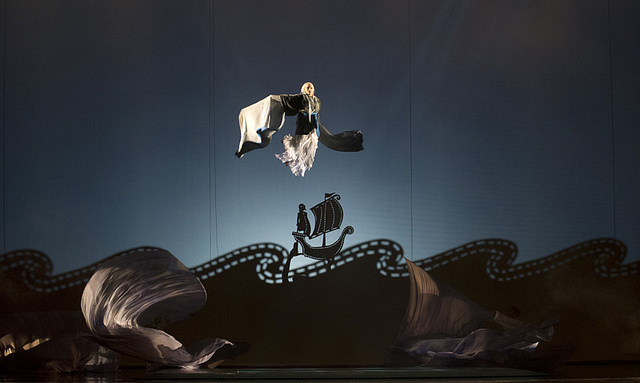
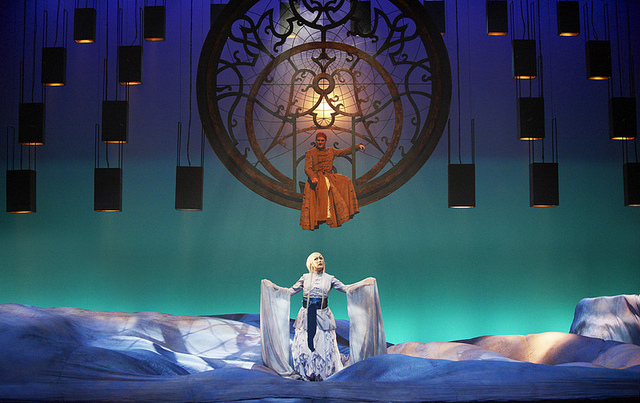
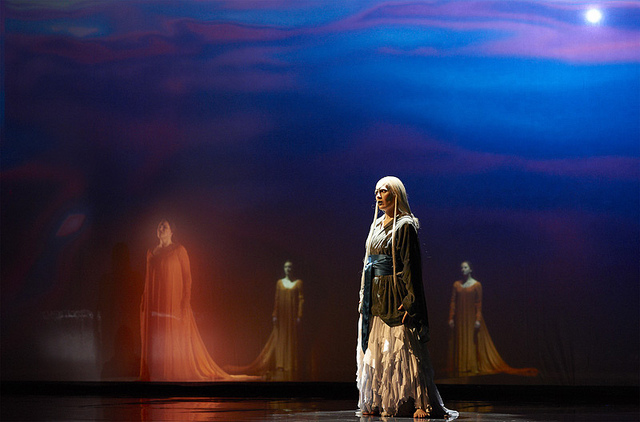
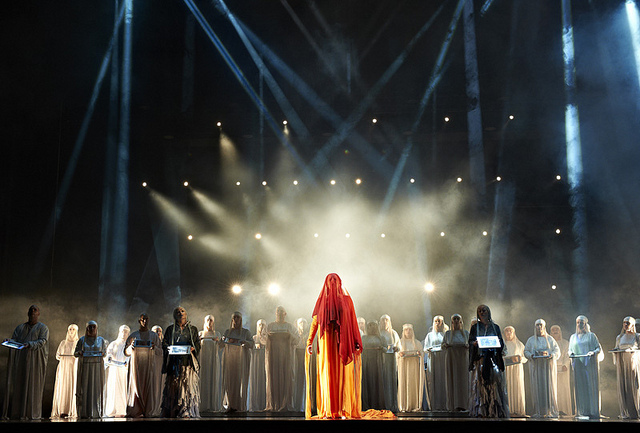
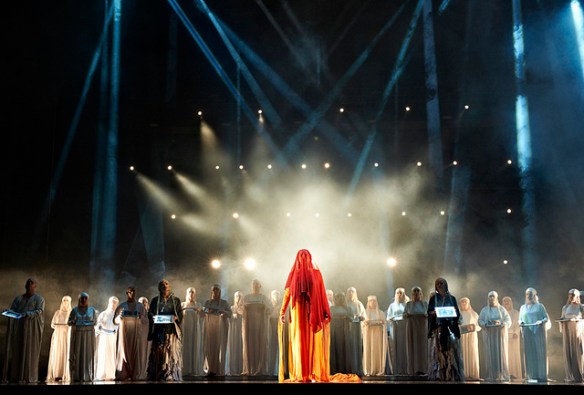
Last night we saw Kaija Saariaho’s L’Amour du Loin at the Four Seasons Centre. It was really, really good. It’s a very unusual piece. There’s not a lot of action in the libretto, despite, or perhaps because of, which Daniele Finzi Pasca devised a most spectacular production (more below). It’s an opera about ideas; love, duty, honour, death, faith, God. The characters spend far more time debating what to do and why than doing it. The plot is very simple. Jaufré Rudel, prince of Blaye, tired of a life of meaningless pleasure, yearns for real love. The Pilgrim tells him of an ideal woman, a countess in Tripoli. devotes Jaufré devotes his life to writing love songs to his “Love from Afar”. The Pilgrim tells Clémence of Jaufré and she falls under his spell. Jaufré decides he must cross the sea and meet Clémence but in doing so falls mortally ill. They meet and throw caution to the winds but Jaufré dies. Clémence decides to take the veil but her attitude to God is ambiguous at best. To who is her finally ecstatically beautiful prayer directed; the deity or her “Love from Afar”? It’s not the easiest piece to engage with. It has something in common with other meditative operas like Dialogues of the Carmélites and Pelléas et Mélisande and it’s rewarding in the same sort of way.
The music really impressed me. It haunted my dreams last night. It is an extraordinary score. In the last couple of weeks I’ve heard quite a few smaller scale works by Saariaho but this was the first time I had heard what she could do with a full orchestra. Her tachnique here seems influenced bu European minimalists like Górecki but the end result is utterly individual. She create waves of sound, often with one section of te orchestra picking a phrase up from another. The effect is almost architectural as textures interplay to create a thing of real beauty. Often, despite the wealth of visuals i found myself wanting to close my eyes and just listen. The solo vocal writing is more straightforward than in some of her chamber works. Each character has a distinct musical signature. The Pilgrim for example has any number of the trills common to medieval vocal music (which I think of as moorish but that’s just my association). The choral writing combines elements of the orchestral and solo vocal styles. It’s all really quite compelling.
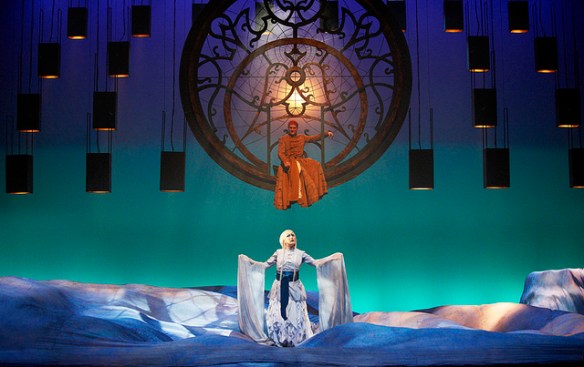
The performances were terrific. All three solo parts are long difficult sings and all three soloists were quite excellent. Russell Braun as Jaufré is on stage for four out of five acts. He was not as smoothly lyrical as he can be but his tougher, more muscular tone suited his line. Kristzina Szabó, as the Pilgrim, also has a lot to do. In many ways her acting must hold the piece together. This she said while sounding very idiomatic in the most ‘medieval’ sounding of the roles. Erin Wall almost stole the show at the end. Much of her part lies cruelly high and includes the sustained f and ff high notes that Saariaho likes to give sopranos. She coped admirably with those to close out the piece with a hauntingly beautiful rendering of the final, despairing prayer. The COC Orchestra and Chorus, were as ever, wonderful and conductor Johannes debus seemed to be right inside the music. Super stuff all round.
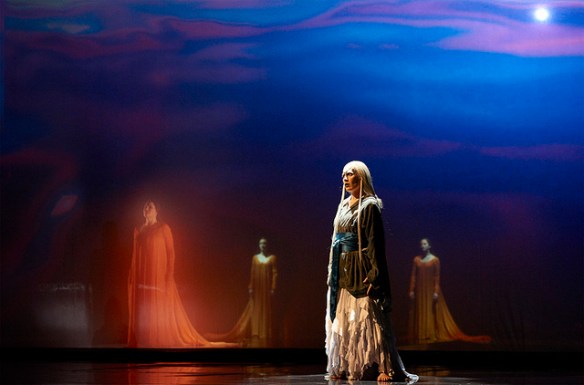
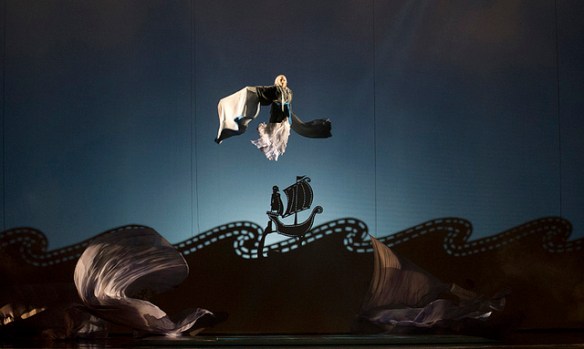
The production is very interesting. Gabriele Finzi pasca and his design team; Jean Rabasse – sets, Kevin Pollard – costumes and especially, Alexis Bowles – lighting and Roberto Vitalini – video, evoke the various settings of the piece extraordinarily vividly using cloth, light and video projections. The evocation of the sea in Act 4 is breathtaking and the ambiguous use of light shone into the auditorium at the beginning and end of the piece ask questions about the stage world and that f the audience. The story telling is embellished with shadow puppets, body doubles, acrobats and aerialists. It’s spectacular in the manner of a rather cerebral Cirque du Soleil performance. It might even be a little over the top to the point of distraction but there’s no denying the beauty of it.
I thought it was a terrific modern opera, beautifully performed and I’d go see this in preference to traditional warhorse productions any time but what I saw last night suggests I may still be a bit unusual in that regard. The house wasn’t full and seats which I’m pretty sure are subscription seats were empty. A significant number of people, young and old, left at the interval. This disturbs me on all sorts of levels. This is quite an accessible piece and it was presented in a production that emphasised that and despite that some people obviously didn’t get it. This worries me far more than people who get offended by blood or nudity in a new production of some over performed Puccini piece. There’s a catch 22 here. A new audience is put off by the idea of opera as a boring museum piece and a section of the traditional audience boycotts anything that isn’t stuffed and mounted. Anyway, if anyone at COC is listening my vote is for innovation, risk and life.

There are four more performances ending on February 22nd.  Go see it!

All photos © All rights reserved by Canadian Opera

Rusalka in the nursery

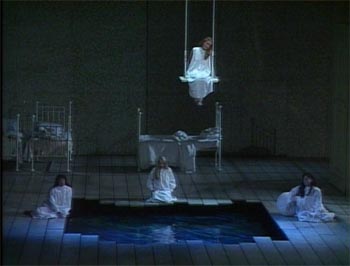
David Pountney’s 1986 ENO production of Dvorak’s Rusalka is set in an Edwardian nursery. The action is all a dream or a figment of Rusalka’s imagination in which her grandfather, in a wheelchair, becomes the Water Gnome, her sisters water sprites, her governess the witch Jezibaba and so on. In Act 1 it works reasonably well. Clearly we are looking at a metaphor of Rusalka escaping the nursery for adult life with all the risks and discoveries that involves. It starts to get pretty strained in Act 2. There’s some not very subtle loss of virginity imagery but that’s about it. By Act 3 Pountney seems to have run out of ideas and the final denouement is played out pretty straightforwardly. Certainly there’s nothing in the ending to bring closure to the concept which seems like a cop out.

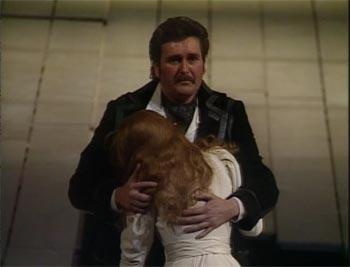
The performances, in English this being ENO, are mostly OK but not stellar. Elaine Hannan has a clear bright voice which suits the idea of Rusalka as a young girl but she doesn’t have the range of colour or dynamic range of, say, Renee Fleming. John Treleaven is rather good, if a bit stiff, as the Prince. You can definitely hear heldentenorish qualities in the voice. It’s a shame that, with his ‘tache and sideburns, he looks like a 1970s lounge lizard. Ann Howard is vocally competent as the governess/witch/Jezibaba but while she’s be fairly scary in a schoolroom she isn’t really the stuff of nightmares the part needs. Rodney Macann is a straightforwardly effective grandfather/Water Gnome but he doesn’t really dominate. The other parts are all quite well sung tough far from thrilling.Mark Elder conducts a rather routine sounding reading from the ENO Orchestra and Chorus. To be fair, part of the problem may be the sound, see below.

The video direction by Derek Bailey needs to be taken on its own terms for a record of what’s happening on stage it isn’t. There are lots of superpositions and some weird camera angles. It does reinforce the “dream” aspects of the production so I think it can be considered a valid approach.


Technically this is not a great disk. The 4:3 picture is 1986 TV to DVD quality. I suppose that, in a way, reinforces the dream quality too. The sound is very average Dolby 2.0. At times it’s worse than that. At the end of Act 1 it sounds like Treleaven is singing from the bottom of a well and nowhere does it do the orchestra any favours. There are no subtitles and the less than vivid sound makes it even harder than it otherwise might be to figure out the words. Documentation is limited to a track listing.

Given that Robert Carsen’s fascinating Paris production; strongly cast and well recorded, is also available on DVD it’s a bit hard to see why anyone would bother with this one.

Opera Atelier announces 2012/13 season

Opera Atelier announced their 2012/13 season today.

Carla Huhtanen slumming it with the rest of us, queuing to get into a concert at the Four Seasons Centre

The exciting bit is a move into early romantic territory with Weber’s Der Freischutz.  The cast includes local favourites Krešimir Špicer, Carla Huhtanen, Curtis Sullivan, Olivier Laquerre and Michael Uloth. The creative team is the usual OA gang and Tafelmusik will be in the pit, which is an interesting choice to out it mildly.

The less exciting bit is another revival of The Magic Flute in English. I’ll be tempted to see it to see the Pamina of Laura Albino, Mireille Asselin sing Papagena and see how Ambur Braid does with the Queen of the Night in a smaller house. Still, I first saw OA’s Flute over 20 years ago. I’ve seen it quite a few times in both its “full” and cut down for kids versions and I’m not that excited. Has that “bums on seats” feel.

Here’s the full announcement.

Collaborations

Each year the Studio Ensemble at the Canadian Opera Company does an exchange with its counterpart the Atelier Lyrique de’l’Opéra de Montréal. Part of this collaboration is a free concert in the Richard Bradshaw Amphitheatre featuring singers from both companies. Last year I found it quite hard to write about as, frankly, Montreal didn’t bring much to the party. This year, happily, was different.

Philip Kalmanovitch

Two of the Montreal singers really impressed me this time. Philip Kalmanovitch is a tall, slim baritone with an engaging stage manner and a very nice voice indeed. He kicked off the programme with the Largo al factotum from Rossini’s Il barbiere di Siviglia. I would not have thought it possible to overact this piece but Kalmanovitch came close! It was very characterful, well sung and he communicated that he was having fun very effectively. We also got a characterful Là ci darem la mano from Don Giovanni sung with Jacqueline Woodley. Their voices blended very well and the acting was good too. His final piece was the much more romantic Mein Sehnen, mein Wähnen from Korngold’s Die tote Stadt. He didn’t seem quite as at home in this repertoire and he could use some work on shaping his lines but, again, he sang with beautiful tone and the closing pianissimo was very well done.

Emma Parkinson

I was just as impressed by mezzo-soprano Emma Parkinson. She has a lovely smoky voice of some power. In her first number, Come ti piace, imponi from La clemenza di Tito she was singing with the Studio Ensemble’s biggest voice, soprano Ileana Montalbetti. I was worried going in that she’d be blown away (probably literally) but it wasn’t so. They actually worked very well together. Emma and Ileana collaborated again with the addition of baritone Philippe Sly in Soave sia il vento from Cosi fan tutte. This wasn’t so successful. Even when she’s throttling back, Ileana has a distinct ‘slice’ which doesn’t really suit a Mozart number like this and the voices didn’t really blend. I really want to hear what she can do with an orchestra in a genuine spinto role. Also, Philippe sang well enough but it’s going to be a long, long time before he sings Don Alfonso.  Getting back to Emma, she also sang a spirited Parto, parto, agian from La Clemenza di Tito. This was the real deal and raised hairs on the back of my neck. There was power, passion and variation of tone colour. Her coloratura was a bit ragged in places but that will come. Ms. Parkinson is one to watch.

Aidan Ferguson

The Montreal contingent was rounded out by mezzo Aidan Ferguson and tenor Isaiah Bell. Ferguson sang Va! laisse couler mes larmes from Massenet’s Werther, Sein wir wieder gut from Strauss’Ariadne auf Naxos and collaborated with Mireille Asselin in the Presentation of the Rose from Der Rosenkavalier. She and Jacqueline Woodley also sang a very musical version of Belle nuit, ȏ nuit d’amour from Offenbach’s Les contes d’Hoffmann. Ferguson is musical, she’s got plenty of power and was markedly better in the Strauss and Offenbach pieces than in the Massenet where she was a bit wobbly. She just doesn’t sound like a mezzo to me. The voice is very bright and open and I wonder whether she won’t end up as a dramatic soprano.


Bell seems very young. He started out with a very diffident Unis dès la plus tendre l’enfance from Gluck’s Iphigénie en Tauride. He sounded a bit underpowered and undercharacterised. He was better in the duet My Tale Shall be Told from Stravinsky’s The Rake’s Progress (sung with Philippe Sly as a characterful Nick Shadow) where he showed he could convey some real feeling. He finished up with Si, ritrovaria io giuro from Rossini’s La Cenerentola. This really needed more power. he has the notes but he doesn’t have the exciting, ringing top end needed to bring a piece like this to life. He is very young though and with a bit more power and confidence could be quite promising.

The Toronto singers were really in back up roles in this gig but they all performed very well. Mireille Asselin showed she has the classic qualities of a young lyric soprano in her cameo as Sophie and Jacqueline Woodley was excellent in the Offenbach though to be honest I’d much rather hear her singing Weir, Golijov or Saariaho where she truly excels.  Philippe and Ileana I’ve already mentioned.   Accompaniment on the piano was by the Studio Ensemble’s Jenna Douglas and Timothy Cheung who were, as ever, just excellent.

All in all, a very worthwhile effort all round.

Dialogues of the Arkelites

Debussy’s Pelléas et Mélisande is not an opera I’m especially familiar with. It’s a strange piece based on a libretto by Maeterlinck. For much of the time it’s wordy without much action. There is a lot of philosophising. When the action does break out; Golaud’s mad jealousy in Act 3, the killing in Act 4, it gets musically and dramatically quite violent. The music is tonal and mostly quite dreamy. It’s almost mood music. All of this reminds me quite strongly of Poulenc’s Dialogues des Carmélites hence the title of this post. Also it’s French. Actually it’s very French.

Laurent Pelly’s 2009 production for Theater an der Wien is also very French; French director, French conductor, almost entirely French cast. In an opera where the words and the relationship between the music and the words matter a lot that’s a distinct advantage. The sets are semi-abstract and placed on a rotating turntable so that scenes can follow on with a minimum of interruption. The forest, the tower, the cave are all suggested rather than made entirely explicit. Even Mélisande’s extra long hair is not depicted explicitly. This fits the indirect nature of both the libretto and the music rather well. The costumes suggest somewhere around 1900 and the colour palette doesn’t stray far from “forest floor”. Lighting is quite dark but evocative. The sense of a gloomy castle in a gloomy (Breton?) forest is quite strong.

With the exception of a few outbursts from Mélisande’s husband, Golaud, and one fairly lyrical love scene between Mélisande and Pélleas the singers have few opportunities for vocal pyrotechnics. They do need to sing stylishly and articulate well though and this cast excels in that department. Natalie Dessay as Mélisande does the fragile Natalie thing which works really well in this role. Perhaps she could create more mystery around her character but her interpretation seems quite valid. Stephane Degout as Pélleas is a good physical actor and is lyrical where he needs to be. I’m not sure that there is much depth to be got out of the character anyway. Perhaps the most interesting role is the insanely jealous Golaud, sung here by the admirable Laurent Naouri. He has a fairly major emotional arc to go through and is strong in the scene of crazy jealousy where he gets his young son, Yniold (well sung and acted by Beate Ritter), to spy on the lovers. It’s a fine all around performance. The part of the old king, Arkel, is sung by Philip Ens. He conveys wisdom, sympathy and a kind of philosophical detachment in an extremely dignified but weary way. It’s a fine job of portraying a very old man without the voice sounding past it. Good supporting performances too from Marie-Nicole Lemieux as Geneviève and Tim Mirfin as the doctor.

Bertrand de Billy is in the pit with the ORF Radio-Symphonieorchester Wien. He seems to be thoroughly at home with the score and gets some lovely, transparent, sound out of the orchestra. The chorus, the Arnold Schoenberg Chor, does what little it has to do perfectly adequately.

The video direction, by Landsmann and Landsmann, is pretty sympathetic. A lot of the time not much is happening and they close in on the singer(s) which is fair enough. When there is a stage to be shown they show it. It’s nowhere annoyingly gimmicky. The picture is top DVD quality 16:9 and the DTS 5.0 sound is mellow rather than punchy which seems appropriate. AV quality is pretty much as good as it gets without going to Blu-ray. There are English, French, German, Spanish and Italian subtitles. Despite being split over two disks there are no extras. The documentation too is limited to credits (there’s not even a track listing). It;s quite a major omission for a work like this. An interview or an article about the director’s reading of the piece and his approach would be very useful.

There’s some stiff competition for this release, notably from Zurich and WNO, so I’ll certainly be trying to get my hands on some alternative versions in an attempt to deepen my understanding of the work as much as anything.

In defence of Robert Lepage

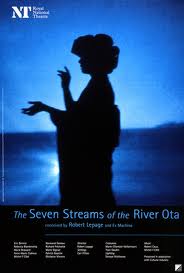
I am getting well pissed off with people taking ill informed shots at Robert Lepage based solely on his Ring cycle at the Metropolitan Opera. For three decades Lepage has been one of the most brilliant minds in the dramatic arts. His oeuvre spans straight theatre, film, circus, opera, multimedia performance art and stuff I don’t even know how to categorize. He acts, he directs, he designs. He also takes risks. In the nature of risk taking, sometimes they don’t come off and, frankly, I don’t think his Ring works. That said I think it shows the height (or depth) of poor taste and ignorance to launch ad hominem attacks on Lepage based on that one production and ignore all the things that have succeeded. The list is long; Elsinore and The Seven Streams of the River Ota would top my list but there have also been award winning opera productions such as Erwartung, Duke Bluebeard’s Castle and The Nightingale and other Short Tales along with a dozen movies, a Cirque du Soleil show that has run for years and an astonishing outdoor multi-media exhibition celebrating the history of Québec. There’s lots more if one cares to look. Even Shakespeare had his off days. Would anybody go on and on and on about how crap Shakespeare was based solely on seeing A Comedy of Errors?

Reflections on Tosca

Photo credit: Michael Cooper

The only known photograph from this production as featured in every other print or internet review I've seen.

Puccini’s Tosca is on at the Canadian Opera Company right now. It’s this years “bums on seats” production. There are fourteen performances scheduled; compared to eight for most shows. It’s double casted. It’s a conservative friendly, traditionalist production seen before just four years ago and it features hone town diva, Adrienne Pieczonka. We saw it last night and were a bit disappointed. It wasn’t the sort of show one comes out of spluttering “travesty” or “disgrace” but it wasn’t the sort of performance that gets a standing ovation and excited deconstruction on the subway home either. It felt like a revival of a traditional production. It has to be said that my reaction, while more positive than some reviews I’ve read, wasn’t shared by a large chunk of the audience who switched from their customary coughing to an extended standing ovation. From the chatter I could hear in seats around me that was largely the reaction of the “once a year” crowd so, in a very important sense, this production accomplishes what it needs to do.

Still it’s sad to come out of a performance of Tosca relatively unmoved so let me try and dissect why. Paul Curran’s production is very traditional so there’s no gimmickry to either offend or help overcome shortcomings in the singing or acting department and, of course, there’s no sense of novelty. A reasonably seasoned opera goer is, inevitably, comparing it with other Toscas. Mr. Curran’s programme notes are quite explicit about the success criteria for an enterprise of this type.

The joy and challenge of directing Tosca is not only in the glorious music and razor-sharp libretto, but ideally in workingclosely with the talents of the singers playing and fleshing out their roles. As the curtain rises it is the characters and relationships we must believe in. Characters are built bar by bar, phrase by phrase and discussion by discussion. No word is too small that it might not be the trigger for a singer to find a new angle into their character’s life or psyche, and the job of the director, I believe, is in part to help the cast explore and discover just these subtleties.

The trouble is that not much of this happened. The three principals; Adrienne Pieczonka (Floria Tosca), Carlo Ventre (Cavaradossi) and Mark Delavan (Scarpia), are all established ‘A’ list singers and sang as well as one would expect but neither their characters nor the relationships between them came fully alight. I can take my Tosca somewhat overblown but lukewarm doesn’t really cut it. Delavan is a big man with lots of physical presence but here he struck (rather odd) poses and never really exuded any sense of menace. He didn’t even seem to be that into Tosca. His physical encounters with her in Act 2 suggested that their mutual priority was not upsetting the costume shop. You could find steamier scenes in any high school parking lot. This just reinforced the aloofness of Pieczonka’s very “in control” Tosca. Vissi d’arte, though beautifully sung, came out of nowhere. This wasn’t a woman on the edge of breakdown and when she stabs Scarpia our surprise isn’t that she’s done so but that she didn’t rip his balls off with her bare hands ten minutes earlier. The less said about Ventre’s acting the better though he too sang very well indeed and E luceva qualche stella was probably the emotional highlight of the evening.

Besides fine singing there was quite a lot to like in the production. The orchestra under Paolo Carignani sounded great. I really like the atmospheric lighting plot which used light level and tone to create a variety of effects, especially in Act 1 and in Act 3, where it managed to suggest night time without being so dark one couldn’t see. The chorus both adults and children were excellent and curran creates some pleasing visual arrangements in Act 1 (nice touch where Scarpia barges out past the bishop celebrant). Unfortunately none of this really overcomes the emotional hole at the centre of the production.

I’ve heard it said, from various quarters, that the second cast of Julie Makerov in the title role and Brendan Jovanovich as Cavaradossi (Delavan sings Scarpia in all performances) may up the EQ a bit so they may actually be a better bet. Sheer curiosity may even get me to go find out.

I’m sure what I’ve written above sounds really negative. It needs context. Expectations for COC productions have been raised very high by some truly excellent efforts in recent years and so a “pretty adequate” production that would have received rave reviews ten years ago barely cuts it today. That’s the price of success.