Yesterday afternoon saw the final concert of the season for Off Centre Music Salon; the concert series organised by Boris Zarankin and Inna Perkis at the Glenn Gould Studio. This one, as the title suggests, celebrating philanthropy in music by putting together a concert of works by composers who were supported by patrons. It was very much salon style with many short sets by various combinations of performers. There was some instrumental music; an impressive performance of Khachaturian’s Toccata in E flat minor by twelve year old William Leathers, reprised later on accordion by Michael Bridge. Jacques Israelievitch and Boris Zarankin collaborated on a bravura rendition of Stravinsky’s Suite Italienne and Zarankin and Perkis gave their traditional one piano/four hands performance, this time an arrangement of Beethoven’s Egmont overture, which was received with enthusiasm.
Shiny!
The latest edition of Opera Canada is out and I have an article in it. This is not exactly my first foray into print but it is the first time I’ve published anything about opera. (Previous articles have appeared in various political and business journals and the current WIP is aimed at the Journal of Oncology Practice). Anyway, my piece is a review of a semi-staged performance of Handel’s Orlando. The real reason to buy the thing though is Lydia Perović’s (She of Definitely the Opera) article on the Canadian Opera Company Orchestra.
Paedophilia di Lammermoor
David Alden chooses to set his production of Donizetti’s Lucia di Lammermoor, currently playing at Canadian Opera, in Victorian Scotland in a rather decayed country house. It’s all set up as classic Gothic schtick. The angle is that Lucia herself is very young and is being sexually abused by her brother Enrico. OK, I don’t have a problem with that. It’s a better solution than the idea that women are all just inherently unstable and liable to go from shrinking violet to shrieking murderess at the drop of a forged letter. So, it’s an interesting idea but it poses real problems about the nature of her relationship with her “fiance” Edgardo. If he’s the hero of this thing what is he doing having a clandestine relationship with a girl who’s not yet out of the schoolroom? (We can tell this by how she’s dressed). This is a major Victorian taboo. Respectable men don’t go after girls until they are “out”. Are we then to see Edgardo as as a big a cad as Enrico? Maybe. The trouble with that concept is then why do we care what happens to him? Edgardo kills himself. Goodbye paedophile creep. So what! So bottom line, I can take the groping and the creepiness that some critics have complained about but I wonder what Alden is really trying to tell us about the piece.
Another one for the diary
Coming up on Sunday 28th April at 2pm at the Glenn Gould Studio is Celebrating Philanthropists in Music whereby Off Centre Music Salon concludes its 18th season, paying tribute to the philanthropists who stood in the shadows behind some of the greatest composers and supported their careers. The program will includes a variety of vocal solos and duets, 1 piano, 4 hands, and violin and piano, performing repertoire by: Beethoven, Tchaikovsky, Rachmaninov, Poulenc, Debussy, Chabrier, Ravel and Stravinsky.
Performers include 12 year old pianist William Franklyn Leathers, baritone Peter McGillivrey, soprano Ilana Zarankin, mezzo soprano Lauren Segal, violinist Jacques Israelievitch and accordionist (I kid you not) Joseph Macerollo. They will be accompanied by pianists Inna Perkis and Boris Zarankin.
For more details contact vciarlo@ciarlo.ca
Song and scrunchions
So, apparently Toronto has three opera singers from the otherwise unremarkable town of Corner Brook, Newfoundland. Today they (Michael and Peter Barrett and Adam Luther) together with Doug Naughton on guitar, Andrew Grimes on bhodran and, the definitely not from Newfoundland, Sandra Horst on piano produced a fun recital of arrangements of more or less traditional songs from Newfoundland and the British Isles together with a few pieces that aren’t actually traditional but people think they are. And actually, of course, a lot of the time differentiating between a traditional Newfoundland song and a traditional British song is a bit fraught.
Cinematic Salome
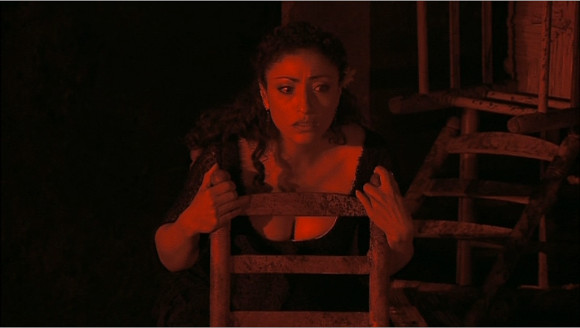
It comes as no surprise that an opera by Atom Egoyan comes across as somewhat cinematic but it’s hard not to use the term of his production of Richard Strauss’ Salome at Canadian Opera Company. It’s quite a spare production. There’s a raked stage; the raised end providing a sort of dungeon for Jochanaan and the back and side walls used for projections, especially of a giant mouth prophesying (shades of Big Brother here) and shadow puppets. Costumes are simple and in shades of red, white and green. The concept is based on the idea that Salome is a very young girl who has a history of sexual abuse at the hands of Herod that explains her “monstrousness”. It’s most vividly explored during the dance of the seven veils where Salome rises above the stage on a swing and her robes form a scrim on which a video is projected. It starts with a very young girl in a garden and gets progressively darker until it finishes up with today’s Salome being raped by her stepfather’s entourage. Fittingly, the opera ends with Herod himself strangling Salome, perhaps more to silence her than out of disgust.
Sher ham
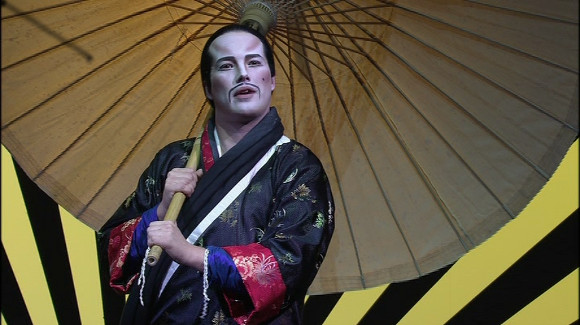
Bartlett Sher’s concept for his production of Rossini’s Le Comte Ory is a theatre within a theatre setting with scruffy bewigged footmen types operating old fashioned stage machinery. Throw in costume design that seems to cross the slutty middle ages with My Little Pony and one gets a production that would probably appeal to the average seven year old girl. Fortunately the singing and acting is really rather fine with splendid vocal contributions from Juan Diego Flórez, Joyce DiDonato and Diana Damrau well backed up by the likes of Stéphane Degout and Susanne Resmark and it’s Maurizio Benini and the Met orchestra so no problems there either. To be honest they are hamming it up for all its worth but that doesn’t seem unreasonable in this very silly piece. The second act trio which features some mind boggling gender bending with the three principals swapping partners faster than Liz Taylor swapped husbands is hilarious.
But is it art?
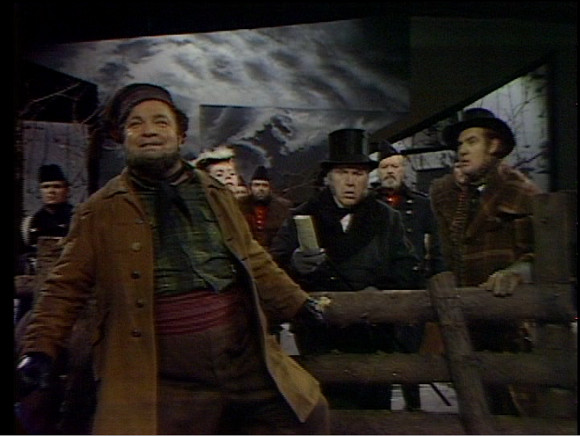
Wagner’s Tannhäuser is the earliest of the canonical works. In some ways it’s very Wagnerian. It has screwed up theology with a heavy dose of misogyny and some recognisably Wagnerian music. On the other hand it is structured more like a French grand opera and some of the music definitely has more than a hint of Meyerbeer to it.The basic plot is that of the hero seduced into sin by the pagan love goddess Venus and then redeemed by the love (and death) of the chaste virgin Elisabeth.
Snakes on a dame
Yet more shows
The Toronto opera/recital calendar just keeps on giving. Late April and May are always a bit crazy with the usual three operas on at the COC but there’s a stack more stuff going on. The latest additions to my calendar are a new Queen of Puddings Music Theatre commission La Selva de los relojes (The Forest of Clocks) by Canadian composer Chris Paul Harman. This vocal chamber work setting texts by Lorca will be performed by Krisztina Szabó and an ensemble of 6 instruments as part of the free lunchtime concert series at the Four Seasons Centre at noon on April 30th. Sadly this will be the last work from Queen of Puddings who are winding up this summer. Next is Ruth, a new opera by Jeffrey Ryan, which will be workshopped by Tapestry at the Distillery on May 4th. Finally there is a Talisker Players show called On the Wing featuring Erin Bardua and Vicki St. Pierre in a birdsong themed programme. It’s playing on May 7th and 8th at the Trinity St. Paul’s Centre.