As we head into summer…

SE_Raccoons_180201_164As we head into summer, as usual, things start to quieten down.  I only have five shows in my schedule for the month of June:

  • June 2nd, 4th and 5th Toronto City Opera are presenting Cavalleria Rusticana at the Fleck Dance Theatre.  It’s the usual TCO format; piano accompaniment, amateur chorus, young professional soloists.  Jennifer Tung conducts.
  • June 2nd, 3rd, 4th at &.30pm at the Canadian Opera Company Theatre it’s the latest iteration of Teiya Kasahara’s The Queen in Me.  It looks like this time it may be with small ensemble rather than just piano.  There’s a promo video on the COC’s Youtube channel.
  • June 3rd to 10th (preview June 2nd) at Crow’s Theatre it’s Maxime Beauregard-Martin’s Singulières; a play about “single ladies” in Quebec.  It’s in French with English surtitles (and/or 3D glasses).
  • June 5t at 4pm at Grace Church on the Hill, Soundstreams are presenting a homage to the late R. Murray Schaefer.  This one is free but registration is required.
  • June 15th, 16th, 18th and 19th at 8pm at Roy Thomson Hall the TSO are presenting Beethoven’s ninth symphony with an impressive line up of soloists including Rihab Chaieb.  It’s coupled with three short premiers including a piece by Adam Scime.

That’s about it until Toronto Summer Music opens on July 7th.

Misfortunes of War

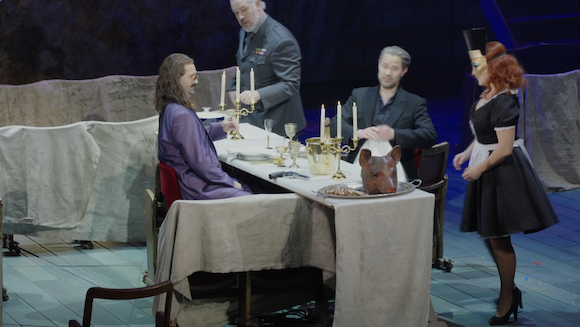
The basic premise of Kasper Holten’s production of Mozart’s Idomeneo, recorded at the Vienna State Opera in 2019, seems to be that Idomeneo and Elettra are so damaged by their experiences that they must yield limelight and power to Idamante and Ilia.  It’s an interesting idea though one wonders why Ilia is considered to be less traumatized given that her parents and siblings have been slaughtered and her home razed to the ground.  What’s really weird though is that Holten seems to show no sympathy for Idomeneo or Elettra.  Not only are they haunted throughout by particularly grizzly corpses but at the end Elettra goes down to Hades; a trench in the stage inhabited by said grizzly corpses, but she’s followed by Idomeneo.  He is visibly disintegrating mentally in Act 3 and by the time of his resignation speech the crowd is actually laughing at him then, as he goes to embrace Idamante he is intercepted by two men who hustle him off to the grizzly trench.  I’m not sure what Holten is getting at here but, for me, it undermines the sense of resolution that the music implies, as well as its essential humanity.

1.trojans

Continue reading

Anne Sofie von Otter at Koerner Hall

Anne Sofie von Otter DSC_3608 Ewa-Marie RundquistVeteran mezzo-soprano Anne Sofie von Otter appeared in recital at Koerner Hall yesterday afternoon with pianist Christopher Berner.  The first part of the programme was some fairly gentle Mozart with some fairly light weight Weckerlin and one long Schubert piece; “Die Viola”.  A short Mozart piano piece rounded out the programme.  It was stylish, enjoyable singing but one felt that both choice of material and method of presentation were being chosen to conserve the voice.  How would things go after the interval when three songs from Winterreise were promised?

Continue reading

Brilliant Brandenburg

TBF_Website_Working_V1-37So to Eastminster United last night for the opening concert of the Toronto Bach Festival.  We got three concerti bookended by (I think) a sinfonia from one of the cantatas; an excuse to show off the trumpets and timpani recruited for Sunday’s oratorios, and an arrangement of the Air on the G String.  Festival director John Abberger contributed a scholarly programme note on the general issue of Bach concerti.  Bottom line, there aren’t very many of them but they can be rearranged for a pretty wide range of instrumental options.  Last night we got the Concerto for Oboe BWV1056, Concerto for Flute, Violin and Harpsichord BWV 1044 and the much better known Brandenburg Concerto No. 1 BWV 1046.

Continue reading

Lesson in Forgetting

Emma Haché’s Lesson in Forgetting (translated by Taliesin  McEnaney and John Van Burek) is an exploration of memory, amnesia and love.  It;’s currently playing in a production by Pleiades Theatre directed by Ash Knight at the Young Centre.  The basic premise is that HE (Andrew Moodie) has suffered head injuries that mean the only thing he can remember is how much he loves SHE (Ma-Ann Dionisio).  She visits him every day to work on his memory issues but it’s obviously hopeless and eventually, wanting to be free to continue her own life, she tries to leave him but can’t.

Continue reading

Soundtrack for an Imaginary Opera

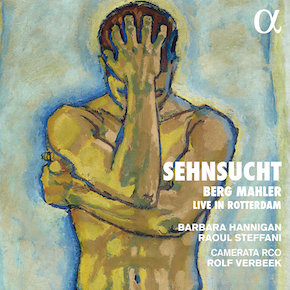
imaginary operaSo continuing my exploration of music by contemporary female composers I listened to Rebecka Sofia Ahvenniemi’s Soundtrack for an Imaginary Opera.  Ahvenniemi is both a composer and a philosopher who is inviting us, in this work, to reflect on opera as a social construct as much as text and music.  There’s lots of information on what she’s getting at plus all the texts at this link.

The texts here are a mix of fragments from opera and other works plus a made up “operatic language” which is a sort of cod Italian.  The pieces are all very different with the soundworlds created by what the composer calls “musical dumpster diving”.  So, in the first track; “Beauty Hurts”, which riffs off Monteverdi’s Orfeo  there are bits of “Monteverdi like” music mixed with strings slipping from arpeggios into slides plus lots of percussion and synthesizer.  The second track; “Punish Me”, uses a variety of vocal techniques; speech, whispering, something akin to Sprechstimme and a kind of pop style, backed up by booming percussion and shimmering strings. Continue reading

Intense Jenůfa

Janáček’s Jenůfa was staged and recorded at the Staatsoper unter den Linden in 2021 under COVID conditions.  There’s no audience and the chorus members, in black, are distributed all around the auditorium.  Even without a live audience it’s extremely dramatic and intense.

1.set

Continue reading

Will They Ever Nomi and Medusa’s Children

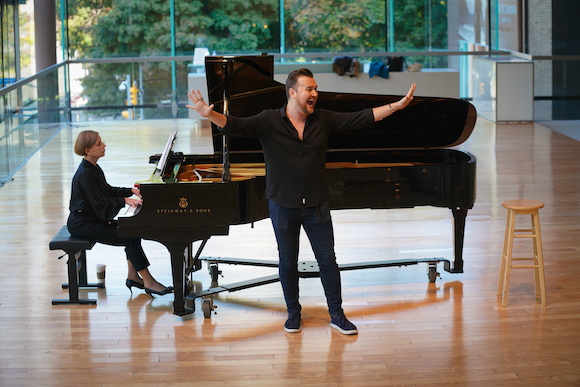
There’s a new video up on the Confluence Concerts Youtube channel.  It’s a lecture recital by counter-tenor Ryan McDonald about Klaus Nomi.  It’s an interesting and scholarly attempt to situate Nomi in the context of both his own time and place (1970s/80s New York City) and in the context of contemporary queerness in the classical music world.  There’s also some singing.  Ryan, accompanied by Ivan Jovanovic, performs some of the material associated with Nomi including a couple of “diva arias” and songs by Dowland, Schumann and Purcell.

ryanmcd

Continue reading

Songs From the House of Death

Songs From the House of Death is a new song cycle for mezzo-soprano and orchestra by Ian Cusson.  It was premiered in April by Krisztina Szabó and the Vancouver Symphony Orchestra.  It’s a setting of three texts from Joy Harjo‘s How We Became Human.  Ian has a knack of finding really strong texts by Indigenous poets and these are no exception.  The longest (13 minutes of the 23 minute work) is “Songs From the House of Death; Or How to Make it Through the End of a Relationship”. This is an evocation of death and impermanence and memory.  The setting is very varied.  The opening pizzicato strings are barely audible but it rapidly builds to blend densely orchestrated (it’s a big orchestra) and very high energy music with much gentler and more lyrical passages; sometimes using the concert master as a soloist.  This fits the changing moods of the text and, as I’ve come to expect with Ian, the music is always rooted in the text.

szabovso

Continue reading