Dancing to Così

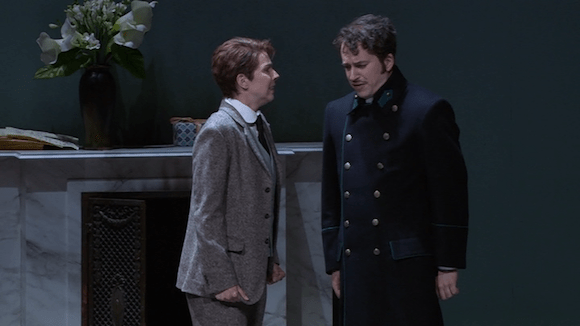
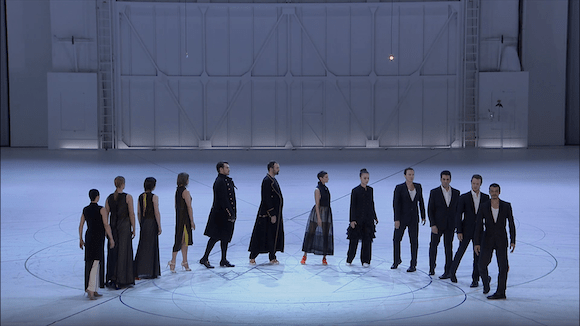
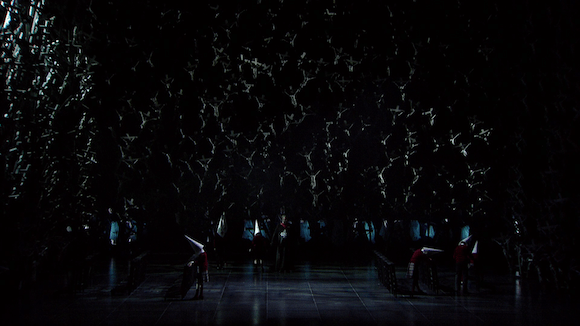
Anna Teresa De Keersmaeker is a well known, rather avant garde Belgian choreographer and not, perhaps, the obvious choice to direct an opera production but that’s the assignment she took at Opéra nationale de Paris in 2017 with Mozart’s Così fan tutte which was recorded at the Palais Garner.  Her approach is to double each of the six characters with a dancer and develop an elaborate, largely abstract and severely modern choreography for all twelve players though, naturally enough, with the more technical dance elements going to the dancers.  The choreography, as is apparently often the case with De Keersmaeker is explicitly geometric.  The stage is marked with circles and other geometric figures which inform or constrain the choreography.  Much of the time this results in a lot of running round in circles or standing in semicircles swaying backwards and forwards.  Indeed right up to Ah, guarda, sorella that’s pretty much all that happens though as things hot up emotionally the dancers get more to do with most of the big arias being paired with a dance solo and so on.

1.circle

Continue reading

Fun with DVD statistics

popularityI thought it might be interesting or amusing to compare the number of video recordings I’ve reviewed of various works with their Operabase popularity ranking (based on number of performances worldwide in the 2015/16 season).  I’ve reviewed a total of 467 DVDs and Blu-rays and 15 works have been reviewed five times or more.  That list includes five of Operabase’s top 10.
Continue reading

A Norma for our times

The recording of Bellini’s Norma made at the Royal Opera House, Covent Garden in 2016 is about as good as video recordings of opera go.  It has it all; a well thought through and well executed production concept, very fine musical values, great acting, judicious camera work and top notch sound and picture.  It doesn’t get much better.

1.schoolies

Continue reading

Vlad Disney does Tsar Saltan

Rimsky Korsakov’s The Tale of Tsar Saltan doesn’t get a lot of performances outside Russia and there’s only one video recording in the catalogue.  It was recorded in 2015 at the Mariinsky Theatre in St. Petersburg in 2015 and is now available as a dual format DVD/Blu-ray package.  It’s a curious work.  It’s based on a Russian folk tale based poem by Pushkin turned into an opera libretto in a prologue and four acts by Vladimir Belsky.  It’s quite odd in that much of it is in a simple strophic form similar to the “wedding song” that Mandryka sings in Strauss’ Arabella.  I have no idea if this is typical of Slavic folk song but it’s a bit repetitive especially when coupled to Rimsky-Korsakov’s colourful but not especially interesting music.  The music is actually rather better in the orchestral interludes, notably the famous Flight of the Bumblebee and some of the choruses which are grand in the Russian manner.

1.sisters

Continue reading

Reflecting on Lucio Silla

I just got my hands on the La Scala recording of Mozart’s Lucio Silla.  It’s the Marshall Pynkoski production that was done at Salzburg, then La Scala, then in somewhat modified form at Opera Atelier in Toronto, which I saw.  It has provoked lots of thoughts about the work itself, how well the OA aesthetic transfers to another house and how seeing a production on video differs from seeing it live.

1.landscape

Continue reading

Forest of the imagination

Malmö might not seem the most obvious place to record Debussy’s Pelléas et Mélisande but in 2016 the opera there assembled a mostly French cast and two young French rising stars; Maxime Pascal as conductor and Benjamin Lazar as director.  The result is interesting, rather good and very French.

1.melisandegolaud

Continue reading

Carmen at Bregenz

One has to recalibrate when reviewing productions from the lake stage at Bregenz.  The challenges for set designer and director are very different from designing/directing in a conventional theatre.  There’s an interview with Es Devlin on the disk of the 2017 production of Bizet’s Carmen that explains the issues very well but broadly it’s a question of creating a single, giant set that can be used throughout the opera and which makes a statement that integrates the work with the environment of the Bodensee.  The challenge for the director, as well, as the usual ones, is to communicate the characters and story when they are rather dwarfed by the setting.  S/he also has to figure out how to fit the lake itself into the story.  I think Devlin and director, Kasper Holten, manage this remarkably well.

1.girls copy

Continue reading

Arabella with Fleming and Hampson

Thomas Hampson and Renée Fleming teamed up for Strauss’ Arabella at the 2014 Salzburg Osterfestspiel.  The production is directed by Florentine Klepper and it’s set late 19th/early 20th century and is conventional in many ways though there are a few interesting touches.  There may be more than a few but video director Brian Large focusses quite relentlessly on the singers 99% of the time so it’s hard to tell.  I noticed a few things.  The hotel set in Act 1 is multi-room but it’s very rare that we see other than the room the principal action is in so who knows what might have been going on.  There’s a use of body doubles during the Act 2 duet to create a sort of “portrait” of Mandryka and Arabella that broods over the stage for the rest of the act.  The fortune teller reappears with the “trouble” card during the “key” scene.  The whole Fiakermilli episode is difficult to interpret because the video gives such a fragmentary view of it.  There’s certainly a couple of suggestive giant dolls.  Otherwise this scene just comes off as pretty crude and lame.  I suspect that there may be much going on here that isn’t on the video.  This all tends to reinforce the weaknesses of the second half of Act 2 and the start of Act 3 which certainly are not Strauss and von Hofmannsthal’s best work.

1.matteozdenka

Continue reading

The Chocolate Soldier on TV

Sometimes curiosity just gets the better of me.  I rather enjoyed Toronto Operetta Theatre’s production of Oscar Straus’ The Chocolate Soldier so I was prepared to take a look at the 1955 made for TV version directed by Max Liebman.  I probably shouldn’t have bothered.  There’s so much weird here.  First off the plot is changed out of all recognition, besides being cut down to 77 minutes.  Nothing much is left apart from the basic idea of the heroine Nadine falling for the Swiss soldier who is chased into her bedroom rather than her bumptious fiancé Alexius.  His escape and return are replaced with a silly impersonation of a visiting general and a farcical court martial.  In mucking about with the plot most of the humour and essentially all the satire is lost leaving just a very silly and dated Broadway style romcom.

1.soldiers

Continue reading

Updated La Bohème

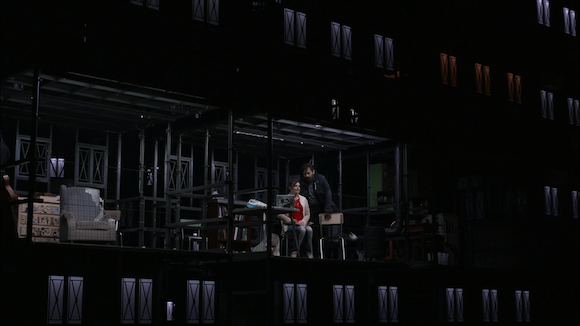
The catalogue is full of La Bohèmes from regional houses sung by serviceable casts.  The version recorded at the Teatro Regio Torino in 2016 is another.  My reason for wanting to look at it is because the production was directed by Àlex Ollé of La Fura dels Baus and I hoped it would prove as insightful as Stefan Herheim’s Oslo production.  It doesn’t really.  He gives the piece a fairly gritty modern setting but I don’t think it speaks to our modern insecurities the way Herheim does.  Rather it plays pretty much as a gritty 19th century setting, which is, admittedly, vastly preferable to Zeffischenk excess or ne0-Broadway tweeness.

act1

Continue reading