Utopia, Limited

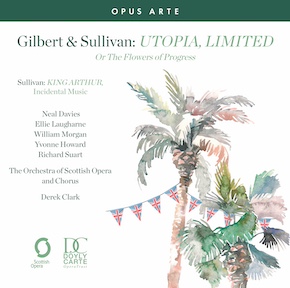
I was curious about Scottish Opera’s new recording of Gilbert and Sullivan’s Utopia, Limited because it’s a G&S I’ve not heard before.  It’s a late work and was less successful than its better known predecessors.  The plot concerns an island in the “South Seas” where the king is so taken with all things English that he sends his daughter to Cambridge and has her return with a bevy of English worthies including Captain Joseph Corcoran KCB.  Eventually the king enacts all kinds of reforms including turning the entire population into limited liability companies.  They revolt but the day is saved by Princess Zara pointing out that with party government all the reforms will inevitably be repealed after the next election. Continue reading

Varied recital disk from Connolly and Middleton

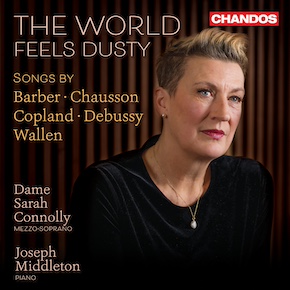
Dame Sarah Connolly and Joseph Middleton have teamed up for another interesting recital album.  It’s quite varied.  It starts with Chausson’s La Poème de l’amour et de la mer which is actually two songs with a piano interlude.  It’s very fin de siècle chanson with the piano line rather more interesting than the vocal line but pretty decent stuff, if a bit emotionally overwrought.

Barber’s Three Songs Op.10 are quite well known, especially the last; “I hear an army”.  They are dark and dramatic and suit Connolly’s voice very well.  Next is the often heard Debussy piece Trois Chansons de Bilitis which purports to be settings of translations of actual Sapphic texts but which sound exactly like a 19th century Frenchman would imagine a Sapphic text to be;  i.e languorous.  Nicely done though.  Next we come to a pair of declamatory songs by Copland; “The world feels dusty” and “I’ve heard an organ talk sometimes”.  Definitely a welcome change of pace. Continue reading

Kafka Fragments

Gyorgy Kurtág’s Kafka Fragments of 1986 is a pretty weird piece.  It sets forty short fragments (anything from less than a minute to maybe six and a half) from Kafka’s diaries and journals for soprano and violin, which is unusual enough.  But it’s the range of techniques involved for both musicians which i think contributes to why people want to perform them and some people at least to listen to them.

Just about every technique fior violin, short of smashing it, is called for; very rapid staccato phrases, pizzicato, percussive effects of various kinds etc.  The vocal part is perhaps even more varied; singing (but with crazy intervals and very high notes), Sprechstimme, speaking, whispering, chattering, screaming ad more.  Each fragment basically deals with an emotion (mostly negative!) and is set accordingly so the emotional range is pretty much as wide as the range of techniques. Continue reading

The complete La vie Parisienne… encore

A couple of years ago I took a look at the Bru-Zane reconstruction of the “original”; never performed, five act version of Offenbach’s La vie Parisienne.  That version was recorded live on stage in Paris; which was one stop on a multi-city tour.  Now it’s got the full Bru-Zane audio recording treatment complete with a 240 page book with much more information about what they did (and why) to create the performing edition used.  I won’t duplicate what I said in the review of the video but there are some things I noticed anew on the audio version. Continue reading

Songs by Debussy and Messiaen

L’extase: Debussy and Messiaen is a new CD from mezzo-soprano Magdalena Kožená and pianist Mitsuko Uchida.  There are four sets of songs; three by Debussy and one by Messiaen.  The Debussy sets are Trois Chansons de Bilitis which set texts by Pierre Louÿs, Cinq poèmes de Charles Baudelaire and Ariettes oubliées to tests by Paul Verlaine.

To my ear all these cycles inhabit a similar sound world.  It’s very beautiful and languorous for the most part with something just not quite wholesome about it.  We are clearly looking forward to the language of Pelléas et Mélisande.  Only occasionally does something a bit more dynamic happen as in the quite dramatic “La tombeau des Naiades” from the first set and the lively “Chevaux des bois” from the Verlaine settings. Continue reading