
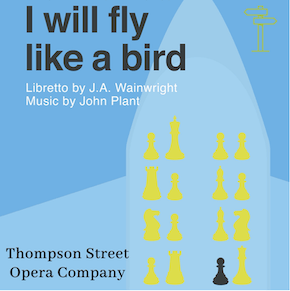
 I Will Fly Like a Bird is a chamber opera for two voices and six instruments composed by John Plant to a libretto by J. A. Wainwright. It deals with the story of Robert Dziekanski, a young Pole who was fatally tasered by police at Vancouver Airport in 2007. It’s not dramatic or angry. It’s more of an elegy recounting the hopes and aspirations of Robert and his mother who waits for him in Kamloops. It’s often very beautiful and very, very sad,
The two characters; Robert and his mother, are sung by baritone and soprano with support from string quartet, piano and clarinet. The music is tonal but quite modern in feel. There are certainly no concessions to musical theatre but it does have a few “songs” notably a drinking song. The music really feels apt for the story and is geared more to allowing the singers to convey the text than show off.
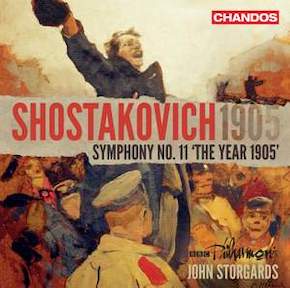 One of the “selling points” of John Storgårds’ new recording of Shostakovich’s 11th Symphony (The Year 1905) with the BBC Philharmonic is that it uses real church bells rather than orchestral tubular bells for possibly the first time since the original recording by the Leningrad Phil. They are interesting but that’s not the main reason to buy this disk. There are two far stronger ones. It’s extremely well played. Storgårds conjures up an almost unbearable amount of tension and it never really relaxes. This is a performance that will have you on the edge of your seat throughout. Needless to say, he’s very well backed up by the BBC’s Salford based orchestra who produce exceptionally lovely string tone and brass that is emphatic without quite the “teeth on edge” quality of some Russian orchestras.
 I don’t spend a lot of time listening to disks of opera arias. I’s music I much prefer live and in context but right now a dose of good old fashioned verismo tenoring is very welcome! Piotr Beczala’s new CD Vincerò absolutely delivers it. There’s a reason this guy (normally) spends his time commuting between Vienna, Zurich, Salzburg and New York with the odd side trip to Bayreuth. He’s the real deal. There’s power to burn allied to control and proper ringing high notes. His diction is excellent too. There are no unnecessary histrionics, just top class delivery.
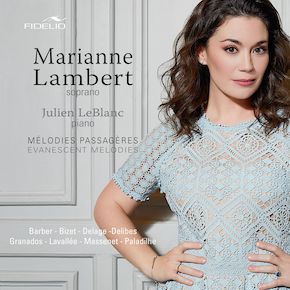 Mélodies Passagères is a new CD from Montreal based duo soprano Marianne Lambert and pianist Julien LeBlanc. Toronto folks may remember the latter as the music director/pianist for Against the Grain’s
 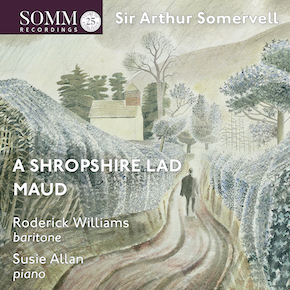 I was browsing the latest Naxos marketing material and was really intrigued by what claimed to be a disk of Tennyson and Housman settings by Sir Arthur Sullivan. It sounded too good to be true and it was. The music was by Sir Arthur Somervell; whose Housman settings I had previously encountered.
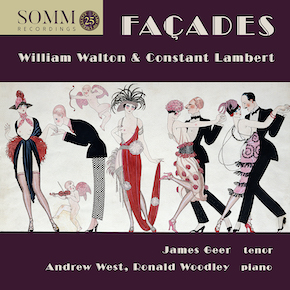 Façades is a new CD of music by William Walton and Constant Lambert; much of it comparatively unknown. It’s a mix of songs for tenor and piano and music for piano duet. The disk begins with Lambert’s Trois pièces négres for two pianos. The bookends are fairly up tempo jazz inflected numbers with a perhaps Poulenc influenced slow middle section. Curiously only the white notes of the pianos are used. It’s the first touch of what I tend to feel about Lambert’s music; clever, well crafted but, in the last analysis, not very interesting.
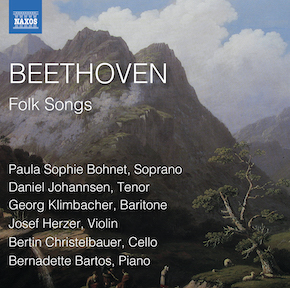 To quote an opera by a rather different composer; “it is a curious story”. It’s the 1810s and in Edinburgh one George Thomson (not the one who became a European commissioner!) had a cunning plan to get various composers to do settings of Welsh, Scottish and Irish folksongs for the domestic amateur music making market. One of the composers he engaged was Beethoven (Haydn and Weber were also involved at various times) and a selection of the songs he produced are recorded on a recently issued Naxos disk.
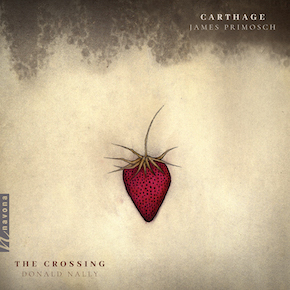 I’m never quite sure that unaccompanied choral music is quite my thing but The Crossing’s new recording of music by James Primosch caught my eye. It was the idea of the title track; Carthage, on prose by Marilynne Robinson from her novel Housekeeping, which employs the devastated city of Carthage as a metaphor for desire and imagination that drew me in. The image of once-fertile fields, salted and wasted, has haunted my imagination for decades and I wanted to see how it might play out in musical terms. I wasn’t disappointed.
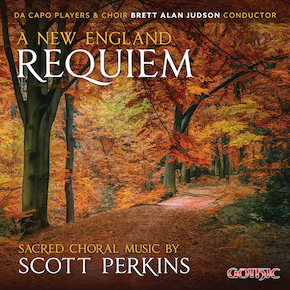 I’ve previously enjoyed both choral music and song from Scott Perkins so I was very interested to get hold of a disk of his sacred choral works which is anchored by his A New England Requiem. In the modern fashion this mixes text from the liturgy with poetry from various sources. It’s quite ethereal music and distinctly churchy; more Tavener than Elgar (though really nothing like either)! The theme is definitely “peace and rest”. There’s no Dies irae or anything like that! The scoring is imaginative and good use is made of the organ’s lower ranges. The singing is very beautiful as is the playing which comes from the sixteen players plus organ and twenty six voices of the Da Capo players & Choir with Tom Mueller on the organ and Brett Allan Judson conducting. A soprano soloist from the choir, Jasmine Gish is used in places. She has an almost vibratoless sound which suits nicely.
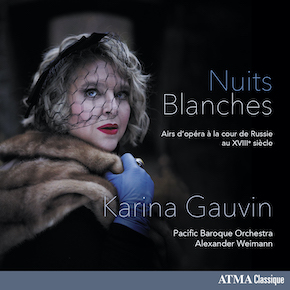 Nuits blanches is the title of a new CD from Karina Gauvin and the Pacific Baroque Orchestra. It’s largely a subset of the material they performed at Koerner Hall in November and I don’t see much point in repeating
  operaramblings