 The remastered SACD release of Siegfried from the Solti Ring cycle is now out. There’s only so much I can add to my reviews of Die Walküre and of the sampler disk of the whole cycle. Overall observations about the technical side of the record remain valid and the Vienna Philharmonic is again fabulous. The packaging is as with Die Walküre… luxurious.
The singing is also very fine and I didn’t have any reservations about anyone sounding “dated”. Hotter and Nilsson are again fantastic and Wolfgang Windgassen’s Siegfried combines beauty and power in full measure. Gustav Neidlinger and Kurt Böhme are back as Alberich and Fafner to good effect. Gerhard Stolze is effective (and not too affected) as Mime and there’s the famous cameo as the Woodbird by Joan Sutherland. Solti’s conducting is once again thrilling. He’s not afraid to take things at pace but can also be intensely dramatic and lyrical; sometimes at the same time. Culshaw’s “soundstage” effects come off really well, especially in the Fafner’s lair scene. This is another impressive instalment in an impressive project.
The version I listened to is the the four SACD disk release. It’s also available (for roughly the price of a Nibelung’s horde) as five vinyl LPs or much, much cheaper digitally in formats ranging from MP3 to 192kHz/24 bit FLAC which I suspect will be very good but not quite up to SACD quality.
Catalogue number: Decca 4853161

 Centrediscs have recently released a CD of music by Toronto composer Colin Eatock. It’s a mix of choral and orchestral works; most of the former for unaccompanied voices. There are ten works on the disc making a generous 67 minutes or so of music.
 One of the strangest records of Kurt Weill’s music that I have ever listened to has just come my way. There are two pieces involved; Propheten and Four Walt Whitman Songs. Propheten has its roots in Weill’s six hour long, Old Testament inspired, opera The Eternal Road which premiered at the Manhattan Opera House in 1937 with a cast of 245 and which ran for 153 performances before, perhaps unsurprisingly, disappearing for a long,long time. Propheten is a 1998 adaptation of the last act by David Drew using the original German text by Franz Werfel plus biblical quotations and additional orchestration by Noam Sheriff. It basically deals with the sack of Jerusalem by Nebuchadnezzar and comes in at a more digestible 45 minutes.
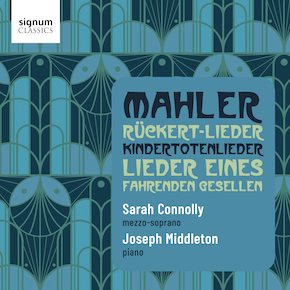 Mezzo-soprano Sarah Connolly and pianist Joseph Middleton have produced a CD with three of Mahler’s best known song cycles; the Rückert-Lieder, Lieder eines fahrenden Gesellen and the Kindertotenlieder. It’s a very fine recording. Both performers are, of course, expert recitalists and they take quite an individual way with these well known pieces. In general they are quite slow (less so in the Rückert songs than the other two sets) but very clearly articulated. The phrasing, by both singer and pianist, is very deliberate and sometimes quite individual. This is most pronounced in the Rückert songs. It’s an interesting approach which I enjoyed.
 I don’t review a lot of full length audio only recordings of mainstream operas. Generally I think video makes more sense but sometimes something comes along that attracts my attention. The recent recording of Handel’s Serse by the English Concert with Harry Bicket was one such. This time it’s the cast that caught my attention. There’s Emily d’Angelo (are we allowed to call her “young” or “emerging” any more?) in the title role but also such fine Handel singers as Lucy Crowe as Romilda and Mary Bevan as Atalanta. As it turns out there’s not a weak link in the cast and while these three turn in fine performances so do Daniela Mack (Amastre), Paula Murrihy (Arsamene), Neal Davies (Ariodata) and William Dazeley (Elviro).
 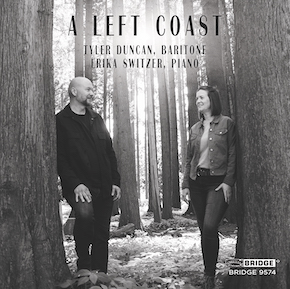 A Left Coast is baritone Tyler Duncan and pianist Erika Switzer’s tribute to British Columbia and its music. Seven composers with birthdates ranging from 1908 to 1985 are featured on the disk. BC is a young country as far as western classical music is concerned though, of course, it has rich artistic traditions stretching far back into the mists of the north west.
 Spontini’s 1807 work La Vestale is the latest French opera to get the Palazzetto Bru Zane treatment. Ir’s extremely interesting as this work has a performance history not unlike the more famous Médée of Charpentier. It’s very much a tragédie lyrique in the same basic style as the works of Gluck, though with some compositional innovations that did not endear the composer to the Paris musical establishment. Indeed, but for the determined patronage of the Empress Josephine it likely would never have made it to the stage. Like Médée it was initially very successful before disappearing from the repertoire in the later 19th century. Also like Médée it was the subject of a mid 20th century revival, notably a 1954 La Scala production (in Italian) by Visconti featuring Maria Callas. Inevitably given the time and place it was given in a style that owed more to verismo than French classicism with a large modern orchestra, conventional (by 1950s standards) tempi and a rather more overblown singing style than was ever heard in early 19th century Paris. If it were revived again for major houses one imagines it would still get essentially the same treatment. Perhaps it will be the next international diva vehicle for Sondra Radvanovsky?
 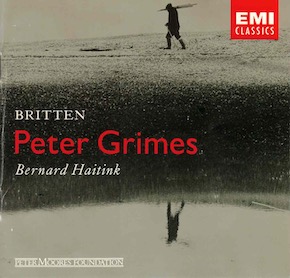 Regular readers will know I’m something of a Peter Grimes completist so I was interested to get my hands on a recording previously unheard by me (one of only two such!). It’s a 1992 recording made in Watford Town Hall and, as far as I know, was not made in conjunction with a stage run. The Grimes is Anthony Rolfe Johnson with Thomas Allen as Balstrode and Felicity Lott as Ellen Orford. There’s also a young Simon Keenleyside as Ned Keene. Bernard Haitink conducts with Orchestra and Chorus of the Royal Opera House.
  Forbidden Fruit is a CD by baritone Benjamin Appl and Pianist James Baillieu due for release on June 23rd. It’s a sort of themed recital dealing with the Garden of Eden and the Fall. It starts with the English traditional song “I Will Give My Love an Apple” and finishes with “Urlicht” from Mahler’s setting of text from Das Knaben Wunderhorn. In between there are about 25 songs, some solo piano and quotes from the Bible which take us on a journey from all kinds of temptation, through consequences, to (maybe) some kind of redemption. In all there’s 69 minutes of music.
  operaramblings