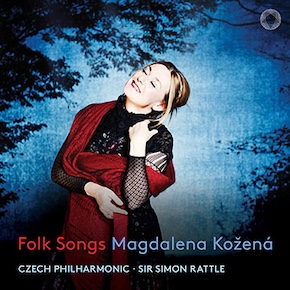
 The new CD from husband and wife team Magdalena Kožená and Sir Simon Rattle consists of four sets of folk songs arranged for mezzo-soprano and orchestra; all of them pretty well known. There are the Five Hungarian Folk Songs of Bartok, Berio’s Folk Songs (all eleven of them), Ravel’s Cinq mélodies populaires grecques and Montsalvatge’s Cinco canciones negras.
They all get really good performances. There some extremely fine and idiomatic singing from Kožená with excellent diction in seven different languages from Occitan to Armenian and a real sense of what each cycle is about. For example, she really catches the Latin American rhythms and feeling in the Montsalvatge. But what’s really even more impressive is that she is so perfectly at one with the orchestra. The rapport is more like what one expects with a really good collaborative pianist. And the Czech Philharmonic is a really good orchestra as witness their playing of the very complex Berio settings. It’s an extremely satisfying album on all counts.
It’s well recorded too. The recordings were made in Dvořàk Hall at the Rudolphinium in Prague at various times between 2020 and 2023 and they are spacious, detailed and well balanced. There is a booklet with full texts and translations plus other information. Available formats are physical CD, MP3 and CD quality and 96kHz/24bit FLAC. I listened to CD quality digital.
Catalogue number: Pentatone PTC 518707

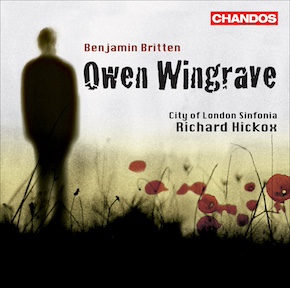 Britten’s Owen Wingrave is a curiously neglected opera. It’s rarely performed live and the only recorded versions are 2 CD recordings plus DVDs of TV productions. The earliest of each feature Benjamin Luxon in the title role and Peter Pears as General Wingrave. The DVD version holds up surprisingly well for a 1970 TV production. The later DVD version is also over 20 years old and features Gerald Finley in a, to my mind, ill conceived production for Channel 4 updated to the 1950s. So I was interested to get my hands on a 2008 Chandos recording with Peter Coleman-Wright as Owen.
 There’s a story behind violinist Christopher Whitley’s new solo album Describe Yourself. Entering the 2017 Canada Council for the Arts. Musical Instrument Bank Competition, he found himself required to offer a Canadian composition. The chosen piece was Jeffrey Ryan’s Bellatrix. He was successful and so this album is played on a
 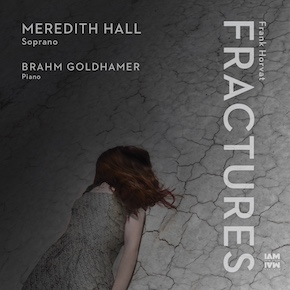 Frank Horvat’s Fractures is a very interesting new CD. It sets eleven texts for soprano and piano on the themes of fracking, environmental degradation and climate change. It’s a tough listen; not because it’s preachy or hard on the ear but rather because there is a degree of irony in the texts, the music and the performance that somehow makes the situations described even more horrible.
 The latest Palazetto Bru Zane’s retrieval from the valley of lost things is Louise Bertin’s Fausto of 1831. It’s unusual in two respects. First of all it’s written by a woman (and quite a young one – she was 26) and secondly it’s an Italian language opera by a French composer written for the Théâtre-Italien in Paris; a theatre which produced mainly operas by Mozart and Rossini (its long time artistic director) with a few from other contemporary Italian composers such as Bellini and Donizetti; some composed for Paris, some imports.
 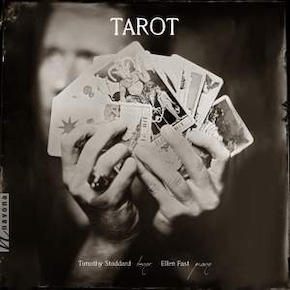 Tarot is a new recital CD from tenor Timothy Stoddard and pianist Ellen Fast featuring recent works by American composers. There are four song cycles on the record. The first, Mortally Wounded, features settings by Mark Markowski of eight poems by Lorca in English translation. These are interesting and treat Lorca’s quintessentially Spanish themes sympathetically. The music is basically tonal but complex with flamenco inflected rhythms. It’s beautifully sung and played with diction so good that the absence of texts and translations is not worrisome.
 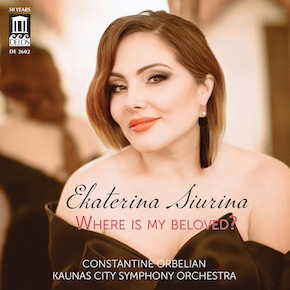 I first came across Russian soprano Ekaterina Siurina as Zerlina in the 2008 video recording of Mozart’s Don Giovanni from Salzburg. She had had plenty of success already in coloratura roles such as Gilda and Adina and was, I thought, the best Zerlina I had come across. Fast forward to 2015 and she sang a very fine Violetta at the Four Seasons Centre opposite her husband Charles Castronovo. A few years on and it’s not terribly surprising that she’s starting to venture into slightly heavier lyric-dramatic territory. This is reflected in her recent album Where is My Beloved? recorded in 2022 with the Kaunas Symphony Orchestra conducted by Constantin Orbelian.
 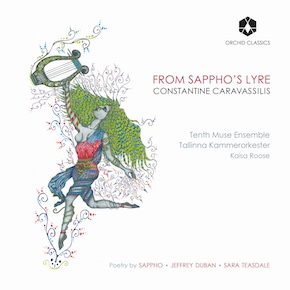 From Sappho’s Lyre is a double CD of music by Constantine Caravassilis. There are five cycles for voice and various combinations of instruments, all, as the album title suggests, related to Sappho of Lesbos. The first is a setting of her Hymn to Aphrodite; the longest, extant work. It’s intended to be performed as a “spectacle” with dance, costumes etc. It’s scored for soprano (Lana Guberman-Chriss), mezzo soprano (Carla Jablonski), countertenor (Daniel Moody), narrator, chorus Jeffrey Duban), eight piece chamber ensemble (Tenth Muse Ensemble) and recorded sounds and it’s conducted by the composer. It’s sung and narrated in a mixture of Ancient Greek and English and it’s richly orchestrated. It’s complex but mostly tuneful music with quite dense textures and lots of percussive effects. It’s really a very distinct musical voice as becomes clearer as one progresses through the pieces on the records.
  Philippe Boesmans’ last opera, On purge bébé, premiered at La Monnaie/De Munt in Dember 2022, a few months after the composer’s death. It’s a one act farce to a libretto by Richard Brunel after Feydeau. Predictably it’s extremely silly and rather French. It begins with an argument between a porcelain manufacturer (Follavoine) and his wife as they try to discover where Les Isles Hébrides are at the request of their unpleasant and constipated seven year old son. Looking under “Z” and “E” doesn’t help very much but it serves as a backdrop to their argument about administering a laxative to said son while awaiting the arrival of a fonctionnaire (Chouilloux) charged with sourcing 300,000 unbreakable chamber pots for the French Army.
 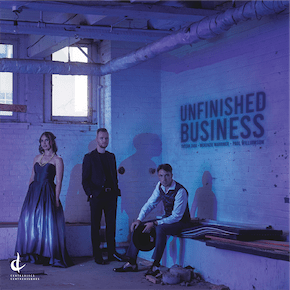 Unfinished Business is a CD of music by Toronto based composer Tristan Zaba. It’s mostly songs for soprano (McKenzie Warriner) and piano (Paul Williamson) but the second and longest track; Matryoski and Blue Vase is a solo piano piece that plays with different textures and densities; sometimes very spare, sometimes very busy, for twelve minutes. There’s also a shorter, ceaselessly busy piece Swan Dive.
