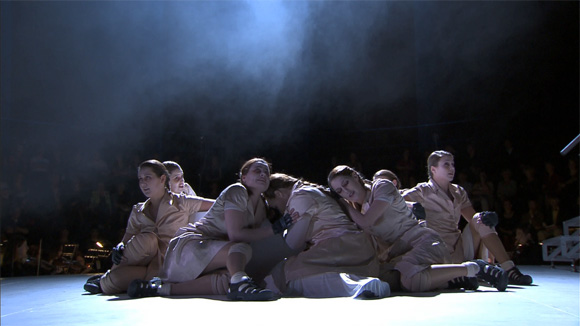
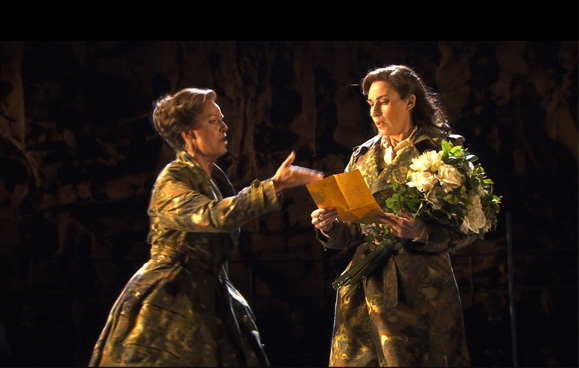
I guess Lohengrin is one of those operas that’s so loaded up with symbols it just begs directors to deconstruct it. Well that’s what Hans Neuenfels’ Bayreuth production, recorded in 2011, does and then some. There is so much going on in this production that I think it would take many viewings to really get inside it. The bit most critics have fastened on is the costuming of the chorus as rats or, on occasion, half rat, half human. It’s visually interesting and since there are also ‘handlers’ in Hazmat suits it’s clear that some sort of experiment is being alluded to. Add in bonus rat videos at key points and there’s a lot to think about. One thing this does do is solve the Teutonic war song problem. A chorus of rather timid looking rats singing with martial ardour is a good deal less Nurembergesque than a similar chorus in armour or military uniforms. Rats aside the story is really told in a quite straightforward and linear way while providing all sorts of moments that one might want to interrogate further,
Author Archives: operaramblings
Best of 2012
It’s been a busy year. Besides recitals and cinema broadcasts and other bits and pieces I managed to see 23 live opera performances of 19 different works. I also watched a ton of DVDs and Blu-rays. What most impressed me?
Live Performances
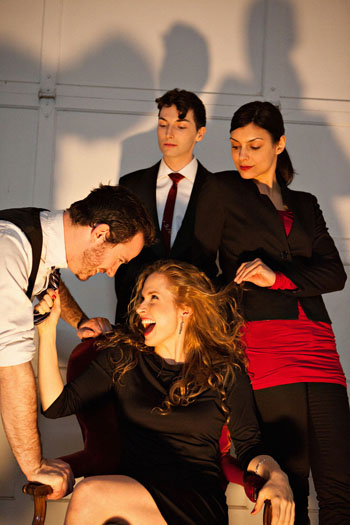
Fully staged performances with orchestra basically meant the COC and Opera Atelier. The highlights for me came early and late in the year. I loved the brilliant and spectaular production of Kaija Saariaho’s L’Amour de Loin. It’s a great score and was beautifully sung by Russell Braun, Erin Wall and Kristina Szabo. The fall season brought Die Fledermaus to the Four Season’s Centre in Christopher Alden’s disturbing “Freudian” production. Great theatre with particularly fine performances from David Pomeroy and Ambur Braid.
Staging Messiah
It’s a rare and valuable experience when a performance makes one reconsider a perhaps overly familiar work. That’s the effect that Claus Guth’s 2009 staging of Handel’s Messiah had on me. I don’t think that there is any piece I’m more familiar with than Messiah. I feel like I’ve known it all my life. I’ve sung it. I own a vocal score (rare indeed for me!). I couldn’t begin to count how many times I’ve heard it. And yet here it came up entirely fresh and had me thinking about it in completely new ways.
New COC podcast
Episode 7 of The Big COC Podcast is up on iTunes and at coc.ca. I’m not involved with this one but Lydia Perovic is holding up an end for us bloggers. There’s discussion of sexing up opera, La Scala’s Lohengrin, the new Meyerbeer at the ROH, the Ensemble Studio competition and singing competitions in general and much more.
‘Tis the season to speculate
With a month or so to go before the Canadian Opera Company officially announces its 2013/14 season it’s surely time for some uninformed speculation.
There are three big anniversaries in 2013; the bicentenaries of Verdi and Wagner and the centenary of Benjamin Britten. One would think all would be represented but maybe not. We know Verdi will be. Gerald Finley announced at the Rubies that he would make his role debut in the title role in Falstaff at COC in 2013/14 so we can ink that one in. Britten seems probable. There’s a Houston/COC co-pro of Peter Grimes, directed by Neil Armfield that is due to to come to Toronto. I think we can pencil that one in. No idea on casting but I would love to see Stuart Skelton myself. Wagner, I’m not so sure. Maybe February’s run of Tristan und Isolde will be COC’s sole nod to Wagner. Certainly the next most likely candidate; the Lyon/Met/COC Parsifal is, apparently, not expected before 2015.
Incidental Music – finally read
What can one say about a novel that combines opera, the Hungarian uprising, philosophising about urban planning, Toronto, the immigrant experience and lots of steamy lesbian sex? We can say that it’s an interesting combination and not surprisingly it appeals to someone who loves opera, is an immigrant, has a half Hungarian partner and thinks a lot about what makes cities work. The lesbian sex doesn’t do a lot for me but at least it’s well written lesbian sex which beats the heck out of a lot of the other kind in novels.
Reward for effort
Various discussions on and around this post got me thinking about the issue of reward for effort versus instant gratification and what that means for audiences, critics and management. It goes something like this. Opera house schedules are dominated by relatively elderly, often unchallenging repertory. As Philip Hensher says, it’s as if The Second Mrs. Tanqueray was still the most performed piece on the straight stage. In North America these works are usually presented in a way that is unchallenging and familiar to audiences. There isn’t much new work on show and most of what there is is musically fairly undemanding. Even 20th century classics like Lulu or Peter Grimes aren’t much seen except perhaps in the very large centres. In Europe it’s a bit different. The standard works tend to be presented in more challenging productions. The 20th century classics are given more often and new work is often rather more demanding in nature; Riemann and Birtwistle rather than Heggie and Adams.
A very AtG Christmas party

Miriam Khalil as the Governess in last season’s The Turn of the Screw. She was looking sparklier and less spooked last night!
Last night was the Against the Grain Theatre fundraiser at the Norman Felix Gallery. It was definitely billed as a Christmas party but was probably one of the most Jewish Christmas parties since the one in the stable. A fair selection of the great and good of the Toronto opera scene turned out together with an even larger sample of the not so great and good, including the lemur and myself. Topher banged the ivories for a few operatic excerpts and some Christmassy songs. There was carolling, of a rather higher standard than my old parish church, and drinking; though not necessarily in that order. There was a small dog. I think everybody had fun.
Do not expect the form before the ideal
That headline is pretty typical of the English translation of the libretto of Schoenberg’s Aron und Moses. “Holy is genital power” is another gem. The whole thing is basically an extended debate about the nature of God with Moses arguing for an extreme degree of abstraction and Aron championing a more populist version that “the people” can relate to. There are ideas in there that could probably be staged quite spectacularly, such as the Golden Calf scenes and a spot of human sacrifice. There’s even a fairly decent opportunity for an orgy. In their 1975 film Daniele Huillet and Jean-Marie Straub reject any opportunity for visual excess or even representation almost as rigidly as Moses himself.
Can’t get no Atisfaction
Despite also featuring William Christie, Les Arts Florissants and François Roussillon, the 2004 Châtelet production of Rameau’s Les Paladins could hardly be more different from the recording of Lully’s Atys that I reviewed yesterday. The work is based on Orlando Furioso and is an utterly anarchic parody of pretty much everything that Rameau had previously written. It was considered shocking in its day. The production by José Montalvo with choreographic help from Dominique Hervieu is completely mad and tremendous fun.