Unknown's avatar

About operaramblings

Toronto based lover of opera, art song, related music and all forms of theatre.

Grimes on Blu-ray

There is, finally, a recording of Britten’s Peter Grimes on Blu-ray.  It’s a Richard Jones production with a largely British cast, recorded at La Scala in 2012.  The sound and picture quality are first rate.  Unfortunately the production and performances aren’t so much.

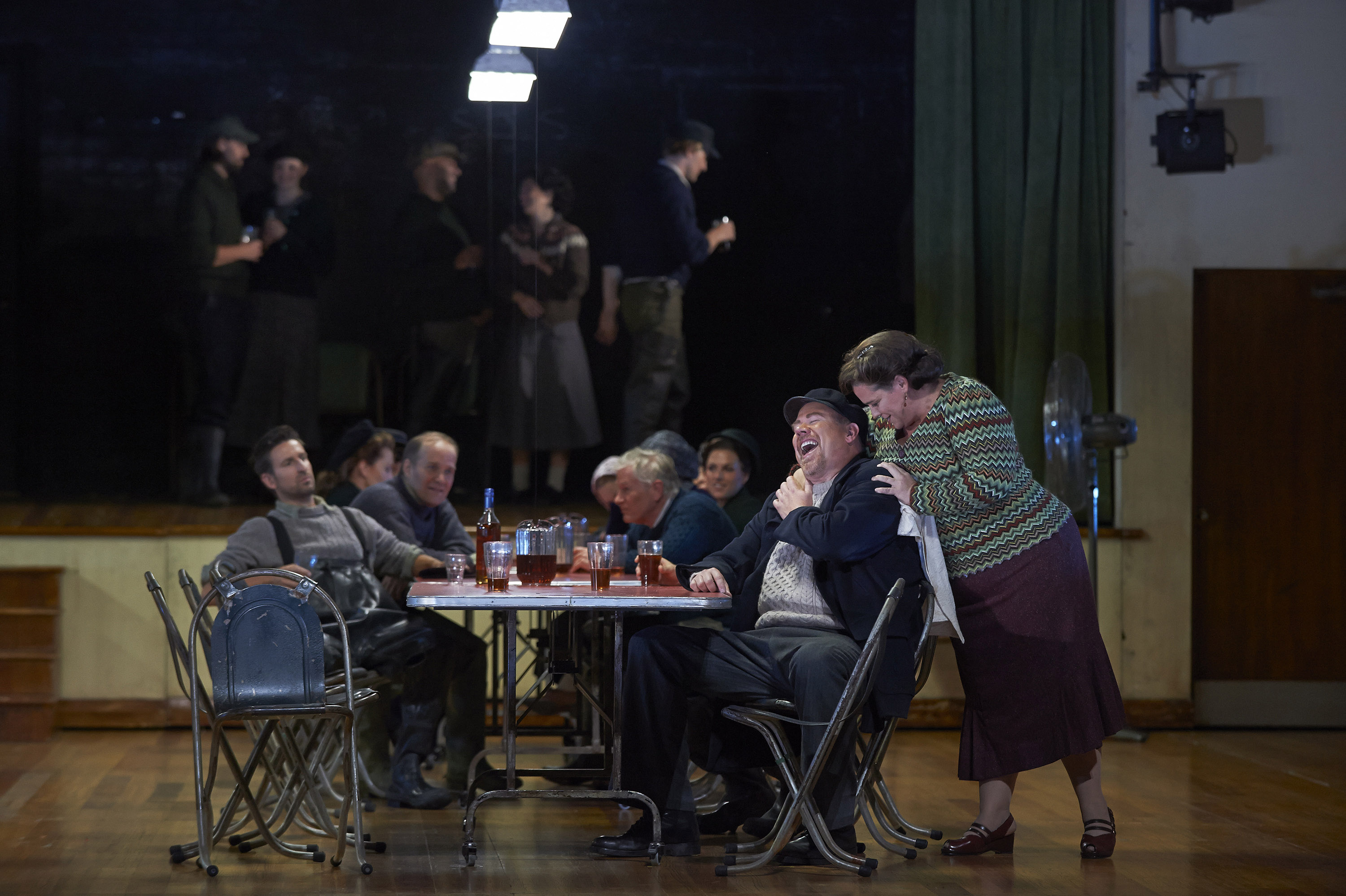
1.moothallRichard Jones has chosen to set the piece in the 1980s and to portray the inhabitants of the Borough as a sort of inbred hive mind fuelled by prejudice, alcohol and drugs.  Actually it’s not a bad concept but it comes off as exaggerated with cast and chorus repeatedly making more or less coordinated middle aged disco moves.  He also portrays the nieces as the sort of permanently stoned bubble heads one wants to avoid on the last train home. There are some neat touches.  The Moot Hall, The Boar and Grimes’ hut are all formed by box like spaces that are tilted and rotated to good effect.  The lighting is effective too.  Unusually for a modern production Jones doesn’t provide any staging for the interludes, leaving the theatre dark with the curtain down.  Overall, it’s a production I’d want to take a second look at but I suspect it’s just painted too broadly to be really effective.

Continue reading

Key Characters

battLast night we attended a concert in the relatively new performance space at the Canadian Music Centre.  It’s a very pleasant room, set up for recording, and seating maybe 50.  The program consisted of four recent works by Canadian composers; three short opera scenes for soprano and piano and a piano piece.


Continue reading

All the Grimes that’s fit to print

opusarteoabd7119dIt will come as no secret to regular readers that I am something of a Peter Grimes completist.  Until recently this blog was probably the only place one could find detailed reviews of all the available video recordings of that great work.  Now the recent La Scala production has been released on Blu-ray and I am no longer complete.  Fear not though, the disk is in the mail as they say and the divine order will shortly be restored.

In other Grimes news, the Aldeburgh Festival is staging the work on the beach.  The estimable Chris Gillett, Horace Adams both there and at La Scala, is blogging about it in his usual inimitable style.  In some ways I really wish I could go but I know that coast.  Even on a good day the wind will freeze one’s soft bits off. Definitely a challenging place to perform or even watch opera.  It’s also just off the A12 and I still have the after effects of 24 stitches on my face from a rather unfortunate encounter on that highway in my youth.  I shall patiently await Ben Heppner, Alan Held, Ileana Montalbetti et al at the Four Seasons Centre in the fall.

The Giacomo Variations

4.snogThe Giacomo Variations is the latest collaboration between John Malkovich, Michael Sturminger, Martin Haselböck and, posthumously, W.A. Mozart.  In that respect it has much in common with The Infernal Comedy.  In other respects, not so much. It’s just wound up a six performance visit to Montreal and Toronto and last night I caught the final performance at the Elgin Theatre.

Continue reading

An unusual idea

blue1121_9My attention has been drawn to a most unusual project.  A group of people are trying to write a bel canto opera based on a Sherlock Holmes fanfic.  I’m not really sure what I think of the idea of fanfic, which I have avoided to date, though I must note that persons I consider almost entirely sane are quite committed to the genre.

For the curious, the details are here.

Elegant and Powerful Ulisse

Monteverdi’s Il ritorno d’Ulisse in patria hasn’t proved as popular as his other late work L’incoronazione di Poppea but, given as compelling a performance as it got at the Teatro Real, it’s a bit hard to see why that is.  On this 2007 recording we have an elegant and interesting production by Pier Luigi Pizzi, an excellent cast headed by Kobie van Rensburg and Christine Rice and the incomparable William Christie and his Les Arts Florissants.  It’s a compelling package.

1.prologue Continue reading

From the House of the Dead

Janáček’s last opera, From the House of the Dead, is a curious piece.  It sets certain episodes from Dostoevsky’s account of his life in prison into a collage of stories that doesn’t have a straightforward narrative arc at all.  It’s quite brutal, as one might expect, and very male dominated.  Few characters stand out as individuals and so the piece becomes very much an exercise in ensemble musical theatre.  The music is unusual too.  In Pierre Boulez’ words it is “primitive”.  Certain phrases are repeated over and over with minimal development to create a sort of “expressionist minimalism”.  It’s extremely interesting to listen to and a great sonic match for the brutal and repetitive nature of prison camp life.

1.arrival Continue reading

Toronto’s got talent

organRecitals at Rosedale is a new venture from collaborative pianists John Greer and Rachel Andrist.  There will be four themed recitals, each featuring multiple singers, on Sunday afternoons at Rosedale Presbyterian Church.  Last night saw a preview of excerpts from all four programs.  Around 200 people showed up on a very hot and humid Saturday evening to see a pretty decent cross section of Toronto’s singing talent.  The venue has a typically resonant church acoustic and tends to swallow the words a bit however carefully the singer enunciates but it’s a sensible size, holding maybe 200-300 and so avoids the problem of feeling empty even when there is actually a pretty decent crowd.

Continue reading

Perplexing Tannhäuser

In Kasper Holten’s production, recorded at Royal Danish Opera in 2009, Tannhäuser is a poet torn between family and the conventional world of the Landgraf’s court and his creative processes symbolized by Venus and Venusberg.  There are numerous visual clues that perhaps we are even supposed to identify Tannhäuser with Wagner himself.  Far from being a young man, this Tannhäuser is middle aged, married to Eizabeth and has a son.  He has withdrawn into a psychological world of his own and Venus, his muse, and Venusberg are in his imagination.  Only after death is he recognized as a genius.  Of the rest, how much is supposed to be external and how much internal to Tannhäuser’s imagination is a bit hard to grasp.  If nothing else it goes some way to making the sixty year old Stig Andersen as Tannhäuser and the equally mature Susanne Resmark as Venus almost believable.  The 1900ish setting works quite well for the sexually repressed court of the Landgraf von Thüringen though a chorus of pilgrims returning from Rome in full evening dress is a bit of a jar.  The concept is quite interesting but really probably stretches further than the libretto can accommodate.  This Venus isn’t remotely credible as a goddess of love and the matronly Elisabeth singing about being a pure, young maiden is just odd.

1.heinrich_venus Continue reading