Today marks the 225th anniversary of Mozart’s death. To commemorate it Universal Records (Deutsche Grammophon and Decca basically) have put together a special commemorative edition which I have had a chance to dip into, but not much more than dip into, because it is huge. It’s a cuboid about the size of an LP record and a little over half as deep. It weighs 10kg. Inside are 200 CDs containing the complete works of Mozart including juvenalia, fragments, arrangements and alternative versions. There’s also a copy of the latest Kerchel catalogue, some prints and two very handsome hardback books; a new biography by Cliff Eisen and a second volume containing essays and work by work commentary. What there isn’t is libretti for the vocal works but it actually gets better. One can go to the website mozart225.com and download an app, offered in a choice of languages, with the libretti of all the works plus translation. (You do need the code from the set to do this). OK so I’m a bit of a gadget freak but all the Mozart libretti on my phone? How cool is that?
Author Archives: operaramblings
Next week
Messiah season gets underway with Soundstreams’ Electric Messiah on Monday. On Wednesday night, Opera 5 have a seasonal fundraiser at the Extension Room including an ugly sweater comp (Greg Finney at very short odds). Then on Saturday owing to bizarre scheduling you can take your pick from the ROH’s Così at Bloor Hot Docs or the Met’s L’Amour de Loin at just about any Cineplex Odeon. Both essentially at lunchtime, for some value of lunchtime.
Hallelujah!
It’s that time of year when one ponders the vexed question of how many Messiahs, and which ones, one is going to see this year. For Torontonians there seem to be four principal contenders; two fairly conventional and two less so. At the conventional end of things there’s the TSO of course. This year it’s back to the usual performing edition though fans of Sir Andrew’s “Big Fat Messiah” as heard last year can now acquire it on CD from the Chandos label. Baroque specialist Nicholas McGegan conducts so it’s probably as close to HIP as the TSO are ever going to get. Soloists are Yulia Van Doren, Abigail Levis, Isaiah Bell and Daniel Okulitch. I’m not familiar with either of the ladies but the guys are top notch. As ever the orchestra will be joined by the Toronto Mendelssohn Choir. There are five performances at Roy Thomson Hall on the 18th at 3pm and the 19th, 20th, 21st and 23rd at 8pm.
The best laid plans
So last night I intended to catch both the FAWN fundraiser/announcement gig at Electric Perfume and AtG’s opera pub night. I figured I could spend an hour up on the Danforth and still hit the Esplanade soon after the start at 9pm. The first part went fine. I saw a most enjoyable performance by Adam Scime of Kurtàg’s Message Consolation with some lovely movement work on the floor by Jenn Nichols. Also I was there long enough to hear Adanya Dunn and Katherine Watson do Anna Höstman’s Children’s Paradise for soprano and flute. There was news too that FAWN is working with Anna on a new full scale opera for some time in the future. I had to leave before the rest of the announcements but I’ll pass the news on when I get it.

Chelsea Rus in the RBA
Chelsea Rus is a recent graduate of the Schulich Scool of Music at McGill University and winner of the Wirth Vocal prize. Today, along with pianist Marie-Ève Scarfone, she gave a recital in the Richard Bradshaw Amphitheatre. I like that it was all song bar the opening number; “Je veux vivre” from Gounod’s Roméo et Juliette. Hearing young singers belt out the same few Mozart and bel canto standards gets a bit tedious. Anyway this was one of those recitals that started quite well and just got better as things progressed. Poulenc’s Fiançailles pour rire are, I suppose, a bit of fluff but they allowed Chelsea to show off a rather lovely middle voice and good French diction, though the registers are still not fully integrated. Even better was Liszt’s Oh! quand je dors. Here she showed just how expressive she can be.

Rusalka à la Freud
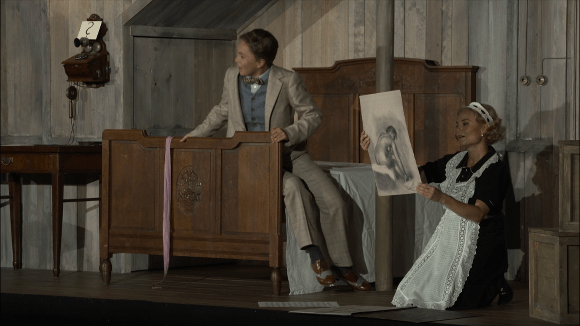
Stefan Herheim’s 2012 production of Dvořák’s Rusalka for Brussels’ La Monnaie Theatre is predictably ambitious and complex. He takes an explicitly Freudian (by way of Lacan) view of the piece(*). The female characters are representations of male views of the female and, sometimes it seems, vice versa. It’s seen most clearly in Act 2 and I found unpacking Act 1 much easier after seeing it so I’m going to start there. We open not with bucolic, if coarse, peasants preparing for a wedding feast. We are on a street in a scruffy part of, I guess, Brussels. The gamekeeper and kitchen boy are replaced by a priest and a policeman. The traditional dismembered game animals become a female chorus, many of them nuns, with exaggerated secondary sexual characteristics. There is, essentially, an orgy. Clearly the human world that Rusalka cannot enter is about sex in its most physical aspects not meaty Central European banquet platters! Rusalka and the Foreign Princess are dressed and wigged identically. They are quite freely interchanged. Lines that are canonically addressed to one are addressed to the other and so forth. It’s pretty clear that each represents, albeit imperfectly, the Prince’s ideal woman. Rusalka is the unattainable feminine ideal; flawed in that she cannot engage in fully satisfying sexual activity. The foreign Princess is sexually satisfying but falls short precisely by not being unattainable. Some less clear male duality is suggested by the appearance of the Vodnik dressed as the Prince. It just gets weirder from there with the ballet of nuns, prostitutes, fish, squid and heaven knows what else spilling over into the auditorium while the Prince and Foreign Princess watch from a box and Rusalka and the Vodnik get caught up in the action. At the conclusion of the act it’s Rusalka not the Princess that he begs for help.

Upcoming opera in cinemas
Bloor Hot Docs, after something of a hiatus, is showing three Royal Opera House productions in December. Here’s the schedule:
Saturday, December 3, 12:00 PM Norma (directed by La Fura dels Baus’ Alex Olle) with Sonya Yoncheva in the title role. It was described as “striking and perverse” by The Guardian. Sonia Ganassi is Adalgisa with Joseph Calleja as Pollione. Antonio Pappano conducts. More info.
Saturday, December 10, 11:00 AM Cosi fan tutte directed by Jan Phillip Gloger, conducted by Semyon Bychkov. With Angela Brower (Dorabella), Corinne Winters (Fiordiligi), Daniel Behle (Ferrando), Alessio Arduini (Guiglielmo) Looks like an updated “theatre in theatre” production. More info.
What’s black and white and red all over?
The 2010 Oslo recording of Monteverdi’s L’incoronazione di Poppea is one of the strangest opera videos I have ever seen. Besides having an almost complete set of the characteristics that critics pejoratively assign to Regietheatre it also has a very unusual video treatment that goes well beyond quirky camera angles and overly intrusive close-ups. So the box is being entirely accurate when it states “Based on a performance directed by Ole Anders Tandberg. Adapted and filmed by Anja Stabell and Stein-Roger Bull”.

Moving into December
Next week is a bit quiet. The lull before Messiah madness perhaps There are though three shows on Thursday December 1st. You can see soprano Chelsea Rus in recital with Marie-Ève Scarfone at lunchtime in the RBA. She will be performing the program that won her the inaugural Wirth Vocal Prize at the Schulich School of Music at McGill.
In the evening FAWN Chamber Creative has a “drop in style event” and fundraiser where they will be announcing their plans for Synesthesia IV. There will also be performances by Jenn Nicholls, Adam Scime and Adanya Dunn among others. It’s at Electric Perfume on the Danforth at 7.30pm and 9pm. PWYC. Details.
Also, as the 1st is the first Thursday of the month it will be Pub Night with Against the Grain at the Amsterdam Bicycle Club. That doesn’t start until 9pm so one could just about catch the first set at Electric Perfume and then head down to The Esplanade.
Comfort
Over 200,000 women from across Asia were conscripted into sexual slavery by the Japanese army in WW2. They were euphemistically described as “comfort women”. In 2009 playwright Diana Tso met some of the survivors, heard their stories and wrote a play based on their testimony. The result was Comfort, currently playing at the Aki Studio in a production directed by William Yong with music by Constantin Caravassilis.