
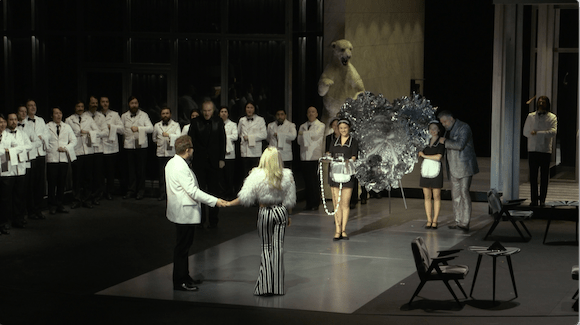
Rimsky-Korsakov’s 1894 opera Christmas Eve is based on the Gogol short story The Night Before Christmas which also formed the basis for Tchaikovsky’s The Tsarina’s Slippers. We are in a small village in Ukraine just before Christmas. Basically the smith Vakula is in love with Oksana, the beautiful daughter of the rich farmer Chub. To complicate matters Vakula’s mother, Solokha, is a witch who is (in the words of the subtitles) “having it off” with every prominent male in the village including Chub plus the Devil. Vakula shows up unexpectedly at his mum’s where she has been hiding successive lovers in sacks as the next (unscheduled) one arrives. Vakula “tidies up” the sacks but then runs into a big party of villagers where the contents of the sacks are revealed (except for the Devil). Oksana teases Vakula and says she will only marry him if he brings her the Tsarina’s slippers as a Christmas gift. Vakula vows never to be seen in the village again and sets off with the Devil in his sack.

 2020 started with news of yet another anti-semitic atrocity in the United States. My musical 2020 started with a new recording of that finest of all musical acts of resistance to anti-semitism, Shostakovich’s Symphony no. 13 in B-Flat minor “Babi Yar”. It’s a setting of poems by Yevgeny Yevtushenko for orchestra, bass soloist and men’s chorus and it’s powerful stuff. It’s often performed at consistently high energy and volume and seething with anger. Riccardo Muti treats it rather differently. The recording, featuring bass Alexey Tikhomirov, the Chicago Symphony and the men of their chorus, doesn’t lack drama or intensity but it’s also often intensely lyrical. When require, Tikhomirov and the chorus produce some gorgeously beautiful, even delicate, singing and the orchestra do the same. There’s not much of the blaring brass one associates with the Leningrad recordings of the Shostakovich symphonies. Instead there’s some wonderful playing, especially by the low brass. The motif in the fourth movement, curiously reminiscent of the Fafner scene in Siegfried, features a sort of duet between tuba(?) and timpani to great effect. This is very fine music making.
 operaramblings