Lohengrin with a twist

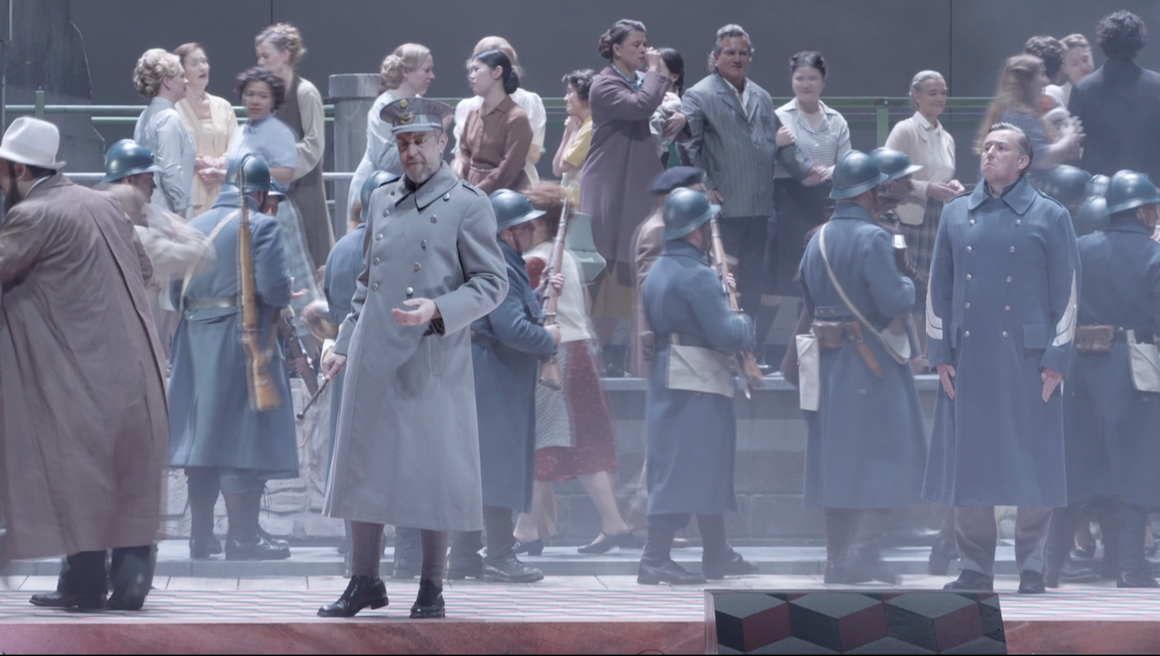
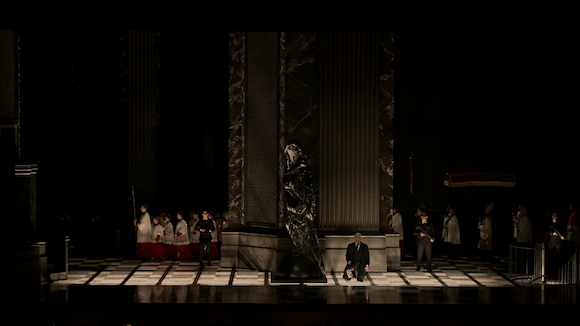
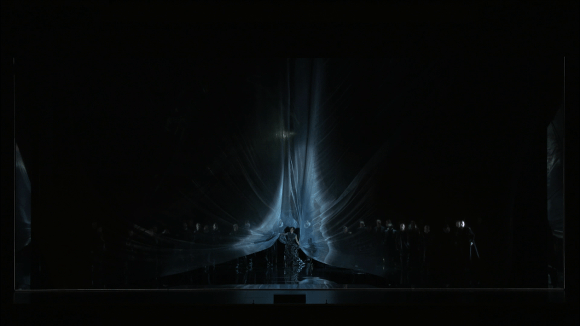
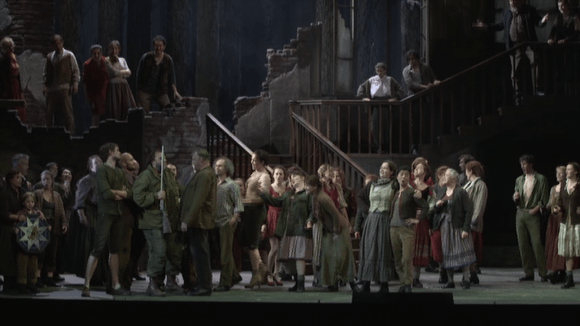
Sometimes opera directors come up with a twist to a plot hat is illuminating without requiring pretzel logic to actually align it with the libretto.  I think Jossi Wieler and Sergio Morabit’s production of Wagner’s Lohengrin for the Wiener Staatsoper in 2024 manages that pretty well.

Continue reading

Siegmund as Psychopath

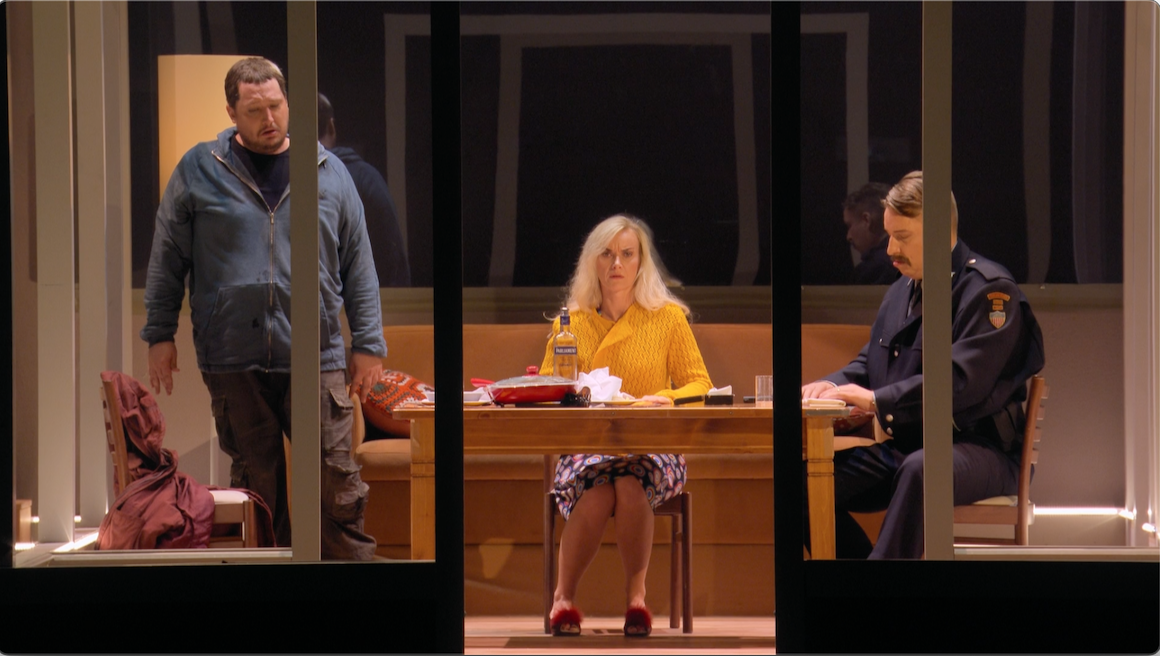
Following on from Das Rheingold, the second instalment of Dmiti Tcherniakov’s Ring cycle; Die Walküre, recorded at Staatsoper unter den Linden in 2022, has now been released on video.  We are sill in the ESCHE psychological research centre.  During the Prelude we see news footage of Siegmund’s escape from the programme he is in.  He staggers into Hunding’s staff apartment to find Sieglinde.  Hunding, when he appears, is some sort of armed security guard.  This illustrates the problems I have with this production.  The psychology of the Siegmund/Sieglinde/Hunding trio works well but the back story of Wälse, Sieglinde’s forced marriage etc makes no sense at all.  Oh, and Wotan seems to be watching everything that goes on.

1.hundingsapt

Continue reading

The Rheingold Research Centre

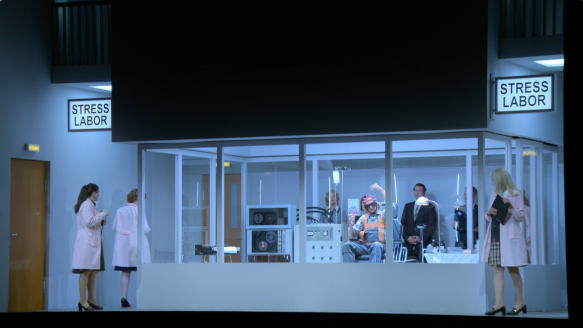
It’s pretty difficult to judge whether or not a high concept production of Wagner’s Ring cycle is going to work or not just from Das Rheingold but I thought Dmitri Tcherniakov’s production for Staatsoper unter den Linden recorded in 2022 was pretty promising.  His world is a large research complex designated ESCHE for reasons that aren’t clear.  The time period seems to be 1970s or thereabouts.  The research is essentially psychological and the characters are variously executives, scientists and experimental subjects.

1.stresslab

Continue reading

Make Brabant Great Again

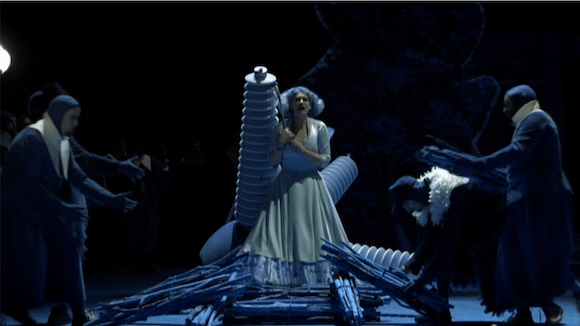
Yuval Sharon’s Lohengrin in 2018 at the Bayreuth Festival was the first production there by an American director and, perhaps unsurprisingly, there are echoes of contemporary events in the US in the show.  Specifically Sharon’s Brabant is a conformist theocracy in which society has regressed technologically.  Some of the action takes place in and around a prominently placed disused electrical installation of some kind.  The Brabanters are cowardly and subservient, initially to Telramund and then, equally, to Lohengrin.  The advent of a charismatic leader. does not necessarily equate to liberation or full citizenship.  Sharon also claims in his director’s notes that the real dissenter is Ortrud and that it is her actions that liberate Elsa and Gottfried.  Whether the staging supports this is, I think, questionable.

1.elsa_pyre

Continue reading

Live from Salzburg

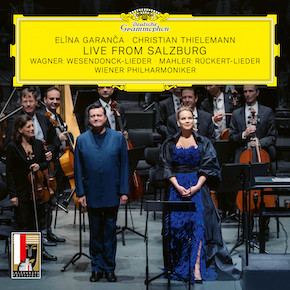
00028948619290-CvrLive from Salzburg is a new CD featuring music recorded live at Salzburg during the pandemic.  The performers are Elīna Garanča, The Vienna Philharmonic and Christian Thielemann.  There are two sets of songs; Wagner’s Wesendonck Lieder (recorded in 2020) and Mahler’s Rückert Lieder (recorded in 2021).  Both recordings were made during live performances in the Großesfestspielhaus.

I like Garanča a lot in this music.  Sometimes I find her a bit “cold” but here there’s a really nice balance of emotion and clarity.  Her articulation of the text is excellent and she sounds good throughout her range.  The lower and middle ranges have a kind of burnished quality; not really dark but definitely not soprano like , while her upper register is controlled and smooth.  The low end is perhaps best heard in Um Mitternacht where she shows real power and depth of emotion.

Continue reading

Tosca noir

The 2018 Salzburg Easter Festival production of Puccini’s Tosca was directed by Michael Sturminger.  The only Sturminger works I’ve seen before are his rather odd Mozart collaborations with John Malkovich; The Giacomo Variations and The Infernal Comedy so I really wasn’t sure what to expect.  The production riffs off film noir and is updated to more or less the present.  It opens with a shoot out between Angelotti and the police  but that lasts only a few seconds and the first act and the first half of the second act are fairly conventional, bar Scarpia on an exercise bike as Act 2 opens.  That said, it’s big and monochromatic and it does have a noir feel.  It starts to get a bit more conceptual around the Scarpia/Tosca confrontation.  It’s an interesting take on Scarpia; perhaps more bureaucrat than psychopath.  The relationship between the two is well drawn and Anja Harteros does a really convincing job of her build up to killing Scarpia including a first class Vissi d’arte sung from some unusual positions.  There’s a hint of what’s to come at the very end of the act when an “I’m not dead yet” Scarpia is seen crawling towards his phone.

1.church

Continue reading

Karajan’s Walküre – 50 years on

To quote a quite different opera, “it is a curious story”.  In 1967 a production of Wagner’s Die Walküre, heavily influenced by Herbert von Karajan [1] who conducted the Berlin Philharmonic for the performances, opened the very first Osterfestspiele Salzburg.  50 years later it was “remounted” with Vera and Sonja Nemirova directing.  I use inverted commas because it’s actually not entirely clear how much was old and how much new.  It might be more accurate to describe it as a homage to the earlier version.  In any event, it was recorded, in 4K Ultra HD, no less and released as one of the very first opera discs in that format.

1.tree

Continue reading

Elegant and subtle Otello

Vincent Brossard’s production of Verdi’s Otello for the 2016 Salzburg Easter Festival is both elegant and subtle; the latter quality being backed up by superb singing and acting from the principals.  In many ways the production is clean and straightforward with a focus on character development but it also makes use of elegant lines and sharply contrasting darks and lights in creating the stage picture.  There’s also a really cool use of mirrors during Già nella notte densa that I can’t quite figure out.

1.storm

Continue reading

Kaufmann’s Cav and Pag

Jonas Kaufmann made a double role debut as Turiddu and Canio in the classic verismo double bill of Mascagni’s Cavalleria Rusticana and Leoncavallo’s Pagliacci at the Salzburg Easter Festival in 2015,  The productions were directed by Philipp Stölzl and Christian Thielemann conducted with the Staatskapelle Dresden in the pit.

1.church

Continue reading

Der Freischütz in Dresden

At first blush Axel Köhler’s 2015 production of Weber’s Der Freischütz for Dresden’s Semperoper seems entirely traditional but as it unfolds it reveals some real depth that pretty much restores the sense of horror that the original audience felt.  It’s set in an indeterminate time period in the aftermath of war.  The first act looks quite conventional but there’s a very tense air to it with both sexuality and violence just below, and occasionally above, the surface.  The atmosphere is greatly enhanced by our first look at Georg Zeppenfeld who is a very fine and rather plastic Kaspar.  There are echoes here of his König Heinrich in Bayreuth.

freischutz1

Continue reading