Mathis der Maler

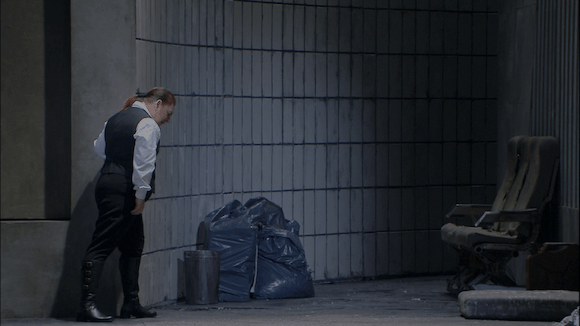
My guess is that Paul Hindemith’s Mathis der Maler is an opera most opera amateurs have heard of but which comparatively few have actually seen.  The video release of a 2012 production at Theater an der Wien directed by Keith Warner is therefore very welcome.

1.monastery

Continue reading

Lucio Silla moda grunge

Claus Guth has a way with Mozart.  At his best; with his Salzburg productions of the da Ponte operas for example, he’s superb while I was unconvinced by his Glyndebourne Clemenza, despite its ambition.  I was really keen to see what he would do with an opera like Lucio Silla which, despite some lovely music, is formulaic and potentially very boring.

1.bins

Continue reading

The Harnoncourt show

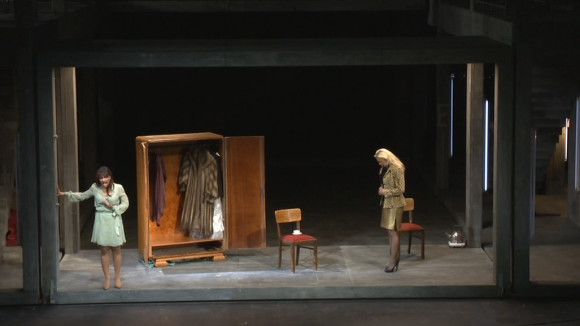
Unusually, the Theater and der Wien’s 2011 production of Handel’s Rodelinda features a father and son team.  Philippe Harnoncourt directs and Nikolaus conducts.  It’s an interesting production with great acting, very decent singing and the always excellent Concentus Musicus Wien in the pit. 1.wardrobe Continue reading

Fear and loathing in Corinth

Cherubini’s 1797 opéra comique Médée was one of the first to use the form for serious drama.  Krzysztof Warlikowski’s 2011 production filmed at La Monnaie in Brussels is certainly that.  Jason, Medea and the rest are very contemporary characters though we often see them against a backdrop of 1960s style home movies and the chorus too, which tends to remain in the background also seems to be from the same period.The meaning of this juxtaposirtion isn’t clear and there is nothing on the disks or in the documentation to help.  We are also told that the libretto was adapted by Warlikowski and dramaturge Christian Longchamp but nothing more than that.  This is definitely a production where the director’s notes would be a major plus.

1.grovel Continue reading

Handel for the Handelians

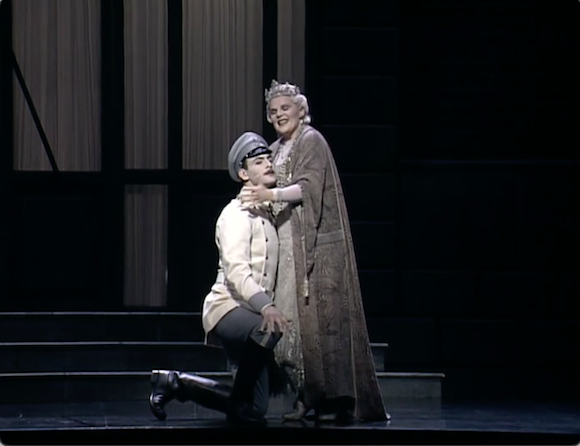
I think maybe Handel’s Rodelinda is one for the hard-core Handelians. It’s got some lovely music but it’s long (200 minutes), not very dramatic (it’s based on Corneille) and, structurally, is a succession of recitative and da capo arias. There is no chorus and I only recall two numbers that weren’t solos; the concluding quintet and a rather lovely duo between Rodelinda and Bertarido at the end of Act 2. Jean-Marie Villégier’s 1998 production for Glyndebourne rather tends to emphasise the leaning to elegance rather than drama. The basic look and feel is “silent movie era”. Sets and costumes are near monochrome and that tends to be emphasised by the lighting. At least when there is a any. Much of this production is very dark, as was fashionable at the time.
r1

Continue reading