Farewell Ileana

Ileana at the Stella Maris competition

It’s that time of year again. With a few months left in the opera season in Toronto today saw the first “farewell” concert by a departing member of the COC Ensemble Studio. It was a solo recital by dramatic soprano Ileana Montalbetti, quite possibly the best sounding thing ever to come out of Saskatoon. Ileana is the only full on dramatic soprano I’ve seen in the few years I’ve been following the Ensemble Studio and, as ES boss Liz Upchurch pointed out, they are rare so it’s always interesting to see another one come along. Fair to say too, I think, that it’s not the voice type that is treated most kindly by a piano recital in a fairly intimate space. That said, it was a very enjoyable performance.

Ileana kicked off with O Sachs! Mein Freund! from Die Meistersinger. Any reservations I have about dramatic sopranos and piano recitals come redoubled in spades where “big” opera arias are concerned. The kind of volume and tone needed to sing against a large orchestra in a big theatre tends not to sound too lovely when throttled back with only a piano for support and, honestly, I don’t think this piece was a great idea.

Things improved enormously in the next section though. This was the song cycle Ekho Poeta; Pushkin texts set by Benjamin Britten and written for the Rostropoviches. It’s a rarity; a Britten song cycle I don’t recall hearing before, and it’s very good. It was a much better vehicle for Ileana who displayed plenty of power, well controlled vibrato and pleasing and varied tone colours especially in the middle register. Her high end was much sweeter here than in the Wagner too. Where she needed a lot of attack, as in the rather spiteful Epigramma she could certainly produce it. Being Britten, the piano part in these pieces was really quite demanding too so kudos to pianist Rachel Andrist for excellent and sympathetic musicianship.

The second half of the programme was all Strauss. It started with Arabella’s final aria, which I enjoyed more than the Wagner but about which I have similar reservations as a recital piece.  Then we got a selection of songs from Op. 37, Op. 48 and Op. 32 before finishing up with Zueignung from Op. 10. This was all good stuff with more excellent control and very good German diction. The final number was particularly lovely. For an encore we got a spirited rendering of Sweet Polly Oliver in the Britten setting.

I think Ileana is a very considerable talent and I’m sure she’ll do well in the wider operatic world.  Liz Upchurch and the COC certainly seem to think so.  Liz  “leaked” that Ileana will be back in an as yet unannounced major role. Putting two and two together and making something like e^iπ and adding in a dose of wishful thinking I’m wondering if there is any connection between Ileana’s first piece today and the long rumoured Toronto debut of a certain ex-pat Canadian baritone.

Also, à propos not much, it was nice to see a certain world famous dramatic soprano in sneakers and sans make up watching from the standing room section.
Barbarella, Prinzessin von Judea

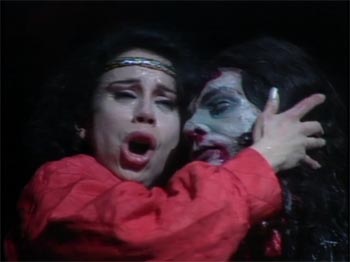
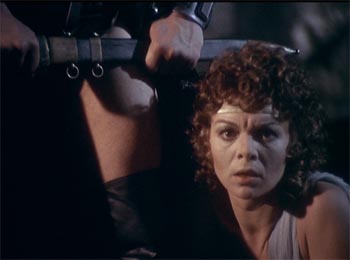
Götz Friedrich’s 1974 film of Strauss’ Salome is a bit of an oddity. It’s a studio film rather than a video recording of a live performance. This allows the casting of singers who might not be able to manage the role in the opera house. In this case, crucially, the light lyric soprano Teresa Stratas sings the title role which she most certainly never did on stage. Continue reading

Ariadne auf Dresden

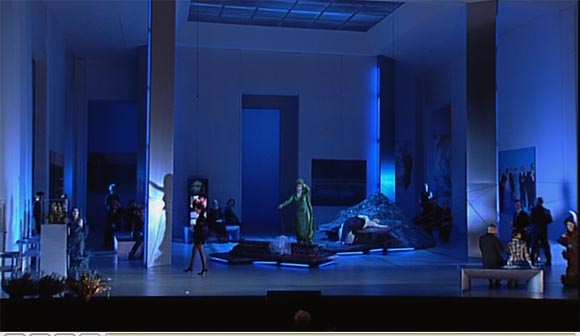
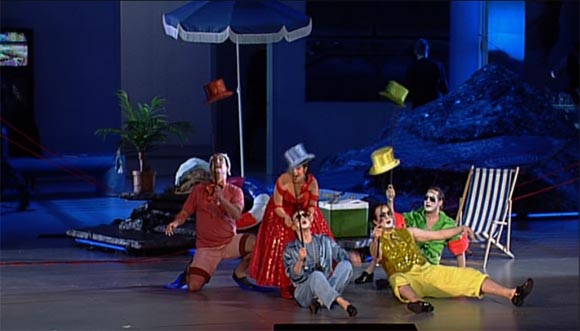
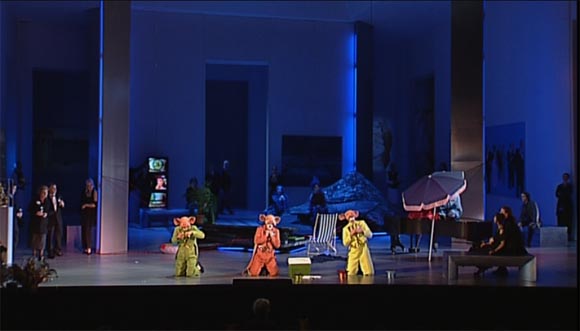
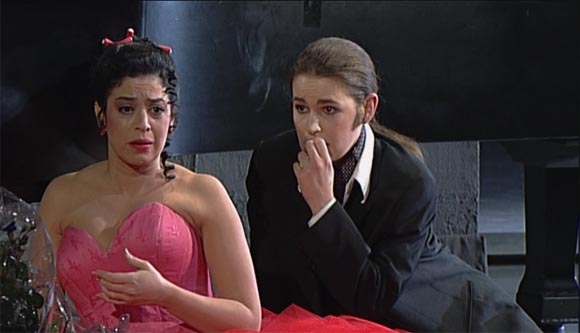
Marco Arturo Marelli’s 2000 production of Richard Strauss’ Ariadne auf Naxos is fascinating and compelling. He sets the work in the present at a very posh, arty party. Throughout there are extras playing party guests all over the place. The “opera” itself takes place in the middle of the main salon where the party is taking place. There are many interesting touches. For example, the Komponist features extensively in Act 2. Obviously smitten with Zerbinetta, he appears to accompany her on piano at the beginning of Groß mächtige Prinzessin and frequently watches from the side of the room as she is drooled over by various male party guests. Only at the end does the staging shift from the party to something that suggests some sort of reality in the relationship between Bacchus and Ariadne before dropping us right back into the party where the guests have completely ignored this piece of transcendence to go and watch the fireworks in the garden. The directorial take on Zerbinetta is interesting too. No flighty airhead here but rather a somewhat cynical and worldly young woman. It works rather well.

The performances are a bit mixed. The Act 1/Prologue is uniformly strong. Sophie Koch is an excellent Komponist. She sings well and acts very well indeed. Her, non singing, portrayal of the character in the second act as a gauche and geeky young man socially and emotionally out of his depth is really quite funny and touching. Friedrich-Wilhelm Junge is excellent as the Major-Domo. He has just the right touch of disdain. Moving on to the main action it’s a bit of a mixed bag. Iride Martinez’ Zerbinetta is a tour de force. She is completely consistent in her portrayal of the character to the extent of, at times, somewhat suppressing the beauty of the music in favour of dramatic verisimilitude. That’s not to say she sings badly. She sings very well but to a particular purpose. Susan Anthony’s Ariadne didn’t really convince me as much. She’s OK but “OK” isn’t a description I want to use about someone singing Es gibt ein Reich. It should make the hair stand up on the back of one’s neck and Anthony’s doesn’t. To be fair she’s not helped by the recording (see below). Jon Villars’ Bacchus is pretty good and the supporting nymphs and players are more than adequate. The players in particular have a lot of business and they handle it with considerable comic flair. Surprisingly, Sir Colin Davis’ reading of the score seems a bit bland. He doesn’t point the rhythms nearly as incisively as Levine on the Met recording or, even better, as Andrew Davies did in Toronto last year. The orchestra sounds a bit undercooked too. The recording may be a significant part of the problem here too.

Technically this isn’t too, too bad for a budget Kultur effort. The video direction by Felix Breisach is very good. He shows us the whole stage often enough to appreciate the complexity of the director’s concept and its execution and his close ups aren’t excessively close. It’s a good balance. It’s a pity he’s not better served by the picture quality. It’s fairly good 16:9 (not 4:3 as the box and most on-line references suggest). It works pretty well on close ups but the lack of definition is a bit annoying on the longer shots.  This production would definitely have benefitted from being shot in HD. The sound is Dolby 2.0 and it’s at best OK. There’s no real sense of space and it’s a bit dry. It certainly doesn’t do Susan Anthony or the orchestra any favours. Subtitles are English only and documentation is limited to a track listing.

There aren’t a lot of versions of Ariadne on DVD. There’s a recent Guth production with Emily Magee, which is said to be quite good, an ancient film with Karl Böhm and a 1988 Met version. The Met version is musically far superior to the Dresden offering but features a deadly dull production that looks like it was first given half a century before Ariadne was written. Given that, I think this Dresden version is well worth a look.

Ewing’s Salome twenty years on

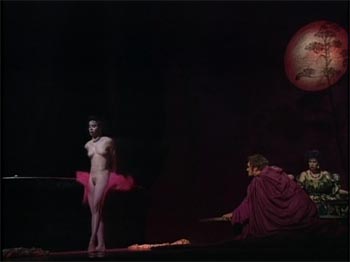
Sir Peter Hall’s production of Strauss’ Salome caused a bit of a sensation when it was first seen at the Royal Opera House and when it was broadcast on Channel 4 because Lady Hall, Maria Ewing, finishes up naked at the end of the Dance of the Seven Veils. How well does it wear after twenty years? First a couple of caveats. My DVD copy is the Kultur release of a few years ago. It now seems to be available from Opus Arte and it’s possible, indeed likely that some of the sound issues have been fixed in that release. If anybody has seen the Opus Arte version please let me know in comments. Anyway, the Kultur release has rather muffled sound with the voices balanced well back from the orchestra and no real solidity to the sound stage which is a pity in this particular work and obviously affects my view.

The production is really pretty conventional. There are lots of greens, greys and blue. It’s quite dark and the set is stagey and conventional. Almost all the visual interest revolves around Ewing’s Salome though Michael Devlin’s scantily clad and palely made up Jochanaan is quite arresting too. Narraboth (Robin Legate) is an unremarkable actor and Herod (Kenneth Riegel) and Herodias (Gillian Knight) look uncomfortably like a couple of drag queens. The latter though does manage a pretty effective hissy fit. For the sound reasons mentioned above it’s hard to be sure whether the rather insipid vocal performances by Devlin and Leggate are really their faults. There’s also no change in acoustic when Jochanaan is singing from the cistern which is odd. Riegel and Knight do better at projecting themselves beyond the orchestra and turn in OK performances.

All that said, one feels from beginning to end that this was set up to be the Maria Ewing show. One really can’t fault her acting which is quite compelling and manages by turns to be chilling, hypnotic, seductive, perverse, frenzied and orgasmic. The choreographer (Elizabeth Keen) does a pretty good job of creating credible dance moves for someone who clearly isn’t a great dancer though there’s no doubting her commitment to what she does. Vocally she gets away with a voice that’s really not big enough for the role. Somehow she manages a lot of projection from not so much volume and her vocal acting is good. It’s an extreme case of Ewing pretty much making things work when really they ought not to. The orchestra under Edward Downes sounds OK but also suffers from the recording.

The recording, directed by Derek Bailey, is about what one would expect from a 1992 TV broadcast. The picture quality is acceptable but not great 4:3 with hard coded English subtitles. Sound, as mentioned, is barely adequate. There are no extras and no documentation.

This is probably worth having a look at as a record of an iconic performance by Ewing but I can’t imagine anyone would choose it as the definitive Salome.

And just for fun, here’s a non-operatic bonus; a set of pictures of my copy of the 1938 edition of Wilde’s Salomé with pochoir illustrations by André Derain.

Salome – DVD of 2008 ROH production

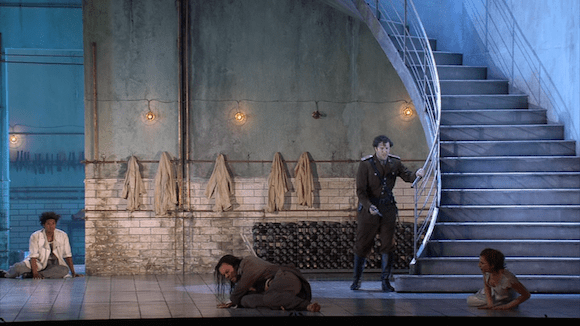
Strauss’ Salome is not for the faint hearted. It contains perversions including, but not limited to, necrophilia, paedophilia and incest. I think this makes David McVicar an obvious choice as director. In fact, by McVicar standards, this 2008 Covent Garden production is fairly restrained and straightforward. McVicar gves the work a 1930s setting which works just fine. The action evolves on a rather elegant two level set; upstairs is Herod’s banquet and downstairs is a sort of guardroom including Jokanaan’s cistern. It’s all quite elegant in light blues and greys and essentially all the action takes place downstairs. There are a few supers including a naked woman and another not far off floating around for no apparent reason except perhaps to suggest that the Judean army is not the Brigade of Guards.

1.beginning

Continue reading

Ariadne auf Naxos

Last night’s Ariadne auf Naxos at the Four Seasons Centre was a delight. It’s a peculiar opera and clearly a section of the audience hadn’t done their homework and were rather confused. It’s in two parts. In the prologue arrangements are being made for two pieces to be performed at a big party at the home of “The richest man in Vienna”. The first is an opera seria; Ariadne in fact written by a young earnest composer and to be performed by a stereotypically haughty diva and tenor. The second is a buffo piece to be performed by the dancer Zerbinetta and her troop of Harlequins. There is much huffing and puffing by the serious opera crowd, especially the composer, about having to perform in such undignified company but the boss is the boss and money talks. The final indignity is when the Major Domo announces his master’s decision that both pieces must be presented simultaneously. Last night this was played out in modern dress on a set that faithfully, at least as I remember it, recreated the rather drab back stage areas of the Four Seasons Centre. I have no idea how many people got the joke but I thought it was funny. Alice Coote, as the composer, and Richard Stilwell, as his mentor, the music master, were excellent and everyone else contributed as needed to make for a very funny first half. It was almost, but not quite, enough to distract attention from some truly gorgeous orchestral playing by the COC Orchestra under Sir Andrew Davis.

The opera proper is a classical myth based story about Ariadne being abandoned by Theseus and wishing to die on her desert island where she is accompanied only by three nymphs who comment on her condition. Ariadne’s big aria, “Es gibt ein Reich”, is all about longing for solace in death. Adrienne Pieczonka sang gorgeously and was well supported by the three nymphs; Simone Osborne, Teiya Kasahara, Lauren Segal. The orchestral playing just kept hitting the spot. All this was played out in front of a very drab backdrop with holes torn in it through which Zerbinetta and her boys were observing the action. This is where it gets weird again as first the Harlequins appear and try to cheer Ariadne up with a bit of comic singing and dancing. She is unmoved. The boys having failed, Zerbinetta herself appears and explains her views on their shared plight as women and her rather cynical philosophy of love. This happens in a coloratura aria of truly fiendish length and difficulty (“Großmächtige Prinzessin”). Jane Archibald brought it off with aplomb and brought the house down. Then it all gets serious again. Bacchus arrives (raving about having been bewitched by Circe, or not). Bacchus and Ariadne sing at each other heroically and rather at cross purposes until they realise that they have redeemed, transformed or something each other through love. Zerbinetta briefly reappears to remind everyone that “a new God always comes”. Ariadne and Bacchus get even more ecstatic, all sorts of starry things start to appear projected on the stage and backdrops, the orchestra goes nuts, and the curtain falls. It shouldn’t work. It’s Strauss and Hofmannsthal perhaps being too clever for their own good but, miraculously, it does work and the music is fabulous. When the performances are as good as last night it’s all really rather wonderful.

The audience reaction was interesting. A non trivial number of seats were empty after the interval and one couple left rather abruptly half way through the opera proper. Those who stayed were very enthusiastic. Makes me wonder what’s happening with the COC audience. Thoughts on that will form part of a season round up post I think.

Capriccio

Yesterday’s Met Live in HD transmission was Richard Strauss’ last opera Capriccio. It’s a curious work and I suspect how one thinks about it seriously affects how one reacts to it emotionally. On the surface it’s a sophisticated meta opera about opera with some side splittingly funny gags about unstageable production concepts accompanied by pastiche Wagner. Taken on that level it’s funny but perhaps, ultimately heartless. When one realises that the opera was written in 1941/2 it adds a new dimension. Why has Strauss set this opera in Enlightenment Paris? Where else could be more symbolic of everything the regime he is writing under is not? This work premiered a few weeks before the German defeat at Stalingrad. Does Strauss sense that german is losing the war? Is this less an affectionate farewell to the form from an elderly composer or an elegy for an artform that may not survive the destruction of European civilization which most would have thought the inevitable consequence of a Russo-American victory (who’s to say they weren’t right?). Any way these were the thoughts that were going through my head as I watched yesterday’s broadcast and no doubt helped give the work, for me, a greater emotional intensity.

Continue reading

Der Rosenkavalier

Back in 1961 Paul Czinner decided to experiment with filming a live opera performance. He chose the 1961 Salzburg Festival production of Richard Strauss’ Der Rosenkavalier. I guess it got a theatrical release in the day then more or less disappeared, popping up up from time to time in a rather poor quality ‘Pan and Scan’ VHS version. Now it’s been digitally restored from a 35mm print and released on DVD and Blu-Ray by Kultur. It’s spectacular. It looks like early 1960s 35mm colour and it sounds like early 1960s analogue stereo. Very impressive. Like watching Il Gattopardo while listening to a recording by John Culshaw or Walter Legge.

1.bedroom Continue reading