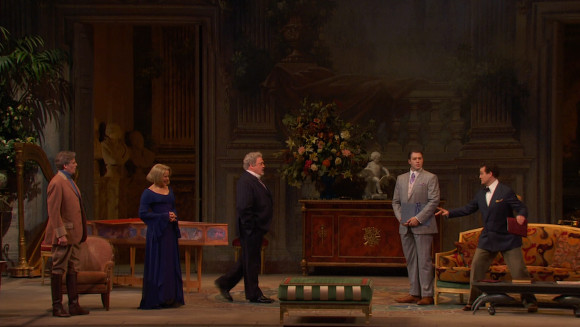
The MetHD broadcast of Strauss’ Capriccio has been issued on Blu-ray. I enjoyed the original broadcast but found watching it again on disk rather unsatisfying. The main problem is the production. It’s a John Cox effort from 1998. The period is updated from ancien régime France to just after WW1, apparently to make the people more contemporary while allowing an opulent, old style Met “all the things” production. Peter McClintock’s direction of the revival emphasizes the most obvious comedy (the ballerina falling over with her legs in the air, for example) while doing little or nothing to bring out the sheer cleverness of this opera, about an opera, within an opera. It all seems very heavy handed, in fact the word that popped into my head several times was “vulgar”.
Tag Archives: strauss
Kleiber’s Rosenkavalier
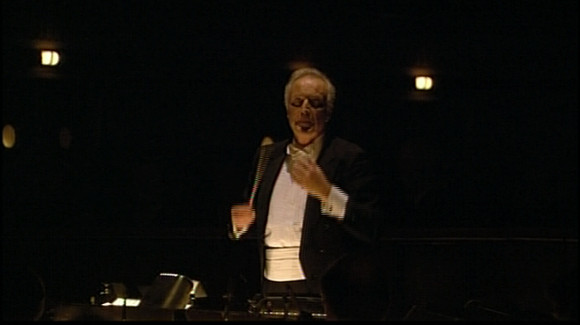
Carlos Kleiber didn’t record much despite enjoying something of a cult following as a conductor. In 1994, shortly before his death, he conducted four performances of Der Rosenkavalier at the Wiener Staatsoper; the first of which was recorded. It’s clearly Kleiber’s night. His appearances at the start of each act are greeted with cheers and wild applause. One can only guess at the reception he got afterwards because the curtain calls don’t make it onto the recording. And, yes, it is a masterly conducting performance with fine support for the singers, beautifully shaped lines and an infectious sense of fun.
Lunchtime with Tracy Dahl
I’ve attended many very good concerts in the Richard Bradshaw Amphitheatre but I’m not sure I’ve ever attended one as intense as Tracy Dahl and Liz Upchurch’s Songs from the Heart recital today. Tracy really is a rather extraordinary artist. She is the antithesis of the lieder singer who stands demurely by the piano and Schuberts mellifluously. She throws every fibre of her being into the performance. It’s not campily histrionic but voice, facial expression and gesture are all used to the full whether she’s hiccupping a drunken Harlequin or sibilantly suggesting a slithery singing snake.
Static Elektra
For the performances of Elektra at the 2010 Baden-Baden festival the Powers that Be chose to revive Herbert Wernicke’s 1997 Munich production with Bettina Göschl directing. The production concept seems to have been inspired by classical Greek drama. Sets and costumes are very simple, even austere, and the singers often address the audience directly. On stage this probably worked quite well as the overall effects are visually striking and the relative lack of interaction between the characters is perhaps appropriate for a work that is so much about alienation.
Where’s the Champagne?
It’s really hard to know where to start with Hans Neuenfels’ Die Fledermaus. It’s a prodcuction that enraged the more conventional patrons when it opened at the Salzburg Festival in 2001. It even provoked a “false pretences” lawsuit! There is so much going on that it almost seems to call for a catalogue raisonnée of the various scenes though one fears that would actually be both tedious and unhelpful. Let’s try instead to explore it thematically. Neuenfels takes very considerable liberties with the libretto. A lot of dialogue is cut, a lot is added and numerous non-canonical characters are inserted. That’s just a start.
Best of 2013
So what was I most impressed with on the opera and related scene in in 2013?
Big house opera
The COC had a pretty good twelve months. I enjoyed everything I saw except, maybe, Lucia di Lammermoor. Making a choice between Christopher Alden’s probing La Clemenza di Tito, the searing opening night of Peter Sellars’ Tristan und Isolde; the night when I really “got” why people fly across oceans to see this piece, Robert Carsen’s spare and intensely moving Dialogues des Carmélites or Tony Dean Griffey’s intense and lyrical portrayal of the title character in Peter Grimes is beyond me. So, I shall be intensely disloyal to my home company and name as my pick in this category the Metropolitan Opera’s production of Die Frau ohne Schatten. Wernicke’s production is pure magic and Anna Schwanewilms was a revelation.
Die Frau ohne Geisterwelt
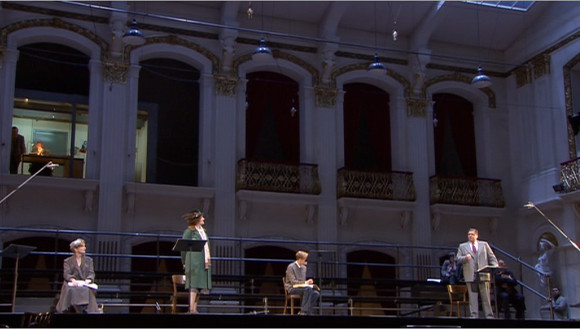
Christoph Loy, in his 2011 Salzburg production of Richard Strauss’ Die Frau ohne Schatten, avoids the problem of how to represent the Spirit World by essentially eliminating it. Instead we get a Konzept based on Böhm’s first recording of the work in Vienna’s Sofiensalle in 1955. Vienna is still recovering from the war and the hall is unheated and the singers unpaid. The Empress is rising star Leonie Rysanek and the Nurse is long time favourite Elisabeth Höngen. They represent the generations separated by the war. The Emperor is an American singing in Europe for the first time and, crucially, Barak and his wife are a real life married couple. Initially we see a lot of recording studio action as singers are moved about by actors in this experiment in early stereo. Then the action, particularly the Barak/Wife interaction slips more and more off stage. For the finale, we get a sort of celebratory concert in evening dress. It’s not a bad concept and this cast handles it very well but I fancy it’s a tough introduction to this far from straightforward opera and it does lose the magic of the Spirit World. (In other words I’m glad I saw the Met production before this one.)
Die Frau ohne Schatten at the Met
We caught Richard Strauss’ Die Frau ohne Schatten at the Met on Wednesday night. Expectations were high. It’s Strauss, and rare Strauss at that. It was our first time at the Met. The on-line opera world was abuzz with Christine Goerke’s performance as the Dyer’s Wife. By and large we weren’t disappointed.
Love and Life
Anne Larlee and Simone Osborne brought their Maureen Forrester recital tour to Toronto today, courtesy of Jeunesses Musicales Canada and the COC’s free lunchtime concert series. The programme featured works by Bellini, Schumann, Hahn and Richard Strauss plus two specially commissioned pieces from Brian Current.
I particularly enjoyed the Schumann and Strauss pieces. Simone’s interpretation of the Frauenliebe und -Leben showed a very wide range of emotion and tone colour and exceptionally good German diction. The three Strauss songs also displayed considerable power. This was very classy lieder singing.
Herheim and Egoyan
This Sunday afternoon (in Toronto) and evening (in Oslo) Brent Bambury of the CBC will interview Atom Egoyan (in Toronto) and Stefan Herheim (in Oslo) about their respective approaches to Richard Strauss’ Salome. The Egoyan version is just finishing up a run at COC (my impressions here) while Herheim’s version, previously seen in Salzburg, opens at Den Norske Opera & Ballett on Saturday. There will be live audiences in both cities connected by videolink. Details for Toronto are under the cut.