Canadian Opera Company season announcement 2012/13

So this morning I was at the Four Seasons Centre for the press conference to announce the COC’s 2012/13 season.

Board President Philip Deck started off with a strong statement about continuing to improve the quality of the product on the Four Seasons Centre stage and striving for “uncompromising and inspiring” programming with a goal of becoming “one of the world’s great opera houses”. There are crucial words here. If General Director Alexander Neef is to meet these goals he will need a supportive Board. It looks like they are there with him at least for now and that’s very good to hear.

There was a very good “teaser video” with contributions from the many Canadians who will feature next season. I guess this will be available on line at some point. Then we got to the main business with Alexander presenting the line up. It’s pretty exciting so here it is in all its glory and with my commentary.  Continue reading

Puzzling but well sung Don Giovanni

I looked at the cast list for the 1999 Wiener Staatsoper Don Giovanni and almost drooled. Carlos Alvarez, Franz-Josef Selig, Ildebrando d’Arcangelo, Adrianne Pieczonka, Anna Catarina Antonacci, Michael Schade, Angelika Kirchschlager and Lorenzo Regazzo. Add to that Riccardo Muti in the pit and musically it’s going to be hard to miss. So, unsurprisingly it turns out musically excellent across the board. I particularly enjoyed Michael Schade’s Don Ottavio. His supremely stylish singing and excellent acting added up to perhaps the best interpretation I’ve seen of perhaps opera’s dullest character. One might have reservations about Pieczonka’s Donna Anna but I think it’s a matter of taste. She can sing very prettily as she shows in her final duet with Schade but when she ups the volume she has great power but significantly less beauty of tone. It really boils down to one’s personal feelings about casting a genuine dramatic soprano in the role. I guess casting a mezzo as Zerlina is a bit unusual too but Kirchschlager is very good indeed. All in all it’s as well sung a Don Giovanni as I have heard.

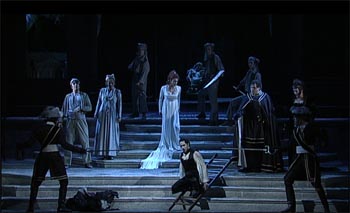
So, what about Roberto de Simon’s production and, supporting it, the acting? First, this production was performed at the Theater an der Wien so space on stage is tight and there’s a tendency for the singers to migrate to front centre stage for their big numbers giving a bit of a “park and bark” feeling. This is reinforced on the DVD by excessive use of close ups. If there is anything else going on we mostly don’t see it. This is a problem because there are some potentially interesting ideas in the production that don’t seem to be fully developed and that may be because the DVD viewer doesn’t see them develop. The first “big idea” is that as the piece progresses the costumes get more modern. Characters update roughly a hundred years on each appearance starting in the 16th century and going up to around 1900. The progression though is uneven and even my resident costume historian had trouble decoding some of the statements. It has to be said too that the early costumes in particular are sometimes bizarrely stylized. Don Giovanni gets visibly younger as the action progresses too. Add to that that there are two statues of the Commendatore; a 16th century one and a 19th century one. The former accepts Don Giovanni’s dinner invitation but the latter shows up. What are we to read into these elements and are they connected? To say that the characters are “timeless archetypes” seems to be a total “so what?” but I don’t have a deeper explanation. The second element is a flirtation with commedia. It’s never full on but we see glimpses of Harlequin in Leporello. In the opening scene he’s wearing what looks like a Harlequin costume that’s been desaturated in Photoshop as well as clown face. Don Giovanni’s acting too has some commedia elements. In particular there’s heavy use of the right-hand-shielding-left-side-of-the-face gesture in the opening scene with Donna Anna and it recurs in the final scene with the statue of the Commendatore. It gives Don Giovanni a sort of cheeky chappy quality at two of the most serious moments of the opera. Why? I don’t know. There are other, more or less isolated, visual references to the commedia sprinkled through the piece.

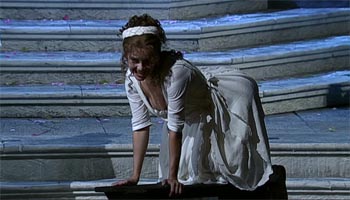
The final element of commedia is that Masetto is played as a complete clod. He’s the stock dim peasant rather than someone who recognizes Don Giovanni for what he is, the class enemy, from the get go. This is then set against an even more knowing than usual Zerlina.  Certainly in “Batti, batti” she appears to be offering far more than poor old Masetto can begin to grasp. Whatever it’s all supposed to mean, the cast give it their all and are clearly acting their hearts out and at least it’s never dull.

The biggest problem with the disc though is the video direction. Once again it’s Brian “close up” Large. With such a small stage it ought to be quite easy to show us what is happening but instead we get super close up on super close up. I particularly hate it when several people are singing and the director is just showing us a headshot of one of them. It interferes with my ability to hear the rest apart from anything else. Besides I don’t have a tonsil fetish. This comes to a final utterly annoying climax in the confrontation between the Commendatore and Don Giovanni. Large keeps cutting back and forth between full screen head shots of the pair of them. Ugh!

Technically it’s OK for a 1999 DVD recording. The picture is decent 16:9 and the LPCM stereo soundtrack is OK but not stunning. There are English, French, German, Italian and Spanish subtitles. There are no extras which is no surprise as it’s all squashed onto one DVD9 disc.

All in all, definitely worth a look but if you figure out what the director is driving at please let me know!

How to do Purcell

A while ago I had the misfortune to watch a thoroughly misconceived version of Purcell’s King Arthur. I have now had a chance to watch a version from the 2004 Salzburg Festival and it’s a lot better! This production by Jürgen Flimm takes Purcell and Dryden’s work and treats it respectfully but not solemnly. As originally intended, it’s given as a series of scenes spoken by actors interspersed by songs which are sung by five singers who change role as needed. The dialogue is in German but the singing is in English which seems a bit odd at first to an English speaker but one soon gets used to it. Flimm uses Dryden’s text for the most part but interpolates some scenes, notably where Merlin, disguised as an investment banker’s wife, enters via the auditorium and delivers a diatribe about Regietheater and how Salzburg has gone all to Hell. It’s just like being at a typical COC Opera 101. It’s staged in the appropriately baroque Felsenreitschule and the set mirrored the arcades of the building with a brightly painted wooden arcade structure set behind the stage. The orchestra is in a sunken pit in the middle of the stage so the action takes place all around them. There is clearly some heavy duty projection equipment behind the set because the production uses a wide range of, often spectacular, lighting effects.

1.sacrifice


Continue reading

Magic Flutes

This afternoon I was listening to the CBC radio broadcast of the Canadian Opera Company’s production of Die Zauberflöte from earlier this year. During the interval there was an interview with Michael Schade, the Tamino, where it was pointed out that he had sung the role, in English, in the famous 1991 Opera Atelier production in Toronto and, also, that Russell Braun had sung Papageno in that show. It was the first opera I saw in Toronto, having moved here only a very short time before. I don’t recall who else was in that production and I can’t find a cast list anywhere. Certainly revivals of the production, which I also saw, weren’t quite so packed with future stars. Curiously, the very first Magic Flute I saw, at the Coliseum in August 1975, also featured future stars, then fairly unknown. Felicity Palmer sang Pamina and John Tomlinson sang one of the Men in Armour. It makes me wonder whether we were seeing any stars of the future at the COC this time. Perhaps not with the “A” cast where all the main roles were sung by well established singers but I might watch out for Wallis Giunta, a very talented mezzo, who sang one of the Three Ladies. Also singing as the alternate to Isabel Bayrakdarian as Pamina was Simone Osborne (I saw her in Ensemble Studio performance). She’s also one to watch. You can catch her as Gilda in Rigoletto at the COC starting September 30th.

La Clemenza di Tito – Salzburg 2003

Second thoughts on this production posted July 20th, 2013.

Original 2011 review

Some time ago, Shezan from LiveJournal pointed me towards the 2003 Salzburg Festival production of Mozart’s La Clemenza di Tito. This is not a work I know at all well and previous efforts to watch it without sub-titles failed miserably. Now I’ve had a chance to watch the DVD. I can do the musical part of the review very quickly. It’s virtually flawless. All six principals (Michael Schade – Tito, Dorothea Roschmann – Vitellia, Vesselina Kasarova – Sesto, Elina Garanca – Annio, Barbara Bonney – Servilia, Luca Pisaroni – Publio) sing exceedingly well and Nikolaus Harnoncourt in the pit coaxes a thoroughly satisfying performance out of the orchestra. What I’m less sure of is what to make of Martin Kusej’s production. He uses the arches of the Felsenreitschule to create a three level heavily compartmentalized area which frames centre stage. Sometimes the compartments are used effectively for the various plotting and overhearing bits of the drama; fair enough. At others they are used to frame tableau that no doubt mean something to Kusej but which escaped me. For example, during the overture, Tito rushes around the set making the odd phone call while very young boys in underpants stand to attention in the various archways. Similarly in the final scene the active stage area is surrounded by a repeated motif of a man and a woman in formal dress with a table with a young boy (again in underpants) draped across it as if for a human sacrifice. I had similar problems with some of the Personenregie. Is Tito supposed to be mad? Certainly many of his arm and facial gestures suggest so and they contrast oddly with his classically stylish singing. My guess is that much more of this kind of thing was going on but Brian Large’s (who else?) direction for video was almost all in close up, often super close up. Maybe he couldn’t figure out what was going on either so decided to ignore it. This was one DVD release that could have used an interview with the director or at least some documentation.

Technically, this TDK release is very good. It’s spread across two disks and has a very good 16:9 picture and choice of LPCM stereo, Dolby 5.1 or DTS sound. The sound balance has the voices fairly far forward but not annoyingly so. The second disk has (at least my copy has) trailers for other TDK Salzburg releases including a 1962 Ariadne and a really freaky Turandot. Definitely worth a quick look!


Zwei Zauberflöten

Thursday night I attended the COC Studio Ensemble’s performance of Mozart’s Die Zauberflöte and last night lemur_catta and I were back to the see the main cast. For context, the Studio Ensemble is the COC’s training programme for young professional singers so the cast members on Thursday are mostly under 25 and I doubt that anyone outside Canada would recognize any of the names. Yet! The main cast was a typical COC cast with established international singers playing the main roles with current and former Ensemble Studio members taking the lesser parts. In both cases the full COC orchestra and chorus was used and Johannes Debus conducted.

The stage production and design was the same for both shows so let’s start there. The production concept is that the opera is being given in a temporary theatre in the garden of a Viennese aristocrat as part of the celebrations for his daughter’s name day. As things go on, the aristocratic audience and their servants are drawn in as actors in the drama. The daughter is Pamina, the father Sarastro etc. In Act 2, the stage on a stage has gone and the action plays out in the garden with hedges being rearranged at intervals to create the Temple of the Initiates etc. In keeping with the setting, costumes are more or less 18th century though decidedly Disneyfied. In particular Pamina wears a flouncy pink dress throughout and Tamino is all in white except for a teal frock coat. When they are together one almost expects animated love birds to circle around them. The Queen of the Night looks straight out of Snow White but the Three ladies look more like a post apocalyptic women biker gang or scary clones of zingerella. There are some effective touches; the animals are whimsical without being too whimsical and effective use of dancers is made in the trials scene.

Overall, I felt the play within a play element didn’t add anything much and it didn’t take much away either. The costumes and sets were OK for the work that Die Zauberflöte is. They didn’t try too hard to be “this is srs opera” like the current ROH production equally they didn’t capture the blend of fairy tale whimsy and menace that the 2006 Salzburg production achieved. Of course, this is the personal view of a somewhat jaded opera goer who has seen the work many times. From what I heard of the audience reaction of, especially, children and first time and occasional opera goers, the whole thing was a big hit. In the overall scheme of things I’d rather a production of Die Zauberflöte helped bring a new audience to opera than made my highly enjoyable evenings into truly memorable ones.

So what about the singing? The two nights were different and had a very different vibe. The Ensemble Studio show was youthful and energetic and felt like everyone was having terrific fun. The main show cast felt like a polished performance towards the end of a longish run. None of that a surprise really.

The differences were perhaps best exemplified by the respective Taminos and Paminas. On Thursday Tamino was sung by Chris Enns who looked the part and sang heroically, giving it his all and achieved the feat of making Tamino believable and likeable. No mean feat. Last night the role was played by 46 year old Michael Schade who has sung this role 250 times in just about every house of consequence. He was immensely stylish and polished and it was almost a master class in what a Mozartian tenor should sound like but, inevitably, he lacked the freshness of Enns, who is half his age.

It wasn’t quite the same with the Paminas. Thursday gave us Simone Osborne, who is an Ensemble Studio member but is also singing four performances with the main cast. She’s right on the edge of becoming an established singer with bookings for the next year that one would expect from a rising young soprano. She sang with confidence, enough heft for the role and a very sweet youthful tone, especially in her high register. It was very affecting. Friday gave us one of the COC’s established favourites; the lovely Isabel Bayrakdarian. She sang and acted with great skill but one really wonders whether Pamina is what she should be doing these days. She has always had a big voice for a lyric soprano and it’s darkened, especially at the top end, over the years. Her website doesn’t give much information about her future plans but it will be interesting to see where she goes from here.

The other key roles are the Queen of the Night, Papageno and Sarastro. In the first of these we got the impressive young coloratura Ambur Braid on Thursday and the established Canadian Aline Kutan on Friday. Ambur looks the part in a Diana Damrauish sort of way and did a pretty good job on her two arias. If I’m being picky I’d say she nailed the high coloratura but didn’t really articulate the tricky legato runs as clearly as needed. Kutan seemed to be holding back in “O Zitt’re nicht, mein lieber Sohn” which was distinctly sonically and emotionally underwhelming though accurate. Maybe she had a bit of a cold and was saving herself for Act 2 because she gave an excellent full throttle rendition of “Der Hölle Rache”. The same may have been true of Friday’s Papageno, Rodion Pogossov, who was definitely stronger in the second act. He was good. He got the physical comedy right and went from pretty good to better than that vocally as the night went on. On Thursday we had Adrian Kramer in the role. he’s a very good comic actor and a stylish singer but sounded just a bit underpowered when heard from Ring 5 of the Four Seasons Centre. Sarastro is always going to be a problem for a young cast. Young basses with gravitas aren’t much more common than unicorns. That said, Michael Uloth was much better than I expected and did a very competent job if, inevitably, a little lighter than Fridays Mikhail Petrenko, who isn’t Rene Pape either, but sang and acted the part well.

The other parts were all perfectly adequate. On both nights The Three Ladies camped it up nicely. Maybe their ensemble was a little crisper on Friday and the physical comedy more evident on Thursday but fine differences. Both nights saw the excellence we have come to expect from the COC orchestra and chorus and Johannes Debus.

I’m glad I saw both performances. The differences were interesting and if I hadn’t gone on Thursday I would have missed Simone Osborne’s Pamina which would have been a shame. It also meant I could have a look at a performance at the Four Seasons Centre from a different angle. On Thursday I was up in Ring 5 which is definitely ice axe and crampons territory and very different from my usual seat in the Orchestra Ring. The sound up there is excellent and with opera glasses it’s OK visually. (Plus $22 ticket so who’s complaining!).

Just to finish on a sour note, I am going to commit homicide in that theatre if people don’t stop their inane chatter during the performance. Also, is it asking too much that if you have a cough you take medication and cough lozenges with you to an opera? The one drawback of a house with excellent acoustics is that every cough reverbs around the theatre and once again, the frequency and volume of coughing was bordering on the absurd.