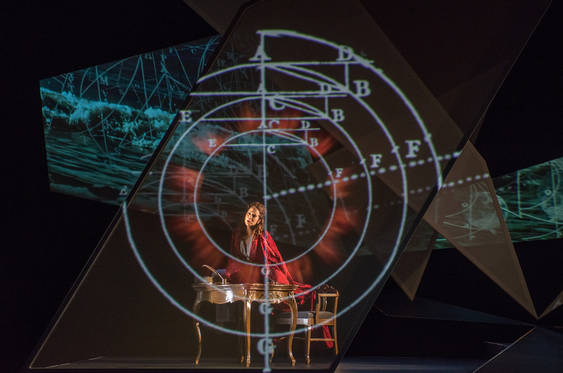
Only the Sound Remains

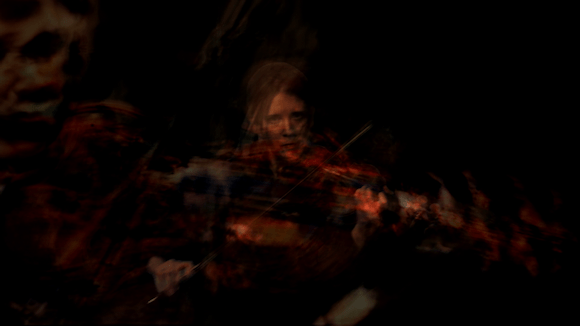
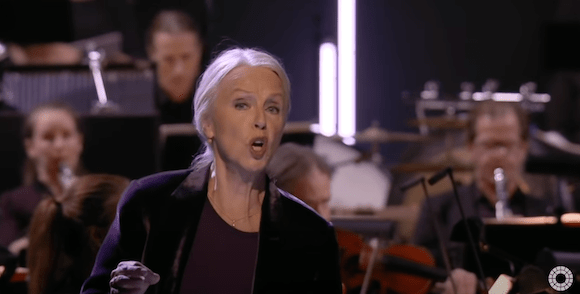
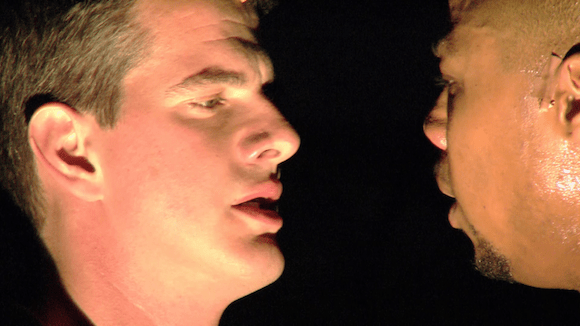
Only the Sound Remains is a chamber opera by Kaija Sariaho based on two Noh plays translated by Ernest Fenellosa and Ezra Pound.  The piece was premiered in Amsterdam in 2016 by Dutch National Opera, where it was recorded.  It’s a co-pro with Teatro Real, Finnish National Opera and the COC so Toronto audiences will likely get a look at it eventually.  Which is good because it’s really hard to figure out much of it from the video recording.  As he so often does, Peter Sellars directs for both stage and camera and while I like his stage work here I find his video direction quite annoying, especially in the first piece.

1.faces

Continue reading

L’Amour de Loin in HD

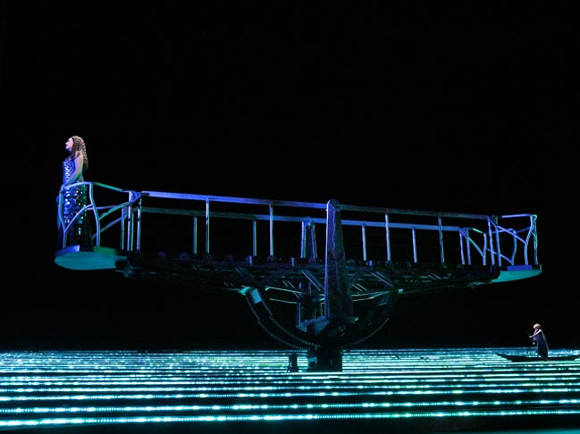
Averse as I have become to the Met’s HD broadcasts the lure of Kaija Saariaho’s L’Amour de Loin in a new production by Robert Lepage proved too strong.  I’m glad I went.  In fact this was probably the best Live in HD broadcast that I’ve seen.  Lepage’s production is magical and absolutely at one with the libretto and the score.  It’s deceptive simplicity mirrors the same qualities in both.  Basically we are face with bands of light (32000 LEDs) across the stage which change colour as required and provide an ethereal shimmering backdrop.  The chorus, rarely more than their heads or hands or both, appear in tight ranks from among the lights.  There’s a sort of swivelling gantry with a platform at each end that configures to be the various settings for Jaufré and Clémence and there is the Pilgrim and his/her boat.  Simple, configurable, effective and very, very beautiful.  Indeed, Lepage and his team at the top of their game.

649x486_amour_1

Continue reading

The Hungarian-Finnish connection

Stephen HegedusThe last Songmasters concert of the season featured a selection of works that sorta kinda had a Finnish or Hungarian connection.  The first part of the prgram featured songs by Sibelius, all but one to Swedish texts, and piano pieces by Selim Palmgren, whose music sounds like a sort of cross between Debussy and Sibelius.  The songs were sung Stephen Hegedus with plenty of power and quite a bit of subtlety.  We had been told he was quite ill but one wouldn’t have known it.  Fine, delicate work at the piano by Robert Kortgaard.   Continue reading
Five operas from the last fifty years

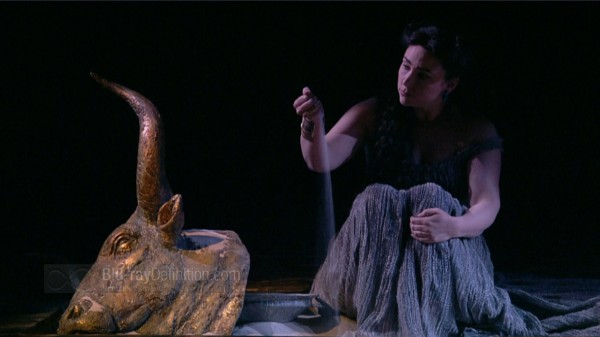
BDDefinition-TheMinotaur-a-1080-600x337Lisa Hirsch asked on Twitter the other day for suggestions for the five most important operas written since 1965 (i.e. in the last fifty years).  It’s a really interesting question and I pinged off a quick, semi-considered response.  Thinking about it some more I think I would stick with my choices.  (Obviously I haven’t seen every eligible opera but it surprises me a bit how many I have seen live or on DVD).  So here are my picks:

Continue reading

Shout out to Washington

Rihab Chaieb and Mireille Asselin

Rihab Chaieb and Mireille Asselin

In February I attended a brilliant lunchtime concert of vocal music by Kaija Saariaho sung by three singers from the COC Ensemble Studio.  I wasn’t the only one who was impressed.  The composer was so taken with the standard of performance that she has arranged for them to perform a slightly different selection of her works in Washington DC in February.

If you aren’t from Toronto or Montreal (or perhaps Paris, Lyon, Dublin or Belgrade) you probably haven’t heard much about Mireille Asselin, Rihab Chaieb or Jacqueline Woodley (except maybe on this blog) but you will!  Strongly recommended both for the music and the singers.

Good news!

Intermezzo reports that Harrison Birtwistle’s 1991 (revised 1994) opera Gawain is to be performed at the 2014 2013 Salzburg Festival.  I saw this when originally broadcast on TV in the UK and really want to see it again.  I’m hoping that there will be a DVD release as it’s unlikely(!) that I will make it to Salzburg.  I’m half surprised that it hasn’t been performed again or spread beyond Covent Garden (same is true of The Minotaur of course).  But only half surprised.  There seems to be a real reluctance currently to produce work that is seen as less “accessible”.  There are exceptions of course.  Saariaho seems to be quite fashionable for example but overall, and especially on this side of the Atlantic, the modernist tradition seems to have been firmly rejected.

Occasional round up

Some stuff that’s caught my eye recently  in the opera blogosphere

Image from the NY production of Émilie pinched from Lucy’s blog

Lucy reviews Kaija Saariaho’s new opera Émilie.

Rob has started a new blog focussed on Regie.

At nonpiudifori there’s a piece on how opera companies can attract teenagers written, shock horror, by a teenager.

The Earworm continues her daily series of posts, most of which are sometimes idiosyncratic but always interesting reviews of opera DVDs.

Von Heute auf Morgen continues to be a great source for news of musical shenanigans in Vienna and Salzburg.

L’Amour de Loin on DVD

I put off watching Saariaho’s L’Amour de Loin on DVD until after the run at the Canadian Opera Company because I didn’t want to prejudge the piece.  Now, having seen it live twice and listened to Kent Nagano’s Berlin CD recording it seemed like time to look at the DVD.  The DVD is of the original Salzburg production directed by Peter Sellars but it was recorded at Finnish National Opera in Helsinki.  It features the original cast of Gerald Finley (Jaufré Rudel), Dawn Upshaw (Clémence) and Monica Groop (Pilgrim).  Esa-Pekka Salonen conducts with the Orchestra and Chorus of Finnish National Opera.  If you are unfamiliar with the piece you might want to check out my review of the COC production which gives a plot summary etc.

The production concept is simple enough.  At each side of the stage is a spiral tower representing Jaufré’s castle in Blaye and the Citadel in Tripoli.  The towers stand in a lake which the Pilgrim traverses in a sort of crystal boat.  It’s simple and effective but much less spectacular than Daniele Finzi Pasca’s production seen at COC.  Colour is used to symbolise the two sides and the journey; blues and greens for Blaye, reds and oranges for Tripoli and black and white for the journey.  In typical Sellars style there is a fair amount of stylized and elaborate gesturing.  It all seems to work pretty well.

The performances are excellent.  All three singers have complete mastery of their parts and can act vocally as well as sing.  Some of the acting is a bit overwrought but I think that’s Sellars.  At key moments, and especially in the beautiful final scene, this very intense approach works much less well than the more understated approach taken in Toronto which seems more at one with what the music is doing.  The Orchestra and, off-stage, chorus are just fine.  Salonen has worked a lot with Saariaho and knows what’s required.

Where I have serious reservations with this recording is the video direction.  Sellars directs this himself and like his Nixon in China Met HD broadcast it’s really quite bizarre.  All video directors use close ups.  Most use too many of them.  Sellars takes this to extremes with bizarre partial face shots or body extremities filling the whole screen.  Coupled with the exaggerated acting style, which might just be OK at a distance, this makes for a very overwrought effect that is at serious odds with the music.  I’ve included four entirely typical screen caps at the end of the post to show what I mean.

Technically the disk is OK.  The picture is European TV quality 16:9.  One might have expected a little better for a 2004 disk.  The sound is decent DTS 5.1 (Dolby 5.1 and PCM stereo alternatives).  It’s quite vivid though I think the voices are balanced artificially forward.  Documentation is pretty decent and the subtitle options are English, French, German and Spanish.  There are very informative interviews with Sellars, Saariaho and Salonen that are all well worth watching. This is the only DVD of the piece and it’s pretty adequate. I wish someone would film Daniele Finzi Pasca’s production though.

OK, here are some screen caps of close ups.  These are not cropped.  This is the screen you see watching the DVD.

Kaija Saariaho’s L’Amour du Loin at Canadian Opera

Last night we saw Kaija Saariaho’s L’Amour du Loin at the Four Seasons Centre. It was really, really good. It’s a very unusual piece. There’s not a lot of action in the libretto, despite, or perhaps because of, which Daniele Finzi Pasca devised a most spectacular production (more below). It’s an opera about ideas; love, duty, honour, death, faith, God. The characters spend far more time debating what to do and why than doing it. The plot is very simple. Jaufré Rudel, prince of Blaye, tired of a life of meaningless pleasure, yearns for real love. The Pilgrim tells him of an ideal woman, a countess in Tripoli. devotes Jaufré devotes his life to writing love songs to his “Love from Afar”. The Pilgrim tells Clémence of Jaufré and she falls under his spell. Jaufré decides he must cross the sea and meet Clémence but in doing so falls mortally ill. They meet and throw caution to the winds but Jaufré dies. Clémence decides to take the veil but her attitude to God is ambiguous at best. To who is her finally ecstatically beautiful prayer directed; the deity or her “Love from Afar”? It’s not the easiest piece to engage with. It has something in common with other meditative operas like Dialogues of the Carmélites and Pelléas et Mélisande and it’s rewarding in the same sort of way.

The music really impressed me. It haunted my dreams last night. It is an extraordinary score. In the last couple of weeks I’ve heard quite a few smaller scale works by Saariaho but this was the first time I had heard what she could do with a full orchestra. Her tachnique here seems influenced bu European minimalists like Górecki but the end result is utterly individual. She create waves of sound, often with one section of te orchestra picking a phrase up from another. The effect is almost architectural as textures interplay to create a thing of real beauty. Often, despite the wealth of visuals i found myself wanting to close my eyes and just listen. The solo vocal writing is more straightforward than in some of her chamber works. Each character has a distinct musical signature. The Pilgrim for example has any number of the trills common to medieval vocal music (which I think of as moorish but that’s just my association). The choral writing combines elements of the orchestral and solo vocal styles. It’s all really quite compelling.

The performances were terrific. All three solo parts are long difficult sings and all three soloists were quite excellent. Russell Braun as Jaufré is on stage for four out of five acts. He was not as smoothly lyrical as he can be but his tougher, more muscular tone suited his line. Kristzina Szabó, as the Pilgrim, also has a lot to do. In many ways her acting must hold the piece together. This she said while sounding very idiomatic in the most ‘medieval’ sounding of the roles. Erin Wall almost stole the show at the end. Much of her part lies cruelly high and includes the sustained f and ff high notes that Saariaho likes to give sopranos. She coped admirably with those to close out the piece with a hauntingly beautiful rendering of the final, despairing prayer. The COC Orchestra and Chorus, were as ever, wonderful and conductor Johannes debus seemed to be right inside the music. Super stuff all round.

The production is very interesting. Gabriele Finzi pasca and his design team; Jean Rabasse – sets, Kevin Pollard – costumes and especially, Alexis Bowles – lighting and Roberto Vitalini – video, evoke the various settings of the piece extraordinarily vividly using cloth, light and video projections. The evocation of the sea in Act 4 is breathtaking and the ambiguous use of light shone into the auditorium at the beginning and end of the piece ask questions about the stage world and that f the audience. The story telling is embellished with shadow puppets, body doubles, acrobats and aerialists. It’s spectacular in the manner of a rather cerebral Cirque du Soleil performance. It might even be a little over the top to the point of distraction but there’s no denying the beauty of it.

I thought it was a terrific modern opera, beautifully performed and I’d go see this in preference to traditional warhorse productions any time but what I saw last night suggests I may still be a bit unusual in that regard. The house wasn’t full and seats which I’m pretty sure are subscription seats were empty. A significant number of people, young and old, left at the interval. This disturbs me on all sorts of levels. This is quite an accessible piece and it was presented in a production that emphasised that and despite that some people obviously didn’t get it. This worries me far more than people who get offended by blood or nudity in a new production of some over performed Puccini piece. There’s a catch 22 here. A new audience is put off by the idea of opera as a boring museum piece and a section of the traditional audience boycotts anything that isn’t stuffed and mounted. Anyway, if anyone at COC is listening my vote is for innovation, risk and life.

There are four more performances ending on February 22nd.  Go see it!

All photos © All rights reserved by Canadian Opera