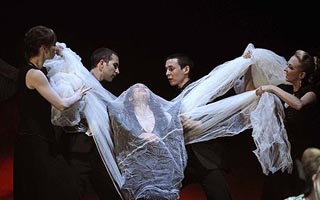
Lully’s Atys was, apparently, Louis XIV’s favourite opera. It’s not hard to see why. Within the rigid conventions of its time and place it really is rather fine. The plot is classical and convoluted. After an allegorical prologue celebrating Louis’ successful winter campaign in the Low Countries we get the story proper. The hero Atys loves the nymph Sangaride, daughter of the god of the river Sangar, who returns his affection She is betrothed to Celenus, king of the Phrygians. The goddess Cybèle fancies Atys and makes him her high priest. Atys uses his position to nix the wedding which upsets both Cybèle and Celenus. Cybèle blinds Atys who kills himself but is immortalised by being turned into a tree by Cybèle. All of this takes over three hours with lots of ballets and other set pieces. The music is French 17th century court music so it’s a bit unvaried but much of it is very fine indeed.
I am developing a pathological hatred of the people who do the video direction for opera DVDs. The sole exception I can think of is François Roussillon. Brian Large, Humphrey Burton, Kriss Rumanis, Gary Halvorson and the rest I could happily roast over a slow fire while poking them with a sharp stick. I do not want to see the tenor’s dental work or the soprano’s tonsils. I certainly don’t want a head shot of someone who isn’t even singing filling the whole screen. I do not watch opera on a 1950s television with a ten inch screen. Who does? FFS let us poor viewers see what is going on on the stage. It’s quite likely that the stage director does all that stuff deliberately(1) and maybe we might be able to understand the production if we could only see the bloody thing. This rant brought to you courtesy of trying to decode David Alden’s Ariodante while looking through the wrong end of the telescope.
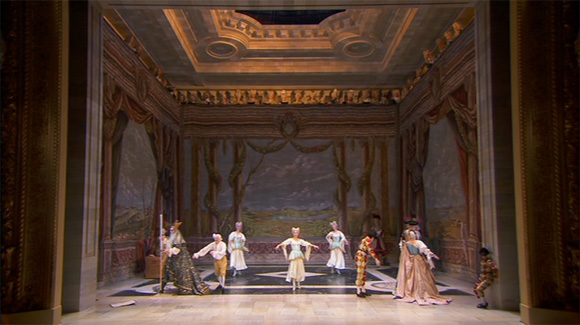
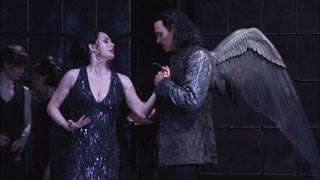
This is what I want to see much/most of the time:
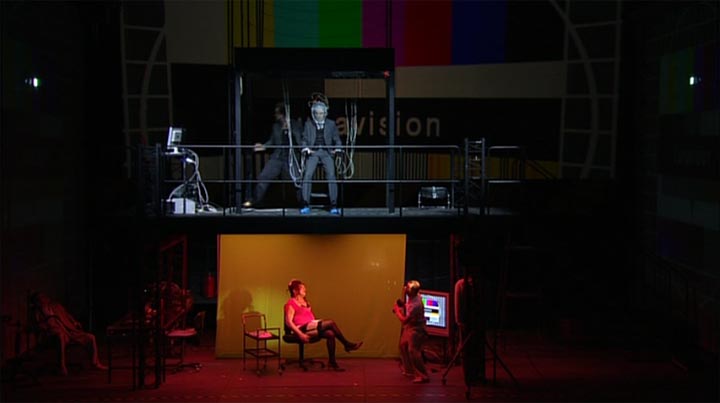
With tons going on all around and in the background this isn’t helpful:
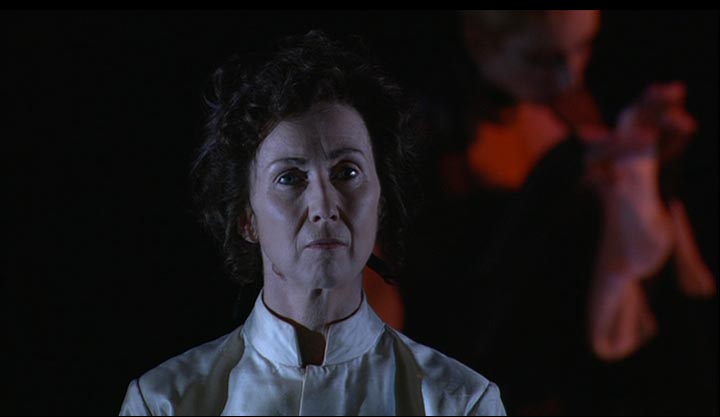
And as for this…
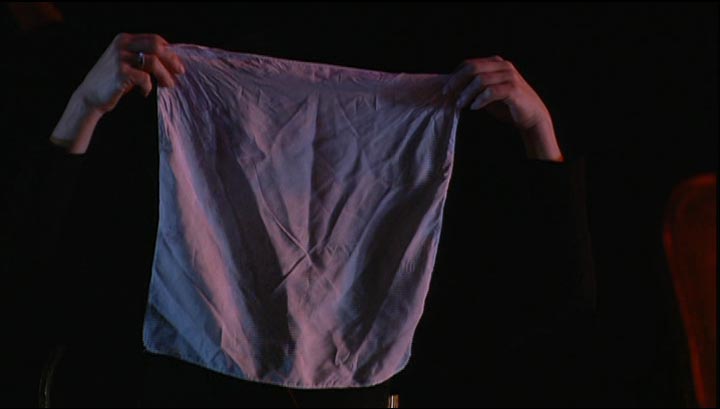
Words fail me.
fn1. OK this may not be true of Zeffirelli or similar Met favourites. If the alternative is a furniture catalogue I’ll take the close ups.
I’ve reviewed two DVDs of Purcell’s semi-opera King Arthur on this blog. One was excellent and one was terrible and between them they went a long way to showing how difficult these semi-operas are to stage well but how rewarding when they succeed.
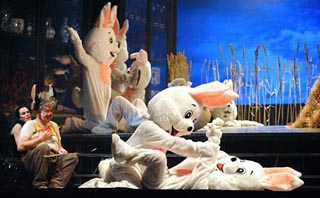
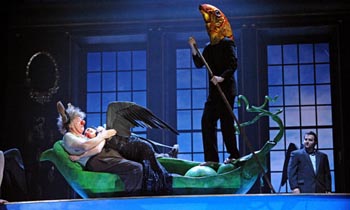
In 2009 Jonathan Kent and William Christie combined to produce a version of The Fairy Queen for Glyndebourne. It’s quite different in style from the successful Salzburg King Arthur but it works splendidly on its own terms. The Fairy Queen combines a libretto based on A Midsummer Night’s Dream with songs, masques and dances of a largely allegorical nature. Like the play itself they range from high flown allegory with classical elements to bawdy humour. It is very English. It almost epitomises what separates the English baroque from the French. Kent and Christie tackle this with a robust English sensibility, There are some changes to the dialogue and to the order of the numbers but it all makes sense (so far as this piece can). The allegorical elements are gorgeously and wittily staged making good use of a large circular lift at centre stage that allows fully formed tableaux to rise into our sight. The bawdy elements are tackled head on with a robustly TV Mopsa (Robert Burt) in the “Dialogue of Corydon and Mopsa” and the, by now, notorious bonking bunnies in the “Dance for the Haymakers”. The audience is totally engaged and one hears plenty of that commodity, rather rare in the opera house, uninhibited laughter. The team of designer Paul Brown and lighting designer Mark Henderson make all of this look quite spectacular. The dramatic action is played out in fairly long segments and the parts are taken by actors rather than singers. The fairies are appropriately sinister with wings that look inspired by contemporary prints of fallen angels. The Rude Mechanicals are rude and not too mechanical. The “humans” are credibly 17th century in manner though dress gets less formal as the action proceeds. The disparate elements are integrated very well. There’s plenty of dance and it’s choreographed by Kim Brandstrup in a style that is robustly muscular but solidly in the classical ballet tradition.
The cast of actors, singers and dancers is huge and consistently excellent.
I was particularly impressed with Sally Dexter’s Titania and Desmond Barrit’s Welsh accented Bottom among the actors. Barrit even got to do some singing with a not too over the top version of the “Song of the Drunken Poet”. The singing stars were the wonderful, sweet toned Lucy Crowe; her “if love’s a sweet passion” was a delight, and the robust bass-baritone Andrew Foster-Williams who, among other sings, sang a truly chilling Winter. Singling out individual performances isn’t the point though. This is very much an ensemble performance. Christie directs the Orchestra of the Age of Enlightenment from the harpsichord and is as idiomatic as one could possibly hope for.
So, how well does the stage production transfer to disc? Extremely well! The video director is François Roussillon. Unlike most of his peers he appears to have realised that opera lovers are not, for the most part, watching on tiny screens anymore. He makes sure we can see what the designer and director intended. Sure, there are close ups but never at the expense of the bigger picture. The technical quality is of a very high order. There are two formats available; a two DVD set and Blu-Ray. I watched the latter but I doubt most people would see a huge difference. It was filmed in 1080i HD and the picture is clearly better than my first generation HD TV can fully do justice to. The sound is incredibly good. On Blu-Ray it’s DTS-HD Master Audio (DTS 5.1 on DVD). The quality is apparent even as Christie is walking to the pit. The applause simply sounds as if one is in the house rather than the usual muffled fluttering noise. The balance, clarity and spatial depth are exemplary throughout. Both formats also have LPCM stereo. There are English, French, German and Spanish subtitles. There are useful extras. The disc includes interviews with Kent and Christie which are well worth watching and the booklet includes an informative essay by Kent as well as a track listing and synopsis.
All in all this is an excellent production given an exemplary transfer to disc. Here’s the official trailer, unfortunately in less than exemplary Youtube quality:

 operaramblings