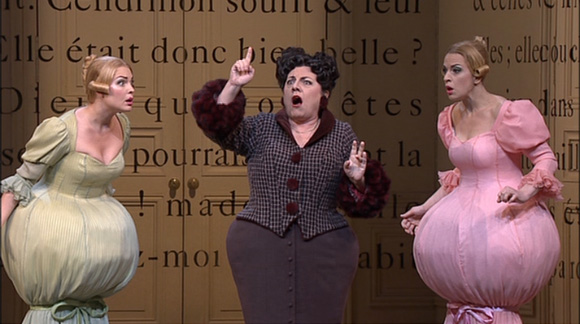
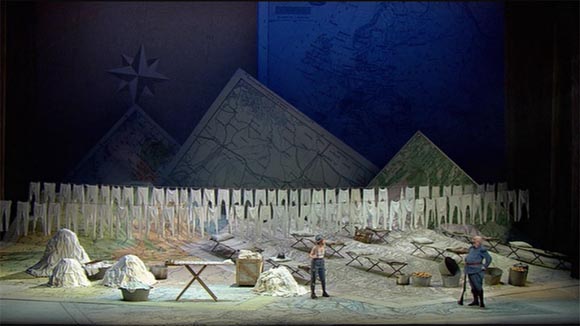
Massenet’s Cendrillon is less often performed than Rossini’s take on the same basic story. I’m really not sure why. Rossini’s take is a bit weird (in a good way), especially in the Ponelle production, but Massenet’s is much more interesting musically. Oddly enough there’s only one version on DVD; a 2011 recording from the Royal Opera House. Fortunately it’s very good. The production is by Laurent Pelly and it has quite a bit in common with his La Fille du Regiment. Here the set is made up of pages from the original syory by Perrault rather than military maps but the effect is similar. Costumes are quite cartoonish (shades of the recent Alice in Wonderland ballet) except for Cendrillon herself, the prince and her father. There’s a strong emphasis on the humorous side of the piece and the “ballets” are thoroughly subverted.
Tag Archives: roh
Catholic kitsch
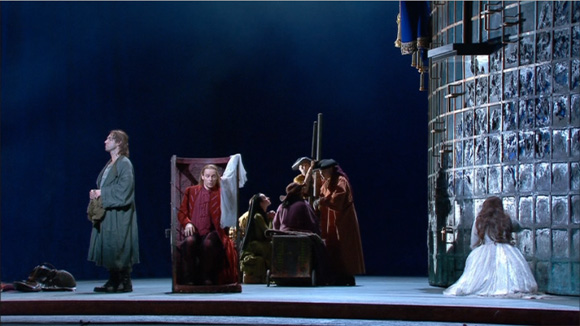
Don Giovanni is one of the most fascinating operas in part because it can be reinterpreted in so many different ways. There’s also the tension between a story with elements of murder, rape, revenge and damnation and broad humour. It’s tricky to find a balance. There’s also a decision to be made between a concept based production and a more laissez faire approach. Francesca Zambello’s production for the Royal Opera House, recorded in 2008 doesn’t really have a concept and sort of goes with the flow mixing very broad humour with lots of Catholic kitsch and some flamboyant stage effects. As a production I find it distinctly underwhelming.
Conspicuous Consumption
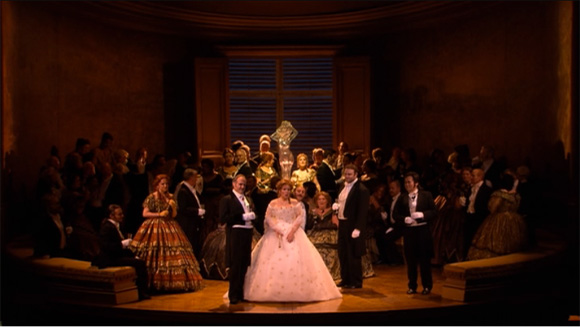
Richard Eyre’s production of La Traviata at the Royal Opera House, filmed in 2009, is a pretty good example of how to do a traditional production. There’s nothing conceptual or thought provoking to it but the direction is careful and tells the story clearly and well. The designs are mid 19th century with crinolines and tail coats but with the odd imaginative touch and a welcome refusal to succumb to the “more stuff” syndrome that plagues so many Verdi and Puccini productions. Backed up by excellent music making it probably makes a near ideal introduction to the piece, even if it won’t entirely displace Willy Decker’s brilliant and disturbing Salzburg production in my affections.
Ballet/Opera Fusion
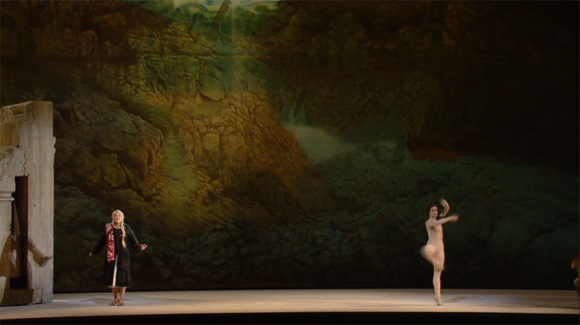
Handel’s Acis and Galatea is a peculiar piece in some ways. It was written to be performed at Cannon’s, the Edgware residence of the then Earl of Caernavon, presumably for his guests. Apparently the performance style was to have the singers sing from music stands in front of a painted backdrop. So, a sort of oratorio with curtains. It’s not uncommon to stage Handel oratorios as opera these days. Theodora is done quite often and even Messiah has been staged so it’s no great surprise that Acis and Galatea should be given a similar treatment. In fact Wayne McGregor’s 2009 Covent Garden production stages it as an opera and a ballet simultaneously combining the resources of the Royal Ballet and the Royal Opera.
Kupfer’s Orfeo
I’ve owned a VHS tape of Harry Kupfer’s 1991 Royal Opera House production of Gluck’s Orfeo ed Euridice pretty much since it came out. I really can’t bear to watch VHS anymore so I haven’t watched it in ages and was intrigued when I managed to get my paws on a DVD copy and was able to see what I thought after all this time. Continue reading
La Fille de Laurent Pelly
Laurent Pelly’s 2007 production of Donizetti’s La Fille du Régiment was a coproduction of the Royal Opera House, The Metropolitan Opera and the Wiener Staatsoper which one make expect to produce a stodgy snoozefest. It’s not. It’s a fast paced, energetic and funny production. There’s nothing especially cleverly conceptual about it but its well designed, well directed and well played. If one were to be hyper critical it would be that the humour in Act 2 is rather laid on with a trowel but it’s not too seriously overdone. The setting is updated from the wars of the first Napoleon to something vaguely WW1 like. In some ways this doesn’t make a whole lot of sense but it does provide a visual “Frenchness” that’s probably easier for modern audiences and, anyway, the libretto as originally written is about as historically accurate as the average piece of bel canto fluff. Best not get into serious military history buff territory and get on and enjoy the show.
Zambello’s Carmen
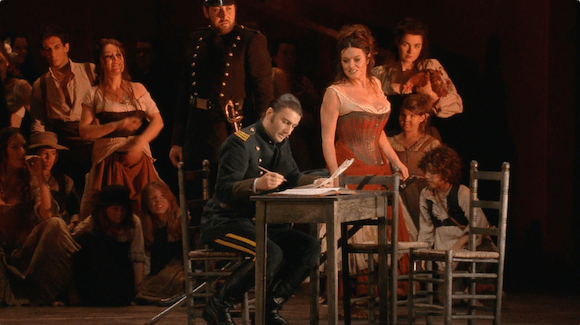
Francesca Zambello’s Carmen for the Royal Opera House has more going for it than is immediately apparent. On the face of it it’s a very traditional, conservative production; period costumes, literal sets, hordes of kids in Acts 1 and 4, live animals, but a close look reveals rather more. Zambello reveals her intentions during the overture where we see a manacled, distraught Don José dragged to execution by a masked executioner. This is going to be Don José’s story rather than one that focuses almost exclusively on the title character. What we see here is a stark contrast between what Don José really wants; respectability, an obedient wife, conformity with the Church, honour and what key choices, accidents and conflicts drive him to; criminality, liminality, execution and, we may suppose, damnation. The staging subtly highlights each of the key moments in Don José’s descent; his arrest and demotion in Act1, the fight with Zuniga in Act 2 and the realisation, in Act 3, that Carmen will never be the women he really wants reinforced by Micaëla’s aria that ironically offers him the choice he can no longer make and does so unmistakeably in terms of Catholic eschatology. There is so much more going on here than a sexy woman and some pretty tunes.

Hunger and starvation is increasing everyday
The Royal Opera House’s 2008 production of Humperdinck’s Hänsel und Gretel makes no concessions to the idea that this is a sort of operatic Nutcracker to be staged for the kiddies at Christmas. Patrice Caurier and Moshe Leiser’s production is firmly in the grim, and Grimm, tradition of central European folk tales and it’s sung in German.
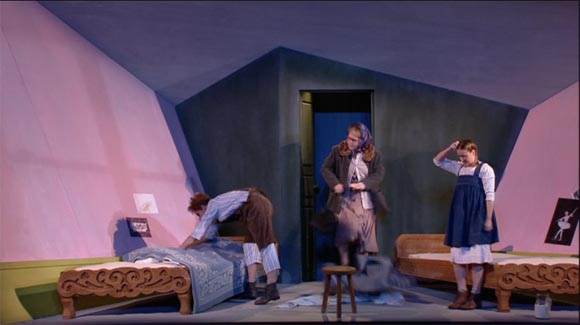
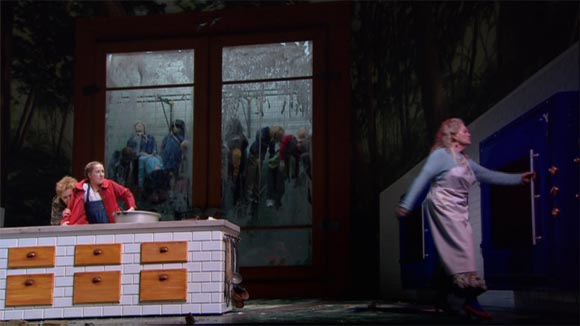
For Act 1, designer Christian Fernouillet has created a claustrophobic bedroom with surfaces at odd angles in which the children (Angelika Kirschlager and Diana Damrau) play out their hunger displacement games until their angry mother (Elizabeth Connell) sends them off to forest to gather berries. The father (Thomas Allen) returns with food and this relief from hunger is played out in a scene heavy with sexual innuendo between mother and father. It’s quite creepy. Finally they realise that the children are missing and set off in search.
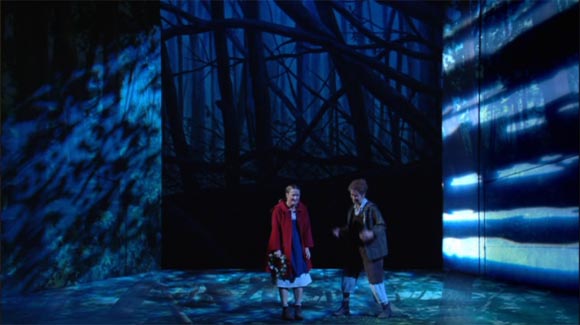
Act 2 starts in a classic fairy tale forest which rapidly darkens into a place of real menace. The sandman (Pumeza Matshikiza) is a strange distorted creature who puts the children to sleep. In the dream sequence the fourteen guardian angels, with animal heads, carry in a bunch of furniture, including a fireplace, to create a fireside scene of bourgeois domesticity. Two of the animal angels reveal themselves as the mother and father and give the children gifts. Inside each elaborate package is a single sandwich which is devoured with rapt concentration.
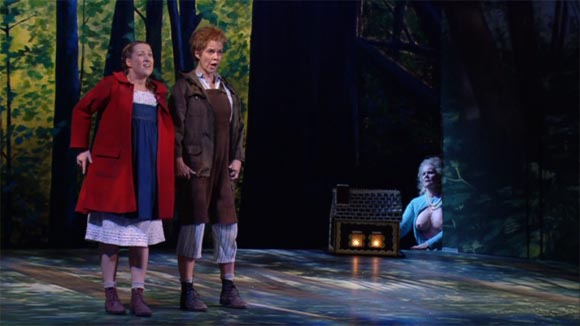
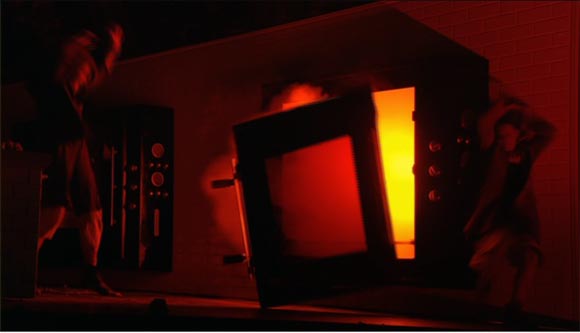
Act 3 opens with the Dew Fairy, here a pink confection played by Anita Watson, waking the children. The witch (Anja Silja), a vicious looking old woman with comedy breasts and a Zimmer frame, leaves a miniature gingerbread house for the children to explore. This transforms to the full size version with dead children hanging in a glass fronted cupboard and industrial scale ovens for the witch’s child based confectionery experiments. There is no concession whatever to comedy. The witch is scary as all hell and the scene in which she is shoved in the oven involves some serious pyrotechnics. The conventional happy ending descends into an orgy of face stuffing as the revived children fall on the cake/corpse of the witch. The production is consistent in its essential seriousness and is supported by fine acting across the board. In line with the concept nobody camps up their part. It’s all in earnest.
Musically it’s a really strong performance. Both Kirschlager and Damrau are quite excellent and work really well together. Kirschlager has quite a rich tone which blends nicely with Damrau’s cleaner sound. Thomas Allen is also really good. He’s quite chilling in the Hexenritt for example. Anja Silja’s Witch is a tour de force. She is every inch the witch/hag of nightmares without descending into cheap vocal trickery. Matshikiza sings very sweetly. Connell and Watson are quite good too but didn’t really register strongly with me. Colin Davis gets a suitably Wagnerian sound out of the orchestra and seems to balance drama and beauty very nicely. He’s well supported by the ROH orchestra, especially the brass and woodwinds, and the Tiffin Boys’ Choir and Children’s Chorus. The sheer beauty of the piece really comes out in the finale with Erlöst, befreit, für alle Zeit which manages to be gorgeous while avoiding dipping into excessive sentimentality.
The video direction of Sue Judd is good. She isn’t fixated with close ups though, since this isn’t a terribly busy production, she brings the camera in when there’s not much else to watch. There aren’t any gimmicks and it’s a good approximation to how one would watch from a decent seat which is what video directors ought to give us. The sound and picture quality are very good. It was shot in 1080i and the DVD picture is generally crisp and clear. The DTS 5.1 soundtrack is absolutely first class; vivid and with spatial depth and everything clearly located. This is also available on Blu-ray. Audio choices there are LPCM 2.0 and 5.1. Subtitle options are English, French, German, Spanish and Italian. There’s a useful “Making of” documentary, an interview with Colin Davis plus cast and synopsis material on the disks. The package includes an unusually lavish tri-lingual leaflet.
ETA 23 May 2019: I have now had a look at the Blu-ray. It is, as expected, even better from an AV point of view. The LPCM 5.1 sound track is especially good with real depth and sense of spaciousness. The stereo is not bad either but switching it to it from surround the reduction in the width and depth of the sound field is tangible. Also note that at time of writing this recording is available as part of a three disk set called Fairytale Operas that also contains the Glyndebourne Cunning Little Vixen and Jonathan Dove’s The Adventures of Pinocchio.
I hesitate to compare this Hansel und Gretel with the roughly contemporary Metropolitan Opera version. They are very different but both worthwhile in their own way.
Mozart’s Mitridate – ROH 1993
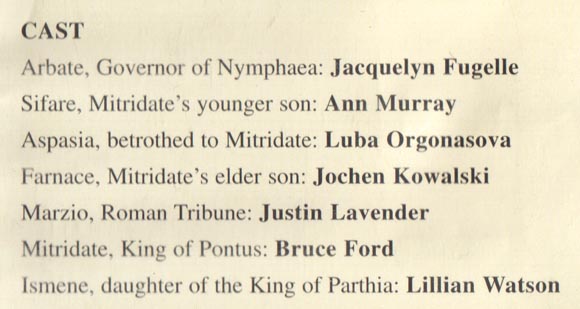
Mitridate, rè di Ponto is a three act opera seria by a fourteen year old kid called Mozart with a libretto based on Racine. Like most operas with a libretto based on Racine, and there are many, it isn’t exactly a barrel load of laughs. While it’s fair to say that the music may well be the best ever composed by a fourteen year old and it is recognisably Mozart it’s still not really quite enough to carry three hours of recitative and da capo arias about the troubled love life and familial relations of a first century BC King of Pontus and his fractious sons. In short, it gets a bit tedious. For a modern audience it’s not improved by the fact that all the male voices are high. Originally the score called for three castrati and two tenors. In the 1993 Royal Opera House production two of the three castrato roles were taken by mezzos and the third, inevitably the baddy, by a countertenor. For the record, here’s the full cast:

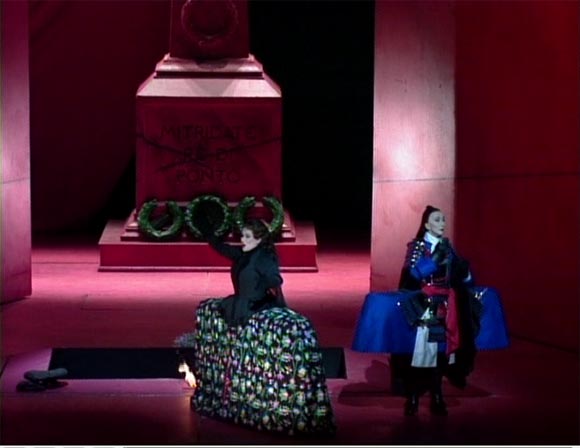
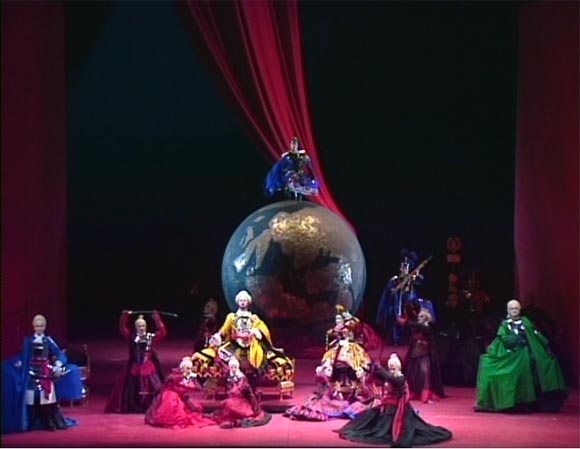
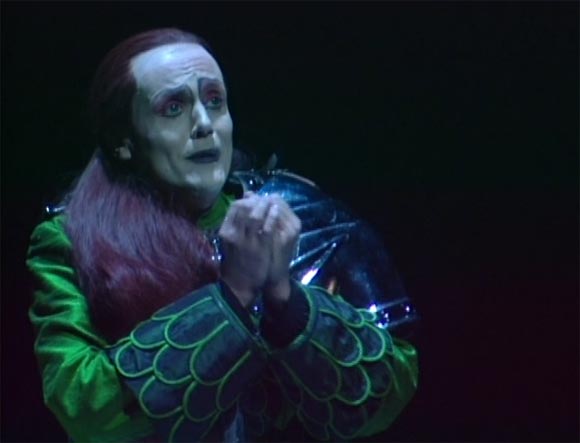
The director – Graham Vick, designer – Paul Brown and choreographer – Ron Howell do a pretty good job of injecting some life into the production with fairly extreme use of colour in the costume design, sets and makeup. The choreography and blocking is also quite striking at times but it still ends up being rather a wash of coloratura. The singers too do a worthy job but after a while it all starts to sound the same. Good work too from conductor, Paul Daniel, and the ROH orchestra but ultimately a bit blah.
Video director Derek Bailey does a pretty good job for the period. It’s hard to object to closing in on the singer during a da capo aria and he does pull out when there is stage wide action. He’s not helped by pretty average picture quality that lacks the definition needed to make long shots fully effective. Technically it’s a typical Kultur release of the period. The less than brilliant picture is coupled with so-so Dolby 2.0 sound, hard coded English sub-titles and minimum documentation. It’s also a bit quirky in that the overture comes on, with lead in credits, as soon as the disc is inserted. There’s no “set-up” menu.
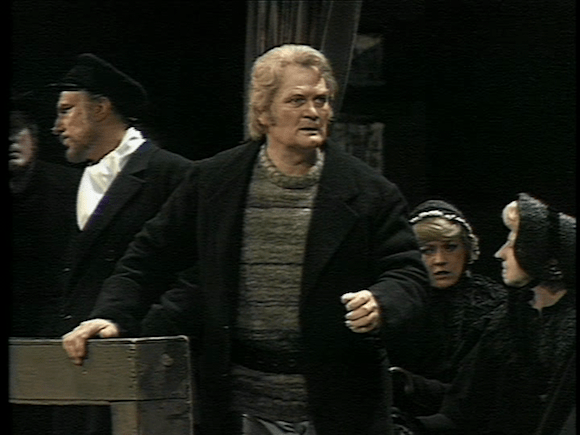
The Vickers Grimes
When the Royal Opera House mounted a new production of Britten’s Peter Grimes in 1975 with Canadian heldentenor Jon Vickers in the title role it was controversial. Whatever else one could say about it Vickers’ interpretation of Grimes was very different from that of Peter Pears for whom the part was written. Britten, it was said, hated it. I saw it that summer and was pretty impressed but then seventeen year olds impress easily. I certainly never expected that the young baritone singing Ned Keene would end up as a knight and Chancellor of the university where I began my degree a few weeks later. When the production was revived in 1981 there were some significant cast changes. Norman Bailey had replaced the retired Geraint Evans as Balstrode, Philip Gelling was in for Thomas Allen as Ned Keene and one John Tomlinson had taken over as Hobson the carter. The incomparable Heather Harper remained as Ellen Orford. It’s the revival cast that was recorded and broadcast by the BBC and which is available on DVD from Kultur in the Americas and Warner Video elsewhere.